Occidental Petroleum: A Lesson in Capital Allocation Disaster and Recovery

A Company Built on One Decision at a Time
Houston, August 2019. Vicki Hollub, President and CEO of Occidental Petroleum, has just outbid Chevron for Anadarko Petroleum. The final transaction value is USD 38 billion. To fund it, Occidental quadrupled its debt to USD 40 billion. Chevron, with its larger balance sheet and lower leverage, had offered USD 33 billion and walked away cleanly when Occidental came over the top.
The oil industry consensus in August 2019 was that Hollub had overpaid. Carl Icahn built a nearly 10% stake in Occidental and argued publicly that the deal was a catastrophic capital allocation error. The board had been bypassed. The price was wrong. The debt load was unsustainable.
Eight months later, oil prices went negative for the first time in history. Occidental’s quarterly dividend was cut to USD 0.11 per share, effective July 2020. The capital budget was reduced from USD 5.2 to 5.4 billion to USD 2.7 to 2.9 billion, a midpoint reduction of 47%. The preferred dividend owed to Berkshire Hathaway, USD 200 million per quarter, was paid in discounted Occidental shares rather than cash to preserve liquidity. The company that had promised to become a global energy leader was managing its cash position week by week.
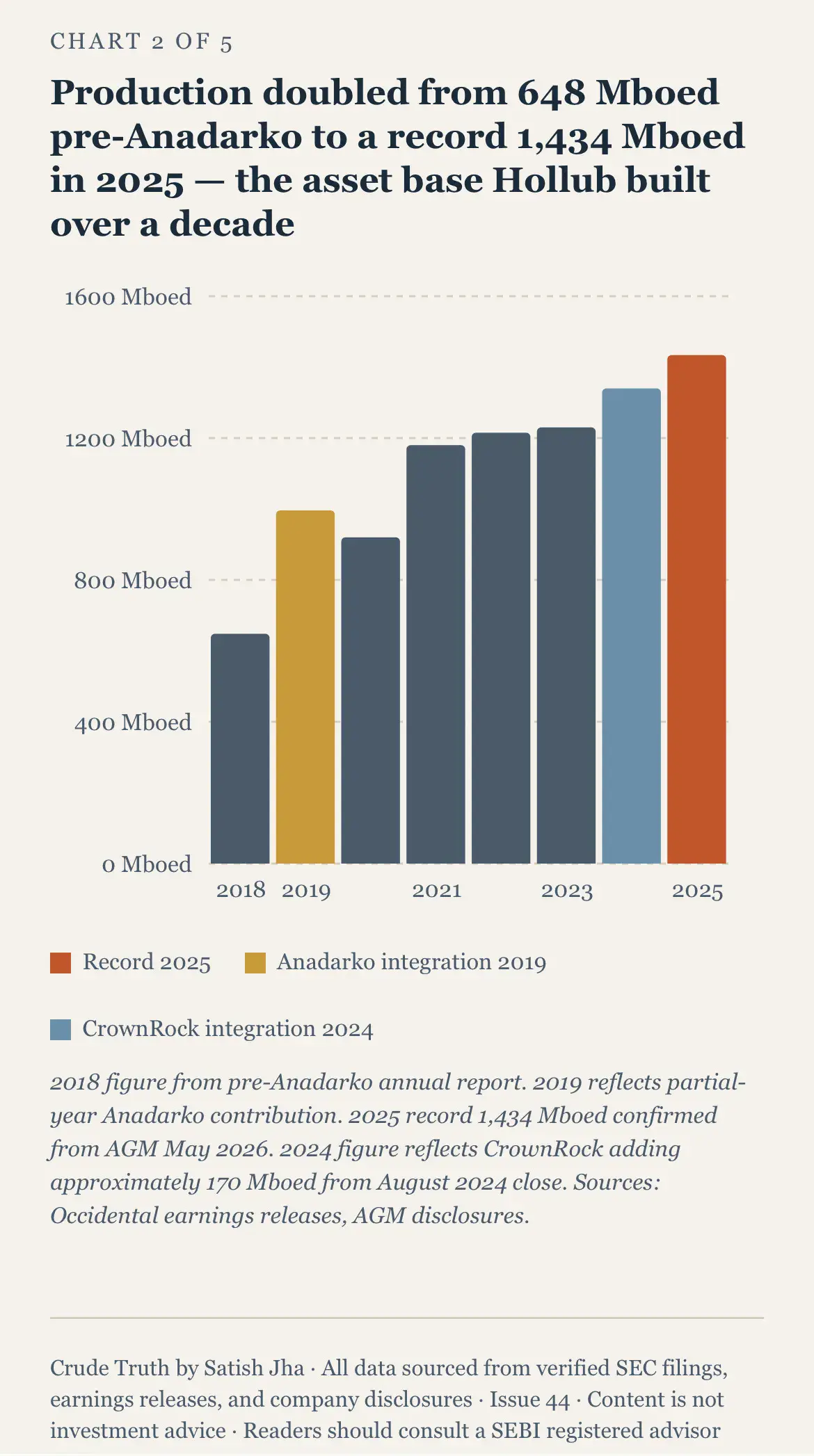
Today, six years later, Occidental has record production of 1.43 million barrels of oil equivalent per day, principal debt of approximately USD 13.8 billion, free cash flow of USD 4.3 billion in 2025, and a quarterly dividend that has almost doubled since the CrownRock acquisition announcement in December 2023. Warren Buffett’s Berkshire Hathaway owns 26.64% of the common stock and paid USD 9.7 billion for the OxyChem chemical business. Hollub retired on June 1 2026 after a decade as CEO, leaving behind a company structurally different from the one she inherited.
The Occidental story is the most instructive capital allocation case study in American oil right now. Not because it went perfectly. Because it went wrong in the most educational possible way and the management team rebuilt the architecture without abandoning the underlying thesis.
What Occidental Actually Is
Before examining what went wrong and what was rebuilt, the business model needs to be understood precisely. Occidental is not ExxonMobil, Shell, or TotalEnergies. It is not a vertically integrated supermajor with refining, retail, and a global trading desk. It is not a pure-play upstream operator like ConocoPhillips either. Occidental occupies a structural position that is genuinely distinct from every other company covered in this series.
Occidental’s business is structured around three pillars: upstream oil and gas production, a midstream and marketing segment that provides flow assurance and price optimisation for the upstream output, and Oxy Low Carbon Ventures operated through its subsidiary 1PointFive, which is advancing carbon capture and direct air capture technology.
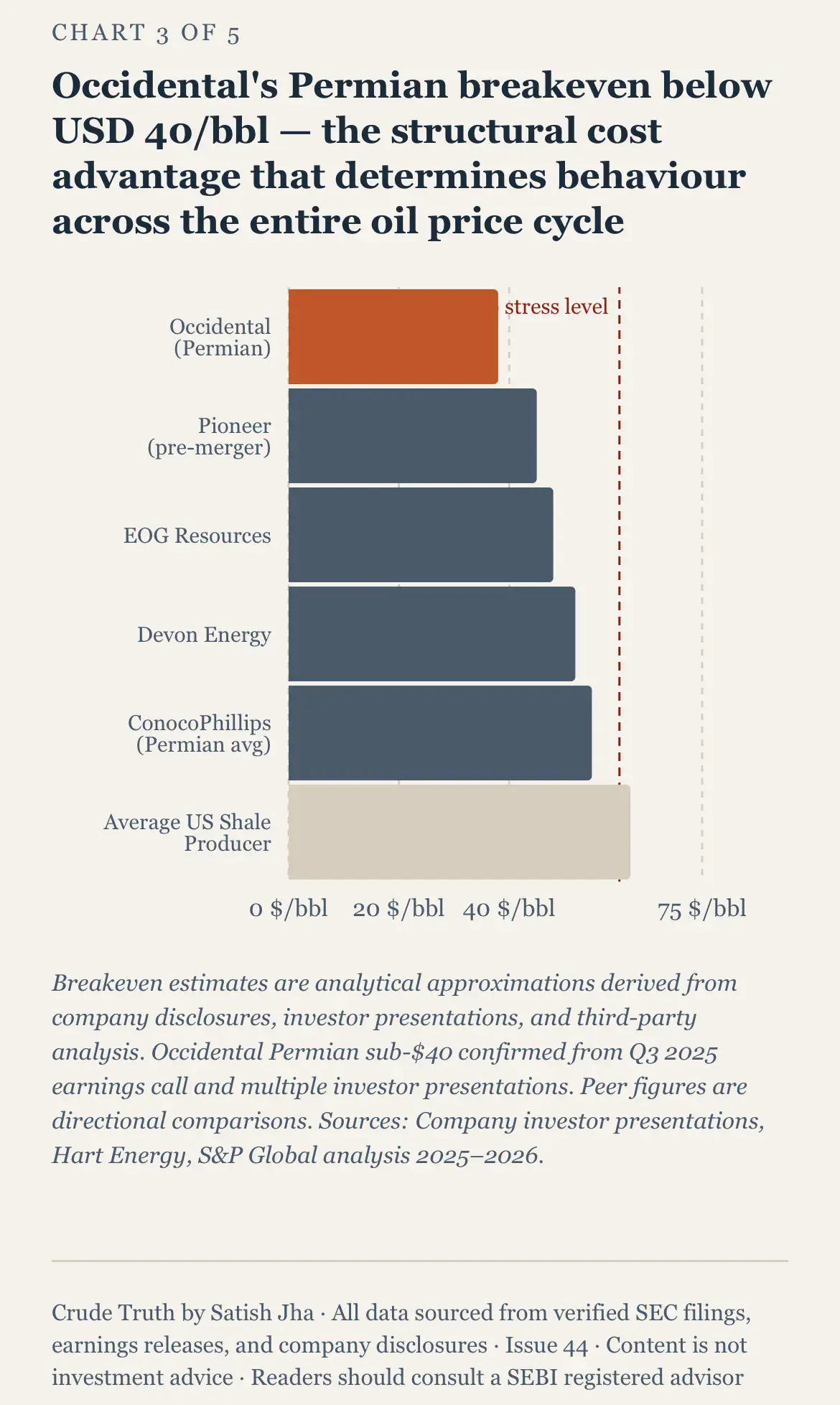
The upstream segment is the engine. Production across Permian, Rockies, Gulf of America, and International in Q1 2025 was 754, 292, 121, and 224 thousand barrels of oil equivalent per day respectively.  The Permian Basin accounts for more than 50% of total production and is the commercial heart of the business. Permian breakeven is estimated below USD 40 per barrel, a stark contrast to peers requiring USD 60 and above. That breakeven advantage is the single most important number in understanding why Buffett backed this company when others walked away.
The one-word label for Occidental’s business model in this series is deleverages. That label describes the strategic state the company has occupied for most of the last six years. Every major decision from 2019 to 2026 has been a deleveraging decision dressed in different clothes. The Anadarko acquisition loaded the balance sheet. The COVID crisis forced emergency deleveraging. The subsequent recovery rebuilt financial capacity. The CrownRock acquisition in 2024 reloaded the balance sheet deliberately and triggered another divestiture cycle. The OxyChem sale closed the loop. The pattern is the story.
The Three Pillars in Detail
Upstream: the Permian as the Core
The Permian Basin is not simply Occidental’s largest asset. It is the asset around which the entire corporate strategy is organised. The Delaware Basin and Midland Basin together contain decades of drilling inventory at sub-USD 40 breakeven costs. The CrownRock acquisition added 750 locations with sub-USD 40 WTI breakeven, increasing Occidental’s sub-USD 40 breakeven inventory in US onshore by 25%. Total Permian footprint contributed to company-wide production near 1.25 million BOE per day in the first half of 2025, prioritising high-return drilling over volumetric growth.
The sub-USD 40 breakeven is structural competitive advantage, not marketing language. At USD 50 WTI, which most US shale producers treat as existential stress, Occidental’s Permian assets still generate positive free cash flow. At USD 60, the company services debt, funds maintenance capex, and returns capital simultaneously. At USD 70 to 80, the balance sheet repair accelerates and excess capital compounds. The Gulf of Mexico assets, inherited from Anadarko, contribute lower-decline production that provides base load stability. Strategic projects in Oman and the UAE, including collaboration with ADNOC on carbon management and EOR, diversify revenue and leverage reservoir management expertise.
The CO2-EOR Technology: Occidental’s Hidden Moat
This is the element most coverage underweights and that Buffett specifically identified as a differentiator.
CO2-enhanced oil recovery involves injecting carbon dioxide into mature oil reservoirs to increase pressure and reduce oil viscosity, enabling extraction of resources that would otherwise be uneconomic. Occidental has practised CO2-EOR in the Permian for more than 50 years. It operates an extensive CO2 pipeline network across the basin. Increased field interconnectivity has enabled Occidental to optimise its use of recycled CO2, with advanced subsurface modelling improving the effectiveness of each molecule injected and enabling reduction of purchased CO2 volumes.
The strategic implication is not just lower cost per barrel in mature fields. It is the foundation on which the Direct Air Capture business is being built. If Occidental can capture CO2 from the atmosphere at scale and inject it into its Permian reservoirs for EOR, it produces what it calls net-zero oil: barrels whose lifecycle carbon footprint is negative because more carbon is sequestered underground than the barrel emits when burned.
The Stratos DAC facility in Ector County, Texas, is designed to capture up to 500,000 metric tonnes of CO2 per year once fully operational. CDR agreements are in place with Airbus, Amazon, AT&T, Microsoft, and Bain among others. As of May 2026, Stratos encountered an unexpected delay related to non-process components, though the technology and process unit operations are performing as expected. The plant is in commissioning and ramp-up.
On scale: Stratos at 500,000 tonnes per year capacity is designed to be approximately fourteen times the capacity of Climeworks’ Mammoth plant in Iceland, currently the world’s largest operational commercial DAC facility.  Climeworks operates commercially. Heirloom and others operate at smaller scale. Occidental is not the only commercial DAC operator. It is building by far the largest commercial DAC facility in the world, and it sits on 50 years of CO2 subsurface management experience that no other DAC developer possesses.
The OxyChem Chapter
OxyChem manufactured chlorine, caustic soda, and polyvinyl chloride, products whose demand cycles correlate with housing construction and industrial activity rather than oil prices. When oil prices fell, OxyChem kept generating cash. It was the earnings buffer across commodity cycles.
Berkshire Hathaway acquired OxyChem for USD 9.7 billion in January 2026, allowing Occidental to reduce its principal debt to USD 15 billion, a drastic improvement from the USD 40 billion peak in 2019. The sale permanently removes the earnings diversification OxyChem provided. Occidental’s financial profile is now almost entirely determined by oil and gas prices. That concentration is simultaneously the company’s greatest vulnerability and its clearest strategic statement: we believe in the Permian, we believe in oil demand, and we no longer need an industrial earnings floor to survive the cycle.
Critically: the Berkshire preferred stock is still outstanding. Berkshire continues to collect 8% per year on the original USD 10 billion preferred position. The OxyChem acquisition was a cash transaction, not a preferred-for-asset swap. Hollub guided that Occidental will begin redeeming the preferred from 2029. Until then, Berkshire holds the common equity stake, the preferred income stream, and now OxyChem. The loop is almost closed. It is not yet fully closed.
The Debt Arc: The Central Capital Allocation Story
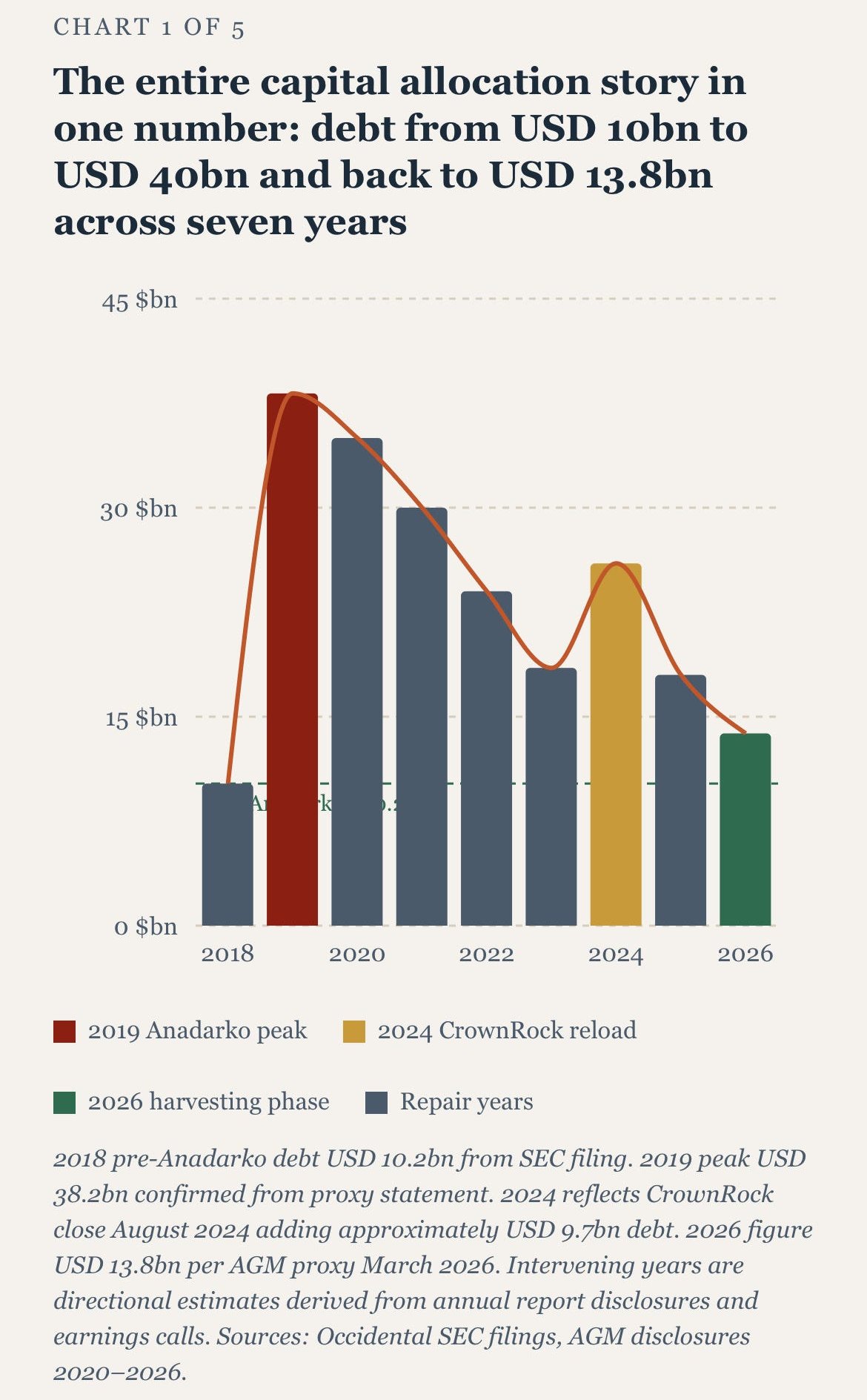
Understanding Occidental as a capital allocation case study requires following the debt number across seven years.
Pre-Anadarko, Occidental carried approximately USD 10.2 billion in long-term debt. After the Anadarko acquisition closed in August 2019, long-term debt reached USD 38.2 billion while interest expenses grew from less than half a billion in 2018 to more than USD 1 billion in 2019. The Berkshire preferred added a further USD 800 million per year in fixed obligations.
The COVID year of 2020 stress-tested the thesis most brutally. The quarterly dividend was cut to USD 0.11. Capital budget was reduced 47%. Hollub lowered the cash flow breakeven level to the low USD 30s WTI.  Within six months of the Anadarko close, Occidental had repaid approximately one-third of the new debt using asset sale proceeds and excess pre-COVID free cash flow.  That pace of early repayment before the collapse is evidence that Hollub had a disciplined deleveraging plan from day one. COVID converted a planned three-year programme into a survival exercise.
From 2021 to 2023, oil prices recovered. The Permian assets generated substantial free cash flow at USD 70 to 80 WTI. Debt fell steadily. The balance sheet was being rebuilt methodically.
Then came CrownRock. In December 2023, Occidental announced the acquisition for approximately USD 12 billion, adding approximately 170 thousand barrels of oil equivalent per day and 1,700 undeveloped Permian locations.  The market recognised the pattern immediately. The same CEO who had nearly broken the company with a debt-funded acquisition was doing it again. The stock fell.
The difference in 2023 was starting position and execution speed. Occidental entered CrownRock with a manageable balance sheet. The assets carried sub-USD 40 breakevens. And Hollub had the OxyChem divestiture already in her strategic toolkit as the deleveraging mechanism. Occidental achieved its near-term debt repayment goal of USD 4.5 billion in Q4 2024, within five months of closing CrownRock and seven months ahead of its stated goal.
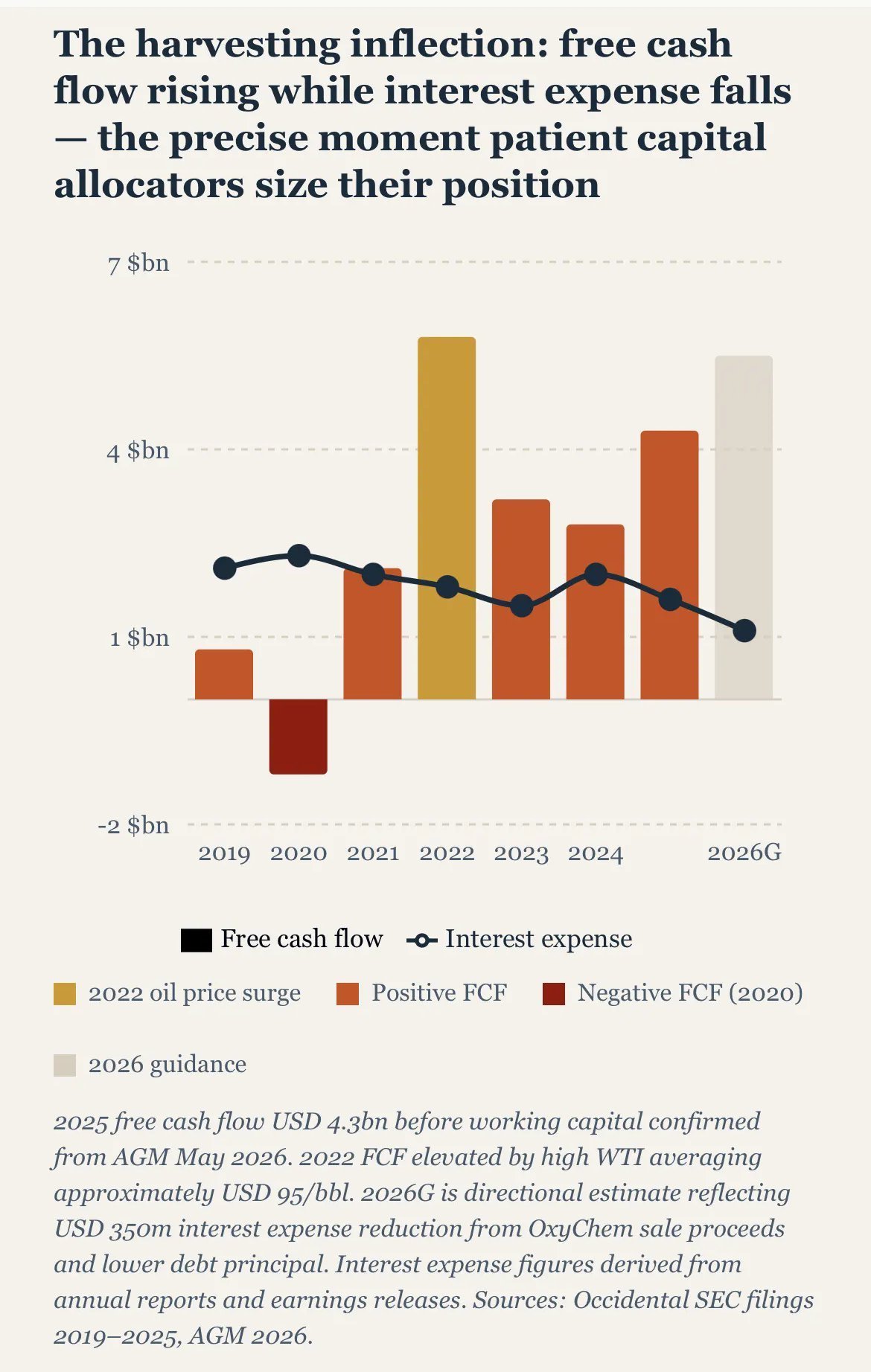
The OxyChem sale to Berkshire for USD 9.7 billion in January 2026 brought principal debt to USD 15 billion. By March 2026 it had fallen further to approximately USD 13.8 billion, with a stated target of USD 10 billion. The transition from a story of debt survival to capital return is the primary catalyst analysts identified as driving the stock. Hollub herself told the 2026 AGM shareholders that the dividend has almost doubled since the CrownRock announcement and that a sustainable and growing dividend remains central to strategy.
How Occidental Compares to the Western Majors
Crude Truth has now covered twelve energy companies. Where does Occidental sit?
Against ExxonMobil, which manufactures: Occidental lacks the integrated downstream and chemical scale that makes ExxonMobil’s earnings structurally diversified. But Occidental’s Permian breakeven below USD 40 per barrel is materially lower than most peers, with a more concentrated and arguably more efficient Permian position than even Chevron.
Against Chevron, which concentrates: The comparison is most direct. Both are Permian-heavy, US-centric, with multi-decade dividend histories. Chevron’s balance sheet is structurally cleaner and its capital allocation decisions over the last decade have involved fewer near-death experiences. The Anadarko assets that Hollub bought in 2019, which Chevron also wanted, are acknowledged by the industry as genuinely high-quality Permian inventory. Whether the price paid at USD 38 billion was correct is an analytical view, not a settled fact. The quality of what was purchased is not contested. The timing and leverage used to purchase it were the variables that nearly mattered fatally.
Against ConocoPhillips, which purifies: ConocoPhillips stripped itself of all downstream exposure and became the world’s best pure-play upstream operator. Post-OxyChem, Occidental is moving in the same structural direction, but retains the DAC and EOR technology assets as a third pillar. ConocoPhillips defines purity as absence of non-upstream exposure. Occidental defines it as concentration in the assets where it has genuine technological advantage: Permian oil and CO2 subsurface management together.
The one differentiator that no other company covered in this series is attempting at this scale: Occidental is building the world’s largest commercial direct air capture facility while simultaneously operating 50 years of CO2 subsurface experience as the foundation for that technology. Whether the DAC business reaches material cash flow contribution at USD 60 WTI without sustained policy support is the open analytical question.
Why Buffett Backed It
The Berkshire position in Occidental is the subject of the next issue. But the capital allocation pivot requires a precise note here.
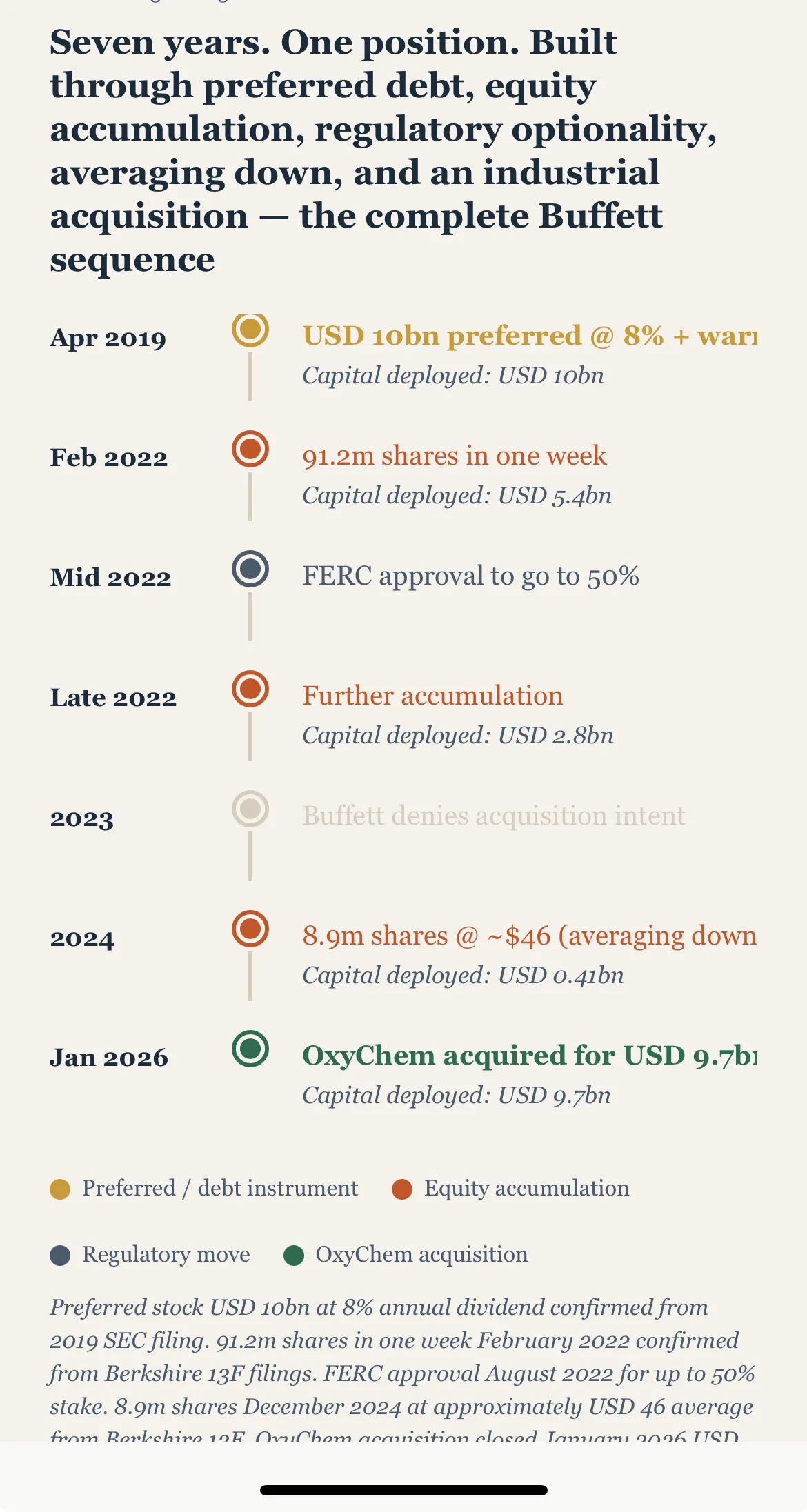
Buffett’s original USD 10 billion preferred stock investment in 2019 was a management thesis wrapped in a yield instrument. The 8% annual dividend made Berkshire whole regardless of whether Anadarko was correctly priced. The warrants to buy 80 million shares at USD 62.50 were upside optionality at zero incremental cost. He funded a bet he was uncertain about at economics that protected him from being wrong, not from watching the common stock fall.
What happened over the next six years validated the management thesis rather than the asset price thesis. Hollub cut the dividend, preserved the company through COVID, rebuilt the balance sheet, made a second large acquisition, hit the deleveraging milestone seven months ahead of schedule, and sold OxyChem to Berkshire at near-trough chemicals pricing. Every one of those decisions reflects the management quality that Buffett said he was backing in 2019. The OxyChem purchase is the closing arc: Buffett funded the original bet in 2019 through the preferred, watched the balance sheet nearly collapse, watched it rebuild, continued collecting his 8% dividend throughout, accumulated common stock during the repair phase at prices averaging USD 54 per share, and then bought the best industrial asset in Occidental’s non-core portfolio for USD 9.7 billion while the preferred income stream remains live.
Hollub described 2026 as the culmination of a ten-year journey to build a top oil and gas portfolio. She retired June 1 2026. Richard Jackson, the COO who spent years managing Occidental’s EOR operations, stepped into the CEO role. The transition signals continuity in the CO2 and EOR technology strategy that defines Occidental’s structural differentiation.
The Harvesting Phase: What It Actually Means for Capital Allocation
Hollub described Occidental as entering a harvesting phase, emphasising using existing infrastructure to get more from its reserves rather than requiring transformative acquisitions.  That phrase signals a fundamental shift in how the company will allocate capital through the next phase of the commodity cycle.
In the building phase from 2019 to 2024, every excess dollar of free cash flow went to debt reduction. Shareholder returns were secondary. The company was investing in its own survival and then its own recovery.
In the harvesting phase, the priority inverts. As debt continues falling toward the USD 10 billion target, analysts expect a significant share buyback programme.  The quarterly dividend has been raised. The interest expense reduction from the OxyChem sale proceeds eliminates approximately USD 350 million per year of cash outflow. That USD 350 million was previously funding a bank’s balance sheet. It now funds shareholder returns.
The capital efficiency gains from the CrownRock integration compound this effect. In the Delaware Basin, drilling times improved by 20%, bringing well costs below 2025 targets. In the Midland Basin, consistent cost reductions enabled further capital guidance reductions without sacrificing production targets.  A company that drills wells more cheaply than the year before on the same acreage, with the same production outcome, is compounding its per-barrel economics without requiring incremental capital. That is the harvesting model at the well level.
Stress Test
Three risks remain live for anyone allocating capital to Occidental in 2026.
With the sale of OxyChem, Occidental’s financial profile has become more reliant on cyclical oil prices. OxyChem was the earnings buffer across commodity cycles. It is now inside Berkshire’s balance sheet. If WTI falls below USD 50 per barrel for a sustained period, the USD 13.8 billion debt load becomes more burdensome and the dividend growth narrative stalls. The Permian sub-USD 40 breakeven provides protection. Protection is not immunity.
The Stratos DAC commercialisation risk is real and current. The plant encountered an unexpected non-process component issue in May 2026 that delayed full operations.  If the voluntary carbon market softens, if the South Texas DAC hub loses federal funding under the Trump administration’s award review process, or if per-tonne capture costs do not fall on the trajectory required to make the business self-sustaining without policy support, the long-run DAC thesis weakens materially.
The CrownRock integration assumptions must hold. Occidental raised proven and probable reserves to 4.6 billion BOE at year-end 2024, up from four billion BOE mainly due to CrownRock.  Those reserves need to be converted into production at the well costs and drilling times the acquisition economics assumed. Any deterioration in Permian service costs, water management, or regulatory conditions affecting hydraulic fracturing would compress the returns that justified the USD 12 billion price.
The Closing Argument: What This Means If You Are Allocating Capital
This series is not about admiring companies. It is about understanding how money is made and lost in the oil and gas industry so that the frameworks for investing in it are sharper.
Occidental teaches three things that no textbook on oil investing states cleanly.
Asset quality and entry price are separate variables that must both be right simultaneously. The Anadarko Permian inventory was genuinely high quality. What was wrong was the leverage used to acquire it at the moment COVID made that leverage existential. A good asset bought at the wrong time with the wrong capital structure can still nearly kill a company.
Management quality is a more durable signal than quarterly earnings. Hollub cut the dividend, preserved the company, rebuilt the balance sheet, executed a second large acquisition, hit the deleveraging target seven months ahead of schedule, and retired leaving the company structurally stronger than she found it. The earnings moved around throughout. The management quality was consistent. Buffett read that signal in 2019. The earnings volatility did not change his position.
The harvesting phase is where the money is actually made. The building phase generates headlines. The harvesting phase, where a sub-USD 40 breakeven asset generates free cash flow at every price above USD 40 and that cash flows to shareholders rather than interest payments, is where the compounding occurs. Occidental entered that phase in early 2026. The transition from a debt story to a capital return story is precisely the inflection point that patient capital allocators look for before sizing a position.
Buffett saw it in February 2022 when he bought 91.2 million shares in a single week. He was not buying a commodity price bet. He was buying the moment when the balance sheet repair was visible enough to confirm the thesis, the Permian quality was proven, and the market price had not yet reflected the harvesting phase that was clearly arriving.
The next issue examines how he builds that kind of position, why he structures entry through debt before equity, and what the ConocoPhillips mistake in 2008 teaches about the one time his own framework failed him completely.
That comparison is where the capital allocation framework becomes genuinely actionable.
#CrudeTruth #Occidental #OXY #OccidentalPetroleum #CapitalAllocation #WarrenBuffett #Berkshire #OilAndGas #EnergyAnalysis #LinkedInNewsletter #IndianEnergy #PermianBasin #VickiHollub #Anadarko #CrownRock #OxyChem #DirectAirCapture #CarbonCapture #EnergyInvesting #UpstreamOil #GlobalEnergy #OilAndGasIndustry #EnergyIndustry #ValueInvesting #LongTermInvesting #UpstreamIndia #ONGC