Delayed Coker vs Slurry Hydrocracker as the Central Bottoms Upgrader – Dream Project

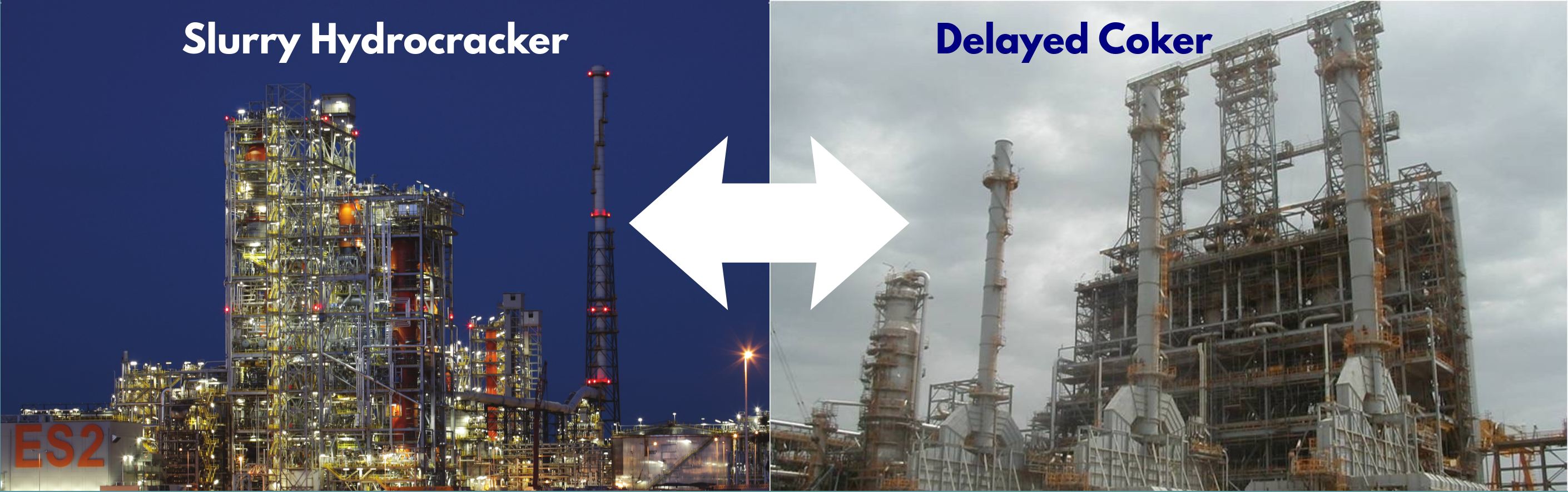
Photos: Left: ENI EST Hydrocracking Unit (source: agi.it) • Right: 6-Drum Delayed Coker Unit (source: coking.com)
|
|
|
During the live interactive Molecules to Market session on September 5, a few queries were raised with respect to the choice of the bottoms upgrader and the reason for proposing a combination of a DCU + SHCU combination for the 20 MMTPA Integrated Dream Refinery project. It is an interesting query and though the reasons for the same was discussed extensively in the earlier Podcasts, it was felt worthwhile to dwell on the same further and therefore this post.
Considering a 50:50 AL: AH crude mix it is anticipated that about 5 MMTPA of Vacuum Residue (VR) that would be produced. Additionally the clarified oil from PFCC, the fuel oils from Steam Cracker, the pitch from SHCU, and the bio sludge from WWTP could be additional potential steams, which would require to be upgraded along with the VR pool. Some of these are otherwise difficult streams to dispose as Fuel oil production anyway is not encouraged.
Another important aspect that is to be considered is that cheap natural gas is not available in India to support high hydrogen production through SMR. In addition, fossil fuel firing in the captive steam and power generation facilities does not make economic sense. The power generated from such captive power plants is expensive vis- a vis coal based power generation. Refineries therefore, are gradually becoming dependent on the grids for Power, and are utilizing solid-fuel for Captive Power Plants (CPPs) that co-fire pet coke and coal for steam and power.
VR Disposition
Amidst the various options, three options directionally emerge to process the VR:
1. Only DCU
2. Only Slurry Hydrocracker
3. Combination of DCU+ SHCU with capped capacity of DCU.
Only DCU: Delivers the lowest capital cost and robust heavy-feed handling, yielding substantial green pet coke for the coal-pet coke boiler mix, but suffers from lower liquid distillate yields and heavy hydro-treating requirements of the products. Low liquid distillate yield means lower overall liquid product revenue realization. Hydrogen consumption is minimal, restricted entirely to treating cracked liquid products (coker naphtha and gas oils). No hydrogen is consumed directly in the thermal cracking in coke drums.
Only SHCU: Maximizes liquid product conversion (>90-95%) into valuable middle distillates, but demands massive hydrogen infrastructure, high capital expenditure, and produces zero pet coke—leaving the CPP entirely dependent on coal. It also Demands massive net hydrogen input (typically 3.5 to 4.5 wt% on feed) to saturate cracked fragments, reject sulfur/metals, and prevent polymerization into coke. This requires massive mega-scale Steam Methane Reforming (SMR) driving up utility consumption significantly.
Combination (SHCU + Rationalized DCU): Balances deep liquid recovery with solid-fuel security by using a rationalized 2.4 MMTPA two-chamber DCU to precisely generate the pet coke required for the CPP along with an SHCU for bulk residue upgrading. Hydrogen demand is reduced significantly as compared to SHCU only Option. The 2.4 MMTPA fraction handled by the thermal Coker rejects carbon as solid coke to help rationalizing the hydrogen consumption.
CPP Requirements
The additional key point would be that for an integrated complex of this nature about 2000 TPH of process steam, 350 MW of internal power generation and 100 MW of grid connect for meeting the total power requirement of 450 MW for the complex. This aspect is important considering the fact that a CFBC based CPP on Pet coke alone is not permitted by the environmental agencies in spite of the maturity in CFBC technology. A combination of Pet coke + coal may therefore have to be considered. To meet the steam and power requirements of the complex in the three options, the following scenario emerges:
In Only DCU case - High Pet Coke Surplus will result as significant quantity of coke is produced i.e. about 30% of Feed. The CPP easily fires a pet coke-coal blend to generate 2000 TPH of high-pressure process steam and easily meet the 350 MW internal power generation target. Net Pet coke surplus will result.
In Only SHCU case - Zero Pet Coke is produced and the heavy pitch byproduct from SHCU is the net resultant. This could be used to produce asphalt. The CPP must shift to 100% coal to meet the 2000 TPH process steam and 350 MW power requirement. This would mean procuring and transporting a lot of coal for a 350 MW solid-fuel boiler.
In SHCU + 2.4 MMTPA DCU case the rationalized 2-chamber 2.4 MMTPA DCU yields enough pet coke to be blended with coal to match the stoichiometric blend requirement to co-fire with coal in the CPP boilers to produce 2000 TPH of process steam and 350 MW power, eliminating the need for 100% coal dependency.
Need for DCU
The DCU in the complex refinery serves as a good sink for several problematic streams eg:
1. SHCU Pitch: In the combined configuration, the heavy pitch bleed from the Slurry Hydrocracker containing concentrated catalyst ash/metals and highly condensed aromatics can be routed directly to DCU. The Coker handles this otherwise difficult-to-dispose- heavy pitch by cracking it further to gas/liquids and enabling the metals/ash to find way into the pet coke product.
2. FCCU Clarified Oil (CLO) / Slurry Oil: Highly aromatic and rich in polycyclic hydrocarbons, CLO acts as a natural solvent that prevents asphaltene precipitation in Coker heater tubes which reduces fouling and extends run lengths. It also suppresses "shot coke" formation, favoring a proper coke matrix for the captive power plant.
3. Steam Cracker Fuel Oil (SCFO): Heavy pyrolysis fuel oils from the steam cracker are highly refractory and aromatic; the DCU cracks these heavy tars efficiently, converting a low-value byproduct into valuable Coker gas oils.
4. WWTP Solid Waste: Co-processing oily sludge or biological solid waste from the Wastewater Treatment Plant in the Coker is a well-established industrial practice for safe thermal disposal, avoiding hazardous landfill burdens while cracking the contained residual hydrocarbons.
5. Feeding SHCU pitch and FCCU CLO into the rationalized DCU eliminates the need for investigating avenues of disposal of these problematic streams. Additionally, the aromatic blending keeps asphaltenes stable and thereby reducing premature fouling.
Final Takeaways
1. Only DCU: Safe, low-CAPEX route, but leaves significant revenue loss due to lower liquid distillate recovery. Overall refinery gross margin is constrained.
2. Only SHCU: Maximizes volume conversion to liquid products, but the astronomical CAPEX for full-scale slurry hydrocrackers and massive hydrogen plants—coupled with the penalty of importing 100% of the coal to support steam and power generation erodes net EBITDA advantage.
3. DCU+ SHCU Combination: Strikes the economic "sweet spot." By rightsizing the SHCU and utilizing a 2.4 MMTPA DCU to co-process internal refinery by-products (SHCU pitch, FCCU CLO, SCFO), it maximizes high-value liquid yields, while generating adequate fuel for the blended fuel loop of the captive power plant. This minimizes imported coal exposure and yields the most robust, balanced EBITDA profile.
4. Considering Total VR to DCU as base the capex for Only SHCU option could be 1.6-1.7 times the base and for the combination, the capex could be 1.25-1.3 times the base. The Opex for the Only DCU option would be moderate, for the Only SHCU option would be 1.3-1.4 times of the base and for the combination would be about 1.1-1.15 of the base. The EBITDA would be the lowest for the DCU only option, moderate for SHCU based option and optimized for the combination option.
All queries are welcome! Click the 'Add Comment / Reply' button here below 👇 👇 👇
#refinery #petrochemicals #feeddiet #hydrocarbons #refinerycapacity #initialdesign #delayedcoker #slurryhydrocracker
|
Venugopal, B.V.
9/9/2026 10:54 AM
Excellent Sir. Regards
|