Setting up a Grass Roots Integrated complex at Priyagraj - Uttar Pradesh
Summary
- Crude supply: A dedicated 48-inch, 1,450 km greenfield crude pipeline from Vadinar (Gujarat) via Chaksu and Shivpuri/Kota, engineered with API 610 BB5 pumping stations and hydraulic headroom for future expansion to 20+ MMTPA.
- Mathura integration: Given environmental constraints near the Taj Mahal, Mathura's vacuum residue blended with surplus light naphtha (~2.2–2.3 MMTPA) would be pumped 120–150 km to Prayagraj for high-value upgrading—reducing net fresh crude demand to ~12.5 MMTPA.
- Petrochemical-maximizing configuration: Aromatics (PX, Benzene, PTA), olefins (PE, PP), LAB/LABSA for a detergent industry, acrylates, and capped ATF output—deliberately avoiding hazardous niche chemicals to keep the complex simple.
- Energy self-sufficiency via gasification: A high-recovery SDA with pitch gasification to supply all hydrogen, steam, power, and syngas—eliminating external gas dependence—plus surplus syngas converted to 800 KTPA of urea for the state's fertilizer needs.
- Future-ready: Phase II integration with green hydrogen, methanol, green ammonia, and green urea.
Open Letter to Hon Prime Minister of India/ Hon Chief Minister of UP
|
|
|
Hon Prime Minister of India/ Hon Chief Minister of UP
It is heartening to witness phenomenal overall progress of UP in the last decade, where massive change and development has taken place. The strategy to address development of State through the resolution of farmers issues, strengthening of Infrastructure, setting of Defense corridors, fillip to Electronics and mobile assembly/manufacturing units, one district- one product philosophy, attending to health related problems of Eastern UP on one end are major Structural Changes. In addition, on the Industrial front, sustained encouragement to sugar mills, ethanol, CBG and Fertilizers, all of them are pointers, which augur well, for the growth trajectory of the state. It is a matter of a closer case study though, as to how improvement of law and order can change the Economic and Investment climate of a state. What is evident is simply phenomenal!
The other major obvious eye catching development is the growth of Infrastructure, Roads and Expressways, Vande Bharat Connectivity, massive improvement in Air travel, which has prompted cascading development in areas in and around the new Airports. This is a huge plus. The commencement of operations at Jewar Airport in short time is another game- changing milestone, which has catapulted UP on a strong growth path. No wonder, the State’s GDP contribution has escalated from the bottom three spots to Top three in the country. The stage is now set for high growth, and the way religious tourism has picked up at Ayodhya and Varanasi, along with record breaking Kumbh Mela at Priyagraj, UP in several ways has signaled its arrival. The Hon CM of UP has rightly therefore, set the ambitious target of achieving a trillion dollar Economy by 2030 for the State. The way things are unfolding, there is good reason to believe, that this ambitious target would possibly be achieved.
It is pertinent to assume that a State, which has set for itself ambitious, targets, and carved out a fast track growth trajectory, would be in need of copious energy requirements. While the emphasis on solar and renewables would remain to align with the national priority of increasing the share of clean energy, it may be worthwhile to note, that the State will have to examine its fossil fuel led energy basket as well.
Currently the State has only one Refinery at Mathura, one Petrochemical Complex at Pata with LPG and Fertilizer plants spread around the HVJ pipeline at Aonla, Shahjahanpur and Jagdishpur. Surely, this is good gas integration for a large State. However, it does suggest that given the size of the State and its growing economy and energy needs, the State would certainly have to be dependent on Petro-product import from the adjoining states of Haryana - Panipat, Punjab - HMEL and also perhaps a bit from MP – Bina. Perhaps, at a time when UP was struggling with its economy a decade ago, this strategy may have been fine, but now the Industrial climate has changed and the requirements have altered substantially. It is essential therefore, that a large integrated complex is installed in the State, which could substantially meet its distillate and LPG requirements and also produce a lot of petrochemicals to support industrial clusters and parks, for providing fillip to industry to generate employment. It may be noted that the States distillate demand is to the tune of 16-18 MMT which is only partly addressed by Mathura. Balance products are all sourced from neighboring states. Similarly, the states total petrochemical requirements are met to the tune of 20-25% though the existing facilities, balance requirements are sourced from the adjoining states.
It is in the backdrop of the above, that the State must consider installation of large integrated Refining/Petrochemical complex to not only meet to the State’s captive demands, but to also spur cascading development. The broad contours of the proposition maybe as below.
Proposition
Crude Pipeline connect to Refinery
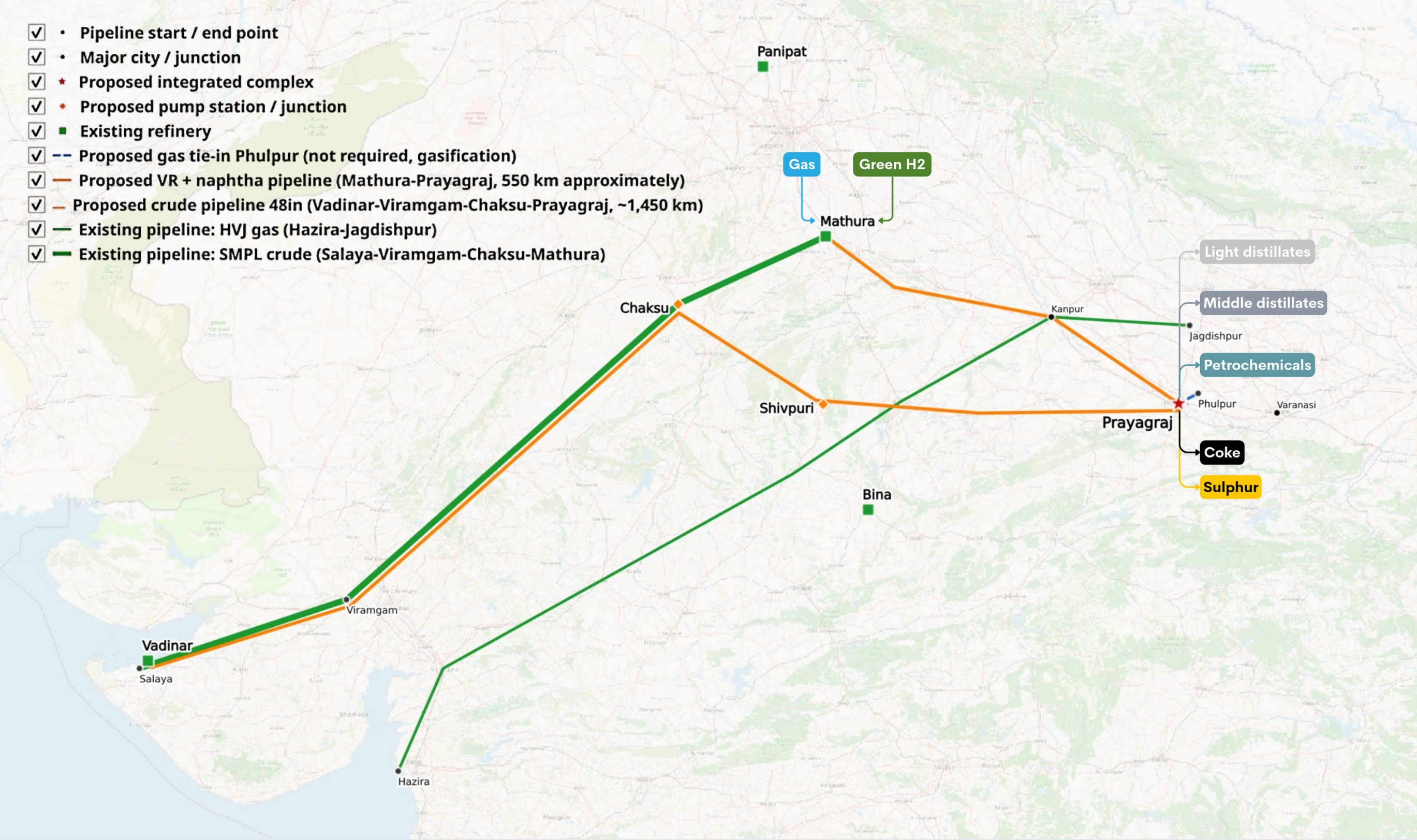
The important part is to connect the Refinery with a new crude line for supplying crude oil to the proposed 15 MMTPA grassroots mega-refinery at Prayagraj, Uttar Pradesh. To bypass the severe capacity constraints and environmental bottlenecks of the western-northern trunk networks, such as existing allocations connected to the Mathura Refinery via the Salaya-Mathura Pipeline, it is proposed to evaluate alternative crude oil transportation architecture originating from the Gujarat marine coast. A dedicated, standalone greenfield pipeline system from Vadinar to Priyagraj via Chaksu, operating with optimized pump stations configured with heavy-duty API 610 BB5 barrel-type multi-stage centrifugal pumps in a 3 Working + 1 Standby (3W+1S) layout is proposed.
Various alternatives were examined to reach Priayraj through crude pipeline:
1. The Bina-Extension Route: This route examined extending the crude line from the Bina Refinery hub. However, because Bina's upstream trunk, Vadinar-Bina Pipeline is limited in capacity, feeding an extra 15 MMTPA through it required heavy parallel looping over 940 KM plus and an an additional 540 KM leg. This made the route nonviable, particularly both along the marine route as well as along the Western Ghats the line had a difficult contour to content with.
2. The Hybrid Looping Model : Explored partial looping of the existing SMPL corridor up to Chaksu which impacted the Mathura Refinery logistics, followed by a new 42-inch / 48-inch single-station line from Chaksu to Priyagraj with significant Capex. While this option was deemed to be capital-efficient, it created operational dependencies and scheduling complexities with existing refinery allocations and hence was not considered.
3. The Standalone Greenfield Model: Conceives a clean, dedicated, independent pipeline corridor directly from Vadinar to Priyagraj , 1,450 KM total length, ensuring 100% control over the 15 MMTPA supply chain. The system architecture considered maximum throughput stability, safety, and operational autonomy with the following specific features:
Route Distance: 1,450 KM continuous greenfield corridor from Vadinar marine terminal through Viramgam, Chaksu, and Shivpuri/Kota sectors directly to Priagraj.
Pipeline Sizing & Material: High-strength carbon steel (API 5L X70 grade), evaluated in both 42-Inch and 48-Inch configurations.
- 42-Inch Line: Maintains an optimal self-cleaning fluid velocity of about 0.7 m/s.
- 48-Inch Line: Lowers fluid velocity to ~0.6 m/s, providing hydraulic headroom and low friction drops.
Pumping Station -3 Stations
- Station 1 (Vadinar Origin Terminal): Marine tank farm integration, multi-unit primary injection discharging at high pressure.
- Station 2 (Chaksu Intermediate Booster Hub, Rajasthan): ~500 KM mark; re-pressurizes line head.
- Station 3 (Shivpuri / Kota Intermediate Booster Station, Madhya Pradesh): ~970 KM mark; provides the final booster push across the northern plateau.
Pumps: Heavy-duty API 610 BB5, Barrel-type multi-stage centrifugal pumps, arranged in a 3 Working + 1 Standby (3W+1S) layout per station, driven by high-voltage (11 kV) electric motors.
Proposed 48-Inch Pipeline System
To accommodate potential future expansions beyond 15 MMTPA and minimize long-term frictional energy losses, the 1,450 KM greenfield system as 48-Inch OD pipeline is proposed notwithstanding the following:
- Steel Tonnage & Material Premium: A 48-inch pipe requires ~18% to 22% more heavy carbon steel tonnage (API 5L X70) compared to a 42-inch line which would imply higher Capex.
- Construction & ROW Impact: Demands marginally wider right-of-way (ROW) clearing and heavier side-boom/trenching machinery, raising civil construction costs across rocky and agricultural tracts in Gujarat, Rajasthan, and Madhya Pradesh.
- CapEx Implication: The upfront capital expenditure may be to the tune of ₹20,000 – ₹23,500 Crore.
- Operational Benefit: Frictional head loss will drop reducing the aggregate electrical power demand of the booster stations, and providing inherent hydraulic headroom for future expansions up to 20+ MMTPA without laying loops.
In view of the above it is proposed to utilize a 48-inch pipeline configuration with three optimized pump stations represents the optimal long-term blueprint for the 15 MMTPA Priyagraj refinery. Although it carries a higher initial steel and capital investment, its superior hydraulic efficiency significantly lowers annual electricity pumping costs, safely future-proofing the refinery's crude supply network for decades to come.
Integration of bottoms from Mathura to Priyagraj for higher value addition
The Mathura Refinery processes a mix of low-sulphur crude (such as Bombay High and imported Nigerian crude) and high-sulphur crude from the Middle East. It has a processing capacity of close to 8 MMTPA. The refinery is fully upgraded to produce ultra-clean BS-VI compliant transportation fuels. The refinery is also equipped with a Visbreaking Unit (VBU) which reduces the viscosity of heavy vacuum residue using thermal cracking.
Mathura Refinery utilizes secondary processing units—such as the Visbreaking Unit (VBU) and Once-Through Hydrocracker Unit (OHCU), alongside environmental clearance projects for residue upgradation—specifically designed to crack and convert these heavy residual bottoms into lighter, more valuable distillates or blend them into products like Bitumen and Low Sulphur Heavy Stock (LSHS) / Furnace Oil. Because the heavy bottoms are largely routed through Visbreaker/Bitumen blowing, the quantity of unprocessed final residue exiting the refinery as heavy fuel oil or straight-run asphalt components is kept to a minimal fraction.
Without a true heavy-residue conversion asset like a Delayed Coker or a Full-Conversion Slurry Hydrocracker, the VBU and BBU function essentially as thermal reduction and asphalt-blending steps, rather than deep-conversion margin builders. This is a bottleneck.
Similar to almost all refineries the secondary hydrogen generation units utilize Light Naphtha to produce high-purity hydrogen required for hydro-processing units. Since the Refinery lacks a captive Naphtha Cracker or a large-scale standalone Aromatics Complex, it acts as a feeder refinery to Panipat Refinery & Petrochemical Complex in Haryana. As natural gas replaces light naphtha in the HGU, nearly half of the total light naphtha pool becomes excess and serves as additional feedstock to the Olefin complex at Panipat.
In order to realize the highest value of the bottoms it is proposed to mix this Light Naphtha with the VR and route it through a pipeline to Priyagraj refinery. Upon receipt at the refinery the combined stream could be flashed to separate LN and VR as streams to be processed in the refinery. This is all the more important as no facilities apparently can be created at Mathura, due to proximity of Taj.
VR Slurry/Blended Pipeline Scheme - Raw VR at room or ambient pipeline temperatures is an extremely high-viscosity fluid and pumping it natively requires heavy heating/continuous heat-tracing. Blending the VR with a lighter diluent like Light Naphtha drastically reduces both the viscosity and density of the mixture. This transforms the heavy bottom into a pumpable fluid mixture that can travel safely through a heated or traced cross-country pipeline.
Upon arrival at the destination complex, the blended stream enters a flash drum or a dedicated fractionation /stripping column. Because of its high volatility, the Light Naphtha flashes off overhead at relatively low temperatures. It can be condensed, stripped of any trace gases, and processed as feedstock to the steam cracker. The heavy VR drops out as a clean bottom stream from the flash vessel and combined with the VR pool of the Refinery for upgradation. The average distance of the pipeline between Mathura to Priyagraj is about 120-150 Km.
Blending the entire Light Naphtha pool—unlocked by gas-integrating the Hydrogen Generation Unit—with the Vacuum Residue eliminates the extreme high-viscosity constraints of pure heavy bottoms. The naphtha acts as an effective solvent and viscosity reducer, transforming the heavy residue into a pump-able, liquid-phase hydrocarbon blend rather than a high-viscosity asphaltic mass. API 610 compliant, multi-stage centrifugal pumps can deliver the steady, high-head pressure required to move the fluid across a 120-150 KM span. Rotary screw or heavy-duty twin-screw PD pumps can be integrated as booster units at the origin for initial line-filling, clearing operations, or cold-start scenarios where local temperature drops might temporarily elevate blend viscosity.
For a 120-150 KM direct cross-country run, a single high-pressure main station at Mathura—operating with pumps in series/parallel to achieve a discharge pressure of 60 to 90 bar—can typically overcome frictional resistance, to keep flow in the turbulent or low-viscosity laminar regime. An intermediate block valve station with pigging facilities would be required for pipeline maintenance. Carbon steel API 5L X65 grade line pipe could be used. A line size of 16” with no intermediate pumping and low had pumps could be used to optimize the system which could envisage a flow of about 2.2-2.3 mmtpa inclusive of 0.8 mmtpa of naphtha. The VBU and BBU at Mathura could be phased out. Through this process the new refinery feedstock could be rationalized and both the refineries operation could be made optimal.
Gas connectivity
The nearest gas point could be at Phulpur about 80-90 km from Priyagraj. However, no gas connectivity is foreseen to the complex as the configuration of the Refinery is proposed to be equipped with its own gasification facilities meant to supply Hydrogen, steam, power, syn gas, Urea to the complex.
Refinery Strategy
1. A 15 MMTPA, AM: AL 50: 50 crude grassroots integrated Refining complex is considered to be located around Priyagraj. The plant is expected to be integrated to receive about 2.2-2.3 MMTPA of VR + LN from Mathura refinery for upgradation.
2. This location may be strategically important for the State and crude could be sourced through an additional greenfield 48 “ 1450 km crude pipeline from Vadinar - Chaksu - Priyagraj. The Pipeline could be of large size with additional crude pumping stations along the Pipeline and could also cater to future expansion of the complex.
3. Mathura is the only refinery in UP which has been constrained for expansion/modernization because of its proximity to the historical monument -Taj. While lot of work was conceptualized in the past to expand/modernize and upgrade the bottoms of Mathura refinery, not much could be realized because of environmental reasons. The Naphtha from the refinery though is integrated through rail connectivity to Panipat Refinery to support a Aromatic and Olefin complex at Panipat, as part of horizontal integration strategy.
4. Mathura refinery for environmental considerations processes sweet crude. A lot of naphtha is integrated to the Aromatic and Olefin complex at Panipat, while some of it is utilized to make gasoline and produce hydrogen for the captive Refinery requirements at Mathura. This refinery should be completely gas integrated initially, and later grey hydrogen replaced with green hydrogen. This will offer a green solution, reduce carbon footprint and displace fuel oils and naphtha from the refinery. All the displaced liquids, naphtha and unprocessed bottoms from the refinery is a feed stream which needs to be upgraded. All these streams could combined and checked for viscosity before pumping to Priyagraj. A 120-150 km pipeline may be envisaged to connect this stream from Mathura to the proposed new Refinery. While precise estimate can be computed, upwards of 2.2-2.3 MMTPA of unprocessed bottoms/Fuel oil+naphtha could be available as additional feedstock to be upgraded into value added products in the new complex.
5. In view of the above, the net crude requirement from the Kandla-Bina Pipeline extension would be 12.5 MMTPA to support a 15 MMTPA complex. This will rationalize capacities, reduce investments, optimize and generate more value for money.
6. With the above, Crude, unprocessed bottoms from Mathura along with naphtha and gas as feed would be available to the proposed new complex.
Project configuration
Objective
- Maximize petrochemicals, reasonable gasoline.
- ATF production to be capped as 1 MMTPA.
- Diesel production to be open but rationalized.
- Petrochemicals to be maximized for PTA, LAB, LAB SA, Benzene.
- Olefins to be maximized to enhance production of Polyethylenes, Polypropylene, Acrylates.
- The configuration to envisage a SDA for VR upgradation with all pitch gasified to provide Hydrogen, steam and power and syn gas to the acrylate complex. All surplus syn gas to be converted to urea to supplement the local state fertiliser requirements.
- All acid gases in the complex to be converted to sulphuric acid and meet the captive SO3 demand of LAB SA, suphuric acid and regeneration requirement for Alkylation block.
- A petrochemical park and a detergent factory to be set up by the state Government to promote employment and industry to the local populace.
Configuration
1. Minimal capacity of CCR to maximise Aromatics envisaged. The downstream of the complex to be integrated to an Aromatic complex to recover Benzene and PX from CCR effluent and FCC naphtha ( after selective hydrotreatment) and Hydrotreated Py gas from naphtha cracker. The idea is to maximize the production of Benzene and PX. The non aromatic effluent from the Aromatic block shall be combined with the Alkylate to supply premium gasoline to the market.
2. A LAB and LAB SA plant shall be envisaged to minimize the kerosene /ATF production. The plant will be 2x 165 KTPA and the LAB SA shall be 2x 75 KTPA with SO3 supplied from the sulphuric acid plant. This is a premium product and will be able to support a massive detergent factory by others to promote overall industry. Balance LAB shall be available for merchant sale.
3. Secondary processing to comprise of VGO HDT, PFCC with 20 % Propylene. The VGO hydrotreater capacity to be maximized with VGO + DAO from SDA . The process to be designed on low severity of 10-15% to ensure maximization of PFCCU capacity. PFCCU may have two trains of Reactor/Regenerator with dedicated MAB/WGC and a common fractionator and Gas Plant.
4. All light Naphtha, residual Heavy Naphtha, off-gases from PFCC, Propane from FCC, all propane and butane from the LPG pool of the complex to comprise the feedstock diet of Cracker. The DHDT to operate as Mild hydrocracker with LPG and Naphtha recovered from the same as feedstock to Cracker. The Cracker to maximize ethylene production. All C4 mix from Cracker and PFCCU to be hydrotreated and cracked to extinction. Cracker Bottoms to PGH as feed to the Aromatic complex for integrated recovery of Benzene and PX.
5. Bottoms to comprise of a high recovery SDA with 65% recovery of DAO routed to VGO hydrotreater. The pitch to be routed to the Gasification block. No SHCU or any other bottoms upgrader is foreseen. The capacity of the SDA to be to the tune of 3.4 MMTPA.
6. Treatment Block to be comprise of DHDT operating as a mild hydrocracker, Straight run and Cracked LPG treatment, Prime G, Sulphur acid etc.
7. Downstream block to comprise of two trains of LLDPE/HDPE along with a dedicated Butene I plant, two trains of HDPE and an LDPE unit. On the propylene side the complex will comprise of two trains of homo PP and one train of Copolymer PP along with an Acrylates plant. The syn gas for the Acrylate plant shall be made available from the gasification block. To rationalize capex, Benzene after meeting the captive requirements of LAB plant is considered for merchant sale. Niche Petrochemicals including VCM/PMC, Cumene/ Phenol, PO/PG are all avoided to keep the complex simple and non hazardous. All polymers to support Petrochemical parks and small-scale industries in the state as well as neighboring states.
Gasification Island
These are troublesome times and the future of sourcing fossil fuels is somewhat uncertain . Wisdom therefore lies in looking for viable solutions to support large complexes while minimising external interfaces. Most of the Hydrocarbon complexes have a high demand of gas price for which is also volatile and can have a negative impact on the plant economics. Gasification therefore, is a good solution. Cokers can be one solution wherein petcoke + coal could either support a CFBC facility or a gasifier to meet additionally the hydrogen requirements of the complex. Solids based gasification is expensive and involves a lot of solids handling. On the contrary, a SDA with 65% recovery is the right blend to maximize distillate recovery and to provide a pitch which can be gasified with relative ease eliminating all solids handling.
Pitch based gasifiers can yield considerable syn gas which can cater to all the requirements of the complex. For instance all the hydrogen requirement, steam and power to avoid any external power back up. It can additionally support all the captive requirements of the acrylates complex, and still leave some syn gas which can be converted to urea, thereby yielding additional revenues, adequate CO2 sequestration and yield a product which could be very useful for a state like UP. All in all, it is a win win and no external gas integration is required and all SMR facilities are also eliminated.
UP requires such a complex. In phase II, this plant maybe considered for integration with Green Hydrogen and SMR plant converted to produce methanol. Subsequently, Green Ammonia and Green urea could be produced for utilization in UP itself.
The product profile of the project is:
- Ultra-Low Sulfur Diesel (ULSD) 4,460 KTPA
- Kerosene / ATF (Jet Fuel) 995 KTPA
- Motor Gasoline Pool 2,390 KTPA
- Polyethylene (PE Total) 1,850 KTPA
- Polypropylene (PP Total) 1 735 KTPA
- Purified Terephthalic Acid (PTA) 1,790 KTPA
- Benzene (Merchant) 500 KTPA
- LAB (Linear Alkylbenzene) 230 KTPA
- LABSA (Linear Alkylbenzene Sulfonic Acid) 150 KTPA
- Acrylates / Acrylic Acid Chain 390 KTPA
- Urea 800 KTPA
Project Cost
The total Capex of the project excluding the land cost is expected to be upwards of $ 16 -18 B with a healthy return between 16-18 %. Such a Project will provide fillip to Industry and will have a cascading impact on the employment generation in the State. Manufacturing too, will gain fillip and later workshop and maintenance facilities will crop up. The State will be able to reduce the sourcing of distillates from neighboring States and gradually, would become a hub to export petrochemicals.
It is felt that for the medium term the project will fit systematically into the vision plan of the Hon PM/CM to help developing a high growth State like UP and sustain its growth momentum!
#UttarPradesh #MOPNG