Aromatic anhydrides are a class of carboxylic acid anhydrides in which one or both acyl groups are attached to an aromatic ring, giving them distinct reactivity and industrial importance compared to their aliphatic counterparts.
Structural Classification
Aromatic anhydrides fall into two structural categories based on symmetry:
-
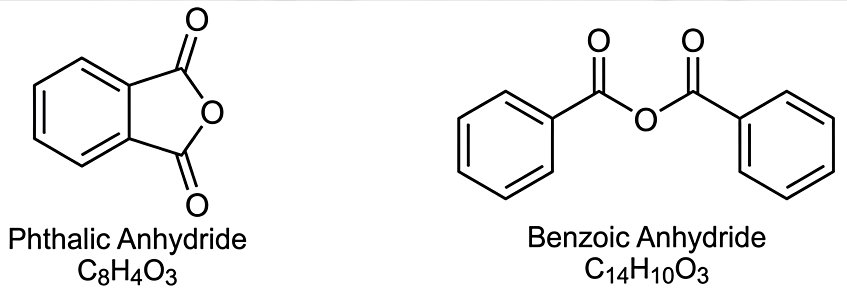
Symmetrical aromatic anhydrides: Both acyl groups derive from the same aromatic acid, connected through a single bridging oxygen (e.g., benzoic anhydride, (C₆H₅CO)₂O)
-
Cyclic aromatic anhydrides: The anhydride ring is fused directly onto the aromatic ring itself, formed when a benzene ring carries two adjacent carboxylic acid groups that dehydrate intramolecularly (e.g., phthalic anhydride, C₈H₄O₃)
Chemistry and Reactivity
The defining reactivity of aromatic anhydrides is their acylation potential: they readily transfer an acyl group to nucleophiles such as alcohols (forming esters), amines (forming amides), and aromatic rings under Friedel-Crafts conditions (forming aryl ketones). Phthalic anhydride, as a cyclic anhydride, is particularly reactive toward alcohols and amines because ring-opening relieves strain and is thermodynamically favorable, making it a preferred plasticizer and resin-curing intermediate over the free diacid. Benzoic anhydride is typically synthesized by dehydrating benzoic acid, either thermally or using acetic anhydride as a dehydrating agent, or via reaction of sodium benzoate with benzoyl chloride.
Production Routes
Industrial-scale aromatic anhydrides are produced predominantly through two routes:
-
Direct dehydration/oxidation: ortho-substituted aromatic diacids (like phthalic acid) cyclize to their anhydride form either spontaneously on heating or as a direct product of catalytic vapor-phase air oxidation of ortho-xylene over V₂O₅ catalyst
-
Dehydrating agent route: Non-cyclic aromatic anhydrides like benzoic anhydride are made by condensing two carboxylic acid molecules with loss of water, often using acetic anhydride or acyl chlorides as the dehydrating/coupling agent
-
Catalytic carbonylation: A less common laboratory-scale route uses palladium-catalyzed carboxylation of arenes with carbon monoxide under pressure (~15 bar) to directly form aromatic anhydrides from the parent aromatic hydrocarbon
Physical and Handling Properties
Most aromatic anhydrides are colorless to white crystalline solids at room temperature, generally insoluble or only slightly soluble in water (many hydrolyze slowly on contact with moisture back to the parent diacid), but readily soluble in common organic solvents like acetone and ethanol. Because of their electrophilic carbonyl centers, they typically require storage under dry, inert conditions to prevent hydrolysis and are classified as skin, eye, and respiratory irritants, with some (like HHPA) recognized as sensitizers.
Applications
Cyclic aromatic anhydrides like phthalic anhydride dominate the resin and plasticizer industry, serving as a monomer for alkyd resins, unsaturated polyester resins, and as curing agents for epoxy systems in coatings, adhesives, and electrical component encapsulation. Non-cyclic symmetrical anhydrides such as benzoic anhydride are used more as fine-chemical acylating agents in pharmaceutical and dye synthesis, and in Friedel-Crafts acylation reactions to build more complex aromatic ketones.