Product
Cycloalkanes
Segment
Chemicals
Main-Family
Alkanes
Sub-Family
Cycloalkanes
Link
Insight Articles
#PS811

Description

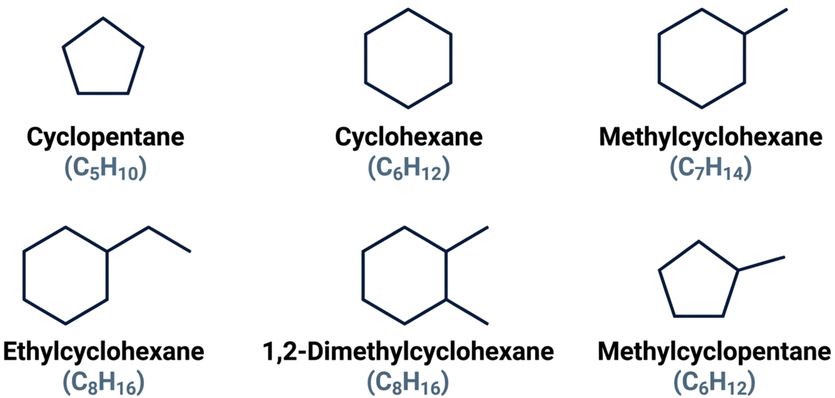
Cycloalkanes — also known as naphthenes or cycloparaffins — are saturated, ring-structured hydrocarbons with a general formula of CnH2n that occur naturally in crude oil and are also produced synthetically. The most industrially important members are cyclohexane (C₆H₁₂) and methylcyclohexane (C₇H₁₄), with lesser commercial roles for ethylcyclohexane, dimethylcyclohexanes, and cyclopentane.


Key Members & Physical Properties

Property Cyclo-
hexane (CYH)
Methyl-cyclohexane
(MCH)
Ethyl-cyclohexane Cyclo-pentane
CAS 110-82-7 108-87-2 1678-91-7 287-92-3
Formula C₆H₁₂ C₇H₁₄ C₈H₁₆ C₅H₁₀
MW 84.16 g/mol 98.19 g/mol 112.21 g/mol 70.13 g/mol
Boiling point 81°C 101°C 131°C 49°C
Melting point 6.5°C −126.3°C −111°C −94°C
Density (15°C) 0.779 g/mL 0.773 g/mL 0.788 g/mL 0.745 g/mL
Flash point −18°C −4°C 35°C −37°C
Appearance Colorless liquid Colorless
liquid
Colorless
liquid
Colorless liquid
Water solubility Insoluble Insoluble
(<0.1 wt%)
Insoluble Insoluble
Vapor pressure (25°C) 104 mbar ~57 mbar
(43 mmHg)
~13 mbar ~345 mbar

All members are non-polar, have petroleum-like odors, and have vapors heavier than air.


Sources & Production

Cycloalkanes are present naturally in straight-run naphtha fractions from crude oil distillation and are a primary component of naphthenic crude oils.

Cyclohexane is predominantly produced by catalytic hydrogenation of benzene (benzene + 3 H₂ → cyclohexane); secondary routes include fractionation of naphtha cuts and hydrodealkylation of toluene.

Methylcyclohexane is recovered from naphtha streams or formed as a by-product in reforming units, where it is mainly dehydrogenated to toluene.

In catalytic reformers, naphthenic cycloalkanes are key intermediates in the naphthene → aromatic dehydrogenation pathway that is central to CCR reforming for BTX and hydrogen production.


Industrial Uses

Cyclohexane

Over 90% of global cyclohexane volume is consumed as a chemical intermediate for nylon production:

  • Adipic acid (for Nylon 6,6): ~60% of demand, via oxidation of cyclohexanol/cyclohexanone
  • Caprolactam (for Nylon 6): >70% of world caprolactam is made from cyclohexane via cyclohexanone
  • Solvent applications: paints, resins, rubber, adhesives, varnishes, oil extraction, perfume/essential oil extraction

Methylcyclohexane

Methylcyclohexane is predominantly used as a non-polar industrial solvent, with properties similar to heptane but a higher boiling point:

  • Solvent for rubber (natural and synthetic), chlorinated rubber, polystyrene, cellulose esters
  • Component in correction fluids (e.g., White-Out)
  • Specialty use as PF-1 priming fluid in cruise missiles (JP-10 fuel systems)
  • In reforming units, used as a feedstock component that dehydrogenates to toluene, boosting octane

Ethylcyclohexane & Dimethylcyclohexanes

These heavier naphthenes appear mainly as components in heavier naphtha and kerosene cuts. They contribute to the naphthenic character of jet fuels and diesel, and serve as blending components or are processed in reformers and hydrocrackers. They are less commonly isolated as pure commercial products.

Cyclopentane

A lighter naphthene (bp 49°C), cyclopentane has a growing market as a blowing agent for polyurethane insulating foams (replacing HFC/HFC-134a in refrigerator insulation), driven by its low global warming potential.


Market Overview

The global cyclohexane market reached approximately 9.6 million tonnes in 2024 and is forecast to approach 10 million tonnes by 2035, at a modest CAGR of ~0.8% by volume. Asia-Pacific (led by China) is the dominant consuming region, driven by strong caprolactam demand for the nylon-6 industry. European prices in April 2026 were approximately $1.12/kg. Methylcyclohexane and other cycloalkanes trade in much smaller volumes and are priced similarly to naphtha-range solvents.


Safety & Environmental Profile

All liquid cycloalkanes are flammable (Class IB or II flammable liquids), with low flash points in the case of cyclohexane (−18°C) and methylcyclohexane (−4°C). They are practically insoluble in water and classified as very toxic to aquatic life with long-lasting effects. Vapor densities are significantly heavier than air (cyclohexane: ~2.9; methylcyclohexane: ~3.38), creating accumulation risks in low-lying areas. All are handled under standard hydrocarbon flammable liquid protocols (ATEX zones, vapor recovery systems).


Insight Articles
Your insights will be shown here

Common naphthenes (cycloalkanes, cycloparaffins)
Settings

Status
A
Unit of Measure
Metric tonne (1,000 kg)
Physical State

Liquid

Content provided by
Transaction Name Date
Modified by UserPic  Kokel, Nicolas 6/18/2026 11:46 AM
Added 2/18/2021 10:59 AM
Map of Cycloalkanes Products producing locations in ppPLUS

ppPLUS Insights: Please register to view the Map!
Production Analysis