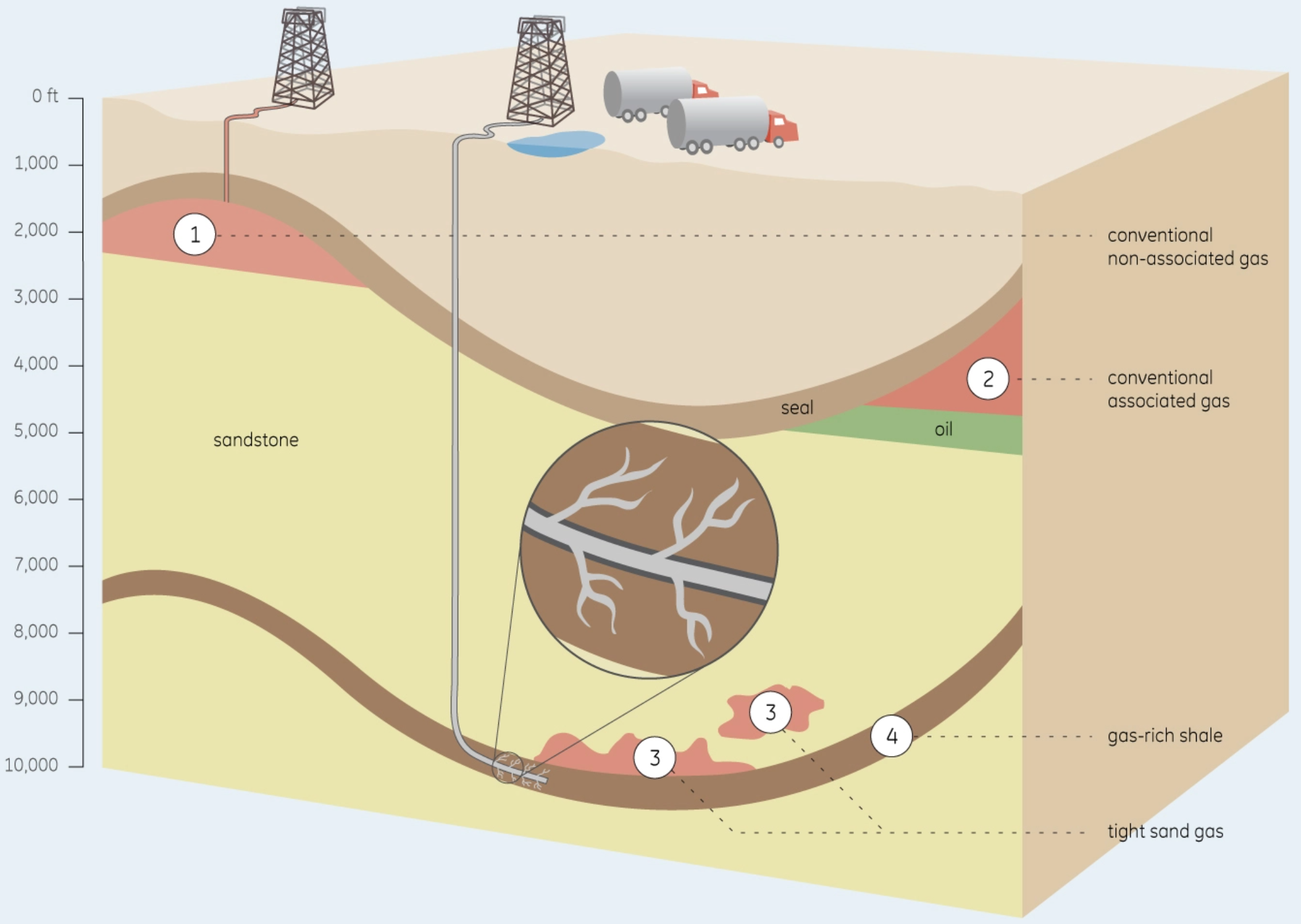

Shale gas is an unconventional natural gas extracted from fine-grained sedimentary shale rock formations, where it is trapped in microscopic pores and fractures deep underground, typically at depths exceeding 1,500 metres (5,000 feet).
Geological Origin
Shale gas originates from organic-rich mud deposited at the bottom of ancient seas and tidal flats hundreds of millions of years ago. Over time, burial, heat, and pressure transformed this mud into shale rock and converted the organic matter into natural gas through a process of kerogen thermal degradation and pyrolysis. Unlike conventional natural gas — which migrates into more permeable sandstone or limestone reservoirs — shale gas remains trapped within the source rock itself, making the shale simultaneously the source rock, reservoir, and cap rock.
Composition
Shale gas is chemically identical to conventional natural gas, consisting primarily of methane (CH₄) at 70–90%, with minor amounts of other hydrocarbon gases. It exists in the shale in two main states: adsorbed onto organic matter and clay particles, and as free gas within natural pores and fractures. Reservoir porosity is typically below 5%, and permeability is very low, which is why the rock requires artificial stimulation for commercial production.
Extraction Technology
Hydraulic fracking diagram
Because shale has very low matrix permeability, gas does not flow freely to a wellbore without intervention. Commercial extraction relies on two key technologies applied together:
-
Horizontal drilling — the wellbore is drilled vertically and then turned horizontally to run through the shale layer, maximizing contact with the gas-bearing formation
-
Hydraulic fracturing (fracking) — high-pressure fluid (water, sand, and chemicals) is injected to create and prop open fractures in the shale, allowing gas to flow to the well
Global Significance
Shale gas has transformed the global energy landscape since the early 2000s, particularly in the United States, where formations such as the Barnett, Marcellus, and Haynesville Shales have driven substantial growth in domestic gas supply. In 2022, shale gas accounted for a major share of the nearly 36.35 trillion cubic feet of natural gas produced in the U.S.. China holds the world's largest estimated shale gas reserves, and exploration interest has expanded to Poland, India, South Africa, and Argentina.
Environmental Considerations
Shale gas emits significantly less CO₂ than coal or oil when combusted, supporting its role as a transition fuel. However, its extraction raises environmental concerns including high water consumption, wastewater disposal, potential groundwater contamination from fracking fluids, methane leakage (a potent greenhouse gas), and local impacts on air quality and seismicity.