
Product
Titanium Dioxide
Abbreviation
TiO₂
Names
Titanium(IV) Oxide; Titania; Rutile; Anatase; Brookite
Insight Articles
#PS715
Main Product
Titanium Oxides
Segment
Chemicals
Main-Family
Inorganics
Sub-Family
Inorganic Oxides
Physical State

Solid

Description

Titanium dioxide (TiO₂) is an inorganic compound composed of one titanium atom bonded to two oxygen atoms. It appears as a white, odorless, crystalline solid that is insoluble in water and alcohol but soluble in concentrated acids.

Crystal Structure and Polymorphism

TiO₂ exists in three primary crystalline polymorphs: rutile (tetragonal, space group P4₂/mnm), anatase (tetragonal, space group I4₁/amd), and brookite (orthorhombic, space group Pbca). In all three forms, titanium exhibits octahedral geometry, with each Ti⁴⁺ ion bonded to six O²⁻ atoms forming TiO₆ octahedra, while each oxygen atom is bonded to three titanium centers. Rutile represents the thermodynamically stable form and begins formation above 600°C, whereas anatase forms at lower temperatures and features a lower surface Gibbs free energy. The anatase structure has significantly distorted TiO₆ octahedra interconnected via corner and edge-sharing to form zigzag chains, resulting in a relatively loose atomic stacking that provides greater absorption capability and more abundant active sites.

Optical and Electronic Properties

TiO₂ possesses exceptional optical characteristics, including an extraordinarily high refractive index of up to 2.7, which produces distinctive bright white effects and excellent opacity. The material exhibits a brightness level of 95.5, making it the whitest pigment used globally. As a wide band gap semiconductor, TiO₂ has a band gap of approximately 3.2 eV for anatase, which can be tuned through various processes. The compound demonstrates strong UV light absorption capabilities and photocatalytic activity under UV radiation. TiO₂ exhibits a high dielectric constant of 85 and dielectric strength of approximately 4 kV/mm, making it capable of storing electrical energy within magnetic fields.

Mechanical Properties

Titanium dioxide displays robust mechanical characteristics including a modulus of rupture of 140 MPa, compressive strength of 680 MPa, and fracture toughness of 3.2 MPa·m⁻¹/². The material has a Poisson's ratio of 0.27, indicating moderate susceptibility to deformation, and a shear modulus of approximately 60 GPa. These mechanical properties contribute to TiO₂'s durability and stability in various applications.

Chemical Characteristics

The Ti-O bond in titanium dioxide exhibits both ionic and covalent character, reflecting its transition metal-nonmetal composition. TiO₂ demonstrates chemical inertness and thermal stability under normal conditions, contributing to its widespread industrial applicability. As an oxidizing agent, titanium dioxide plays a role in Advanced Oxidation Processes for water purification. The compound's properties and performance depend significantly on its crystal phase, crystallinity, morphology, surface area, and particle size. For example, its density is 4.23 g/cm3 in case of rutile and 3.78 g/cm3 in case of anatase.

Production and Industrial Significance

TiO₂ is primarily manufactured through the chloride process, where titanium tetrachloride (TiCl₄) is treated with oxygen at elevated temperatures to produce titanium dioxide while recovering chlorine:

TiCl₄ + O₂ + heat → TiO₂ + 2 Cl₂


The selection between rutile and anatase forms depends on specific application requirements, with rutile preferred for industrial applications requiring high refractive index and stability, while anatase offers greater brightness for specialized uses. TiO₂ accounts for approximately two-thirds of all pigments used globally, finding applications in photocatalysis, renewable energy creation, environmental remediation, pharmaceuticals, coatings, plastics, and inks due to its photochemical stability, non-toxicity, and low cost.

Sources: byjus, Vichem, InterchemicWikipediaChemica Book, people.iiti, NIH PubMed Central, turito  


Insight Articles
Your insights will be shown here

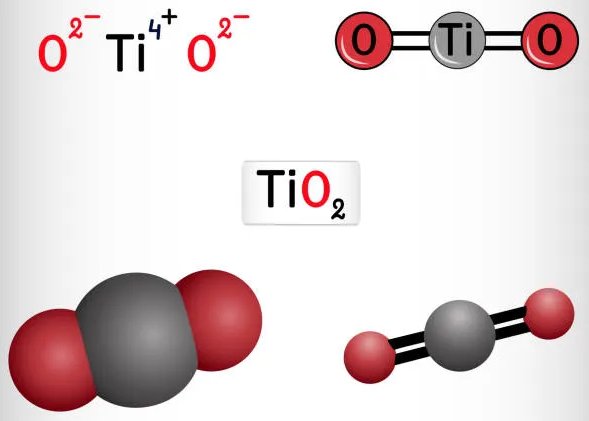
Titanium dioxide molecule https://www.istockphoto.com/photos/titanium-dioxide
Identifiers

logo CAS Number
13463-67-7
logo EC Number
236-675-5
logo ECHA InfoCard
100.033.327
logo IUPAC Name
Titanium dioxide
logo PubChem ID
26042
Chemical Data

Chemical Formula

TiO2

Molecular Weight (g/mol)
79.866
Boiling Point (°C)
2972
Melting Point (°C)
1843
Sulfur Content (wt%)
0
Specific Gravity
4.00
Crude Data

API Gravity
-96.13
Country
Product Settings

Default
Status
A
Content provided by
Transaction Name Date
Modified by UserPic   Kokel, Nicolas 1/6/2026 8:38 PM
Added by UserPic   Fournier-Paradis, Jacob 1/4/2026 7:16 PM