
Product
Mordenite Ore
Insight Articles
#PS800
mordenite aluminosilicate zeolite morframework catalysis gaspurification
Main Product
Aluminosilicate Ores
Segment
Extractive Industry Products
Main-Family
Ores
Sub-Family
Non-Metallic Ores
Physical State

Solid

Description

Mordenite ore is a naturally occurring zeolitized volcanic rock in which the dominant valuable mineral phase is the zeolite mordenite, a high‑silica framework aluminosilicate with one‑dimensional channel porosity and good thermal and acid stability. It is mined, crushed, and graded for use as an adsorbent and environmental medium, and also serves as a natural source material and reference analogue for synthetic mordenite catalysts.


Chemistry and mineralogy

  • Principal ore mineral: Mordenite (zeolite, MOR framework).

  • Typical mineral formula (mordenite): (Ca,Na2,K2)Al2Si10O24 ⋅ 7H2O (Na⁺/K⁺/Ca²⁺ exchangeable; high Si/Al ratio).

  • Associated minerals in ore: Other zeolites (clinoptilolite, heulandite), volcanic glass, feldspar, quartz, and clay minerals; proportions depend on deposit.


Geological occurrence and deposit type

  • Forms by low‑temperature hydrothermal alteration of volcanic glass and tuffs in basaltic to rhyolitic sequences; fills cavities, fractures, and replaces glassy matrix.

  • Ore is typically a zeolitized tuff or lava with high mordenite content, quarried in volcanic provinces (e.g. parts of New Zealand, Japan, western North America).


Main use segments

  • Environmental and water treatment:

    • Adsorbent for removal of heavy metals, ammonium, organic pollutants, and radionuclides from industrial and municipal wastewaters.

    • Media in filtration systems and permeable reactive barriers for contaminated groundwater and industrial effluents.

  • Gas purification and drying:

    • Natural molecular‑sieve/adsorbent for drying and cleaning industrial gases and vapours (often in lower‑spec, non‑critical roles compared with engineered synthetic mordenite).

  • Bulk adsorbent / spill and odour control:

    • Granular products for absorbent pads, spill cleanup, animal‑waste and odour‑control media, and industrial absorbents, leveraging high internal surface area and cation‑exchange capacity.

  • Feedstock / analogue for catalysts (indirect ore role):

    • Natural mordenite provides structural and compositional reference for synthetic mordenite used as an acid catalyst in petrochemical processes (dewaxing, isomerisation, hydrocracking).


Typical properties (ore/product level)

  • Mordenite content: Often targeted at high mordenite proportions in commercial products (exact percentages deposit‑specific; other zeolites and silicate phases are common).

  • Framework type: MOR; 12‑membered‑ring channels with smaller side pores, giving relatively large pore openings for heavy‑molecule adsorption compared with many small‑pore zeolites.

  • Bulk physical traits:

    • Specific gravity of mordenite mineral about 2.1–2.2; ore bulk density lower depending on porosity and grading.

    • Mohs hardness ~3–5; friable tuff in many deposits, suitable for crushing and sizing.

  • Functional traits:

    • High surface area and microporosity; good resistance to acidic environments and elevated temperatures relative to many other natural zeolites due to high Si/Al ratio.


Insight Articles
Your insights will be shown here

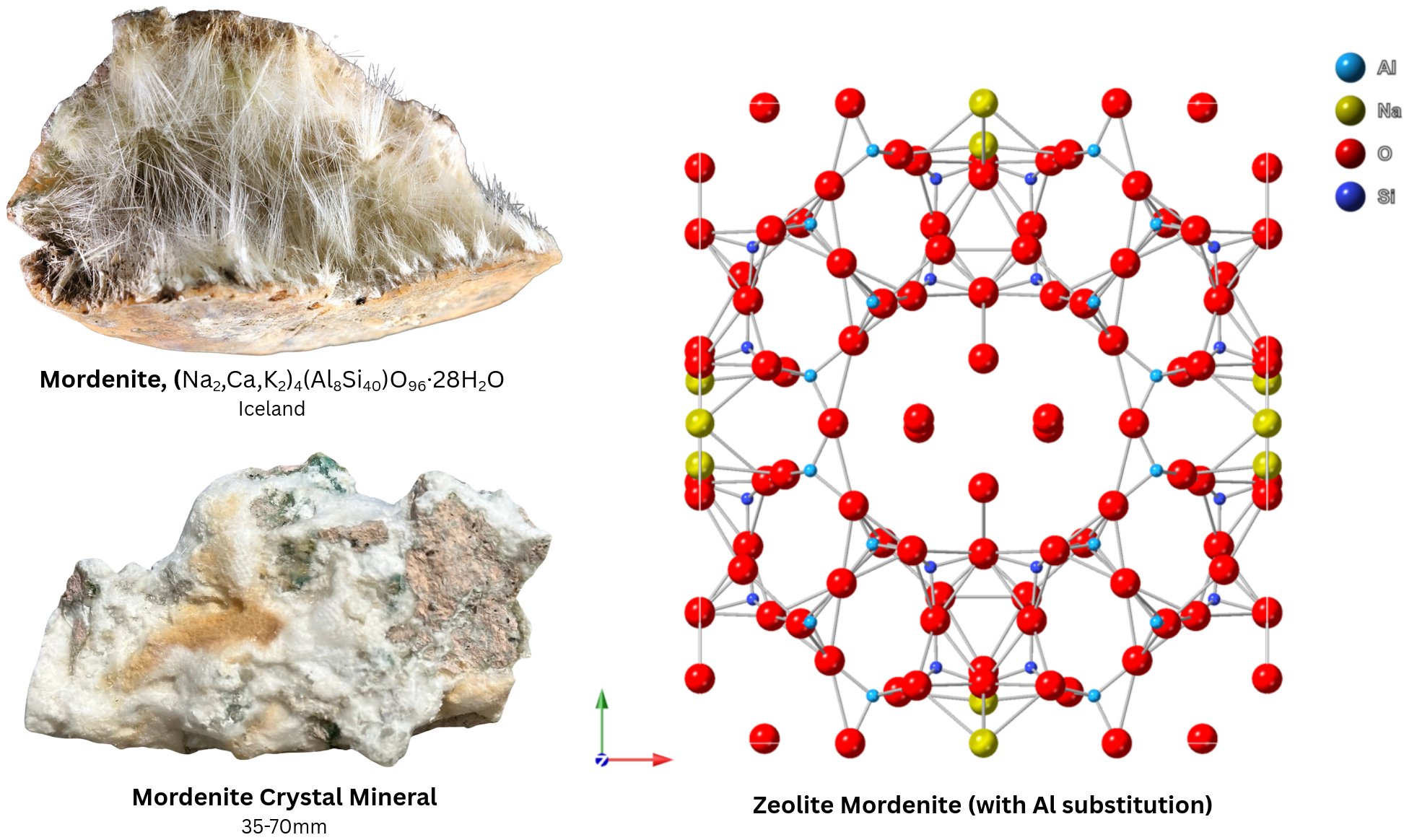
From left to right: Mordenite minerals and crystal structure | Sources: various images sources, crystal structure generated using CrystalMaker®, CrystalMaker Software Ltd, Oxford, England www.crystalmaker.com
Identifiers

No Identifiers defined

Chemical Data

Specific Gravity
1.00
Crude Data

API Gravity
10
Country
Product Settings

Default
Status
A
Content provided by
Transaction Name Date
Modified by UserPic   Kokel, Nicolas 4/19/2026 3:22 PM
Added by UserPic   Kokel, Nicolas 4/19/2026 12:51 PM