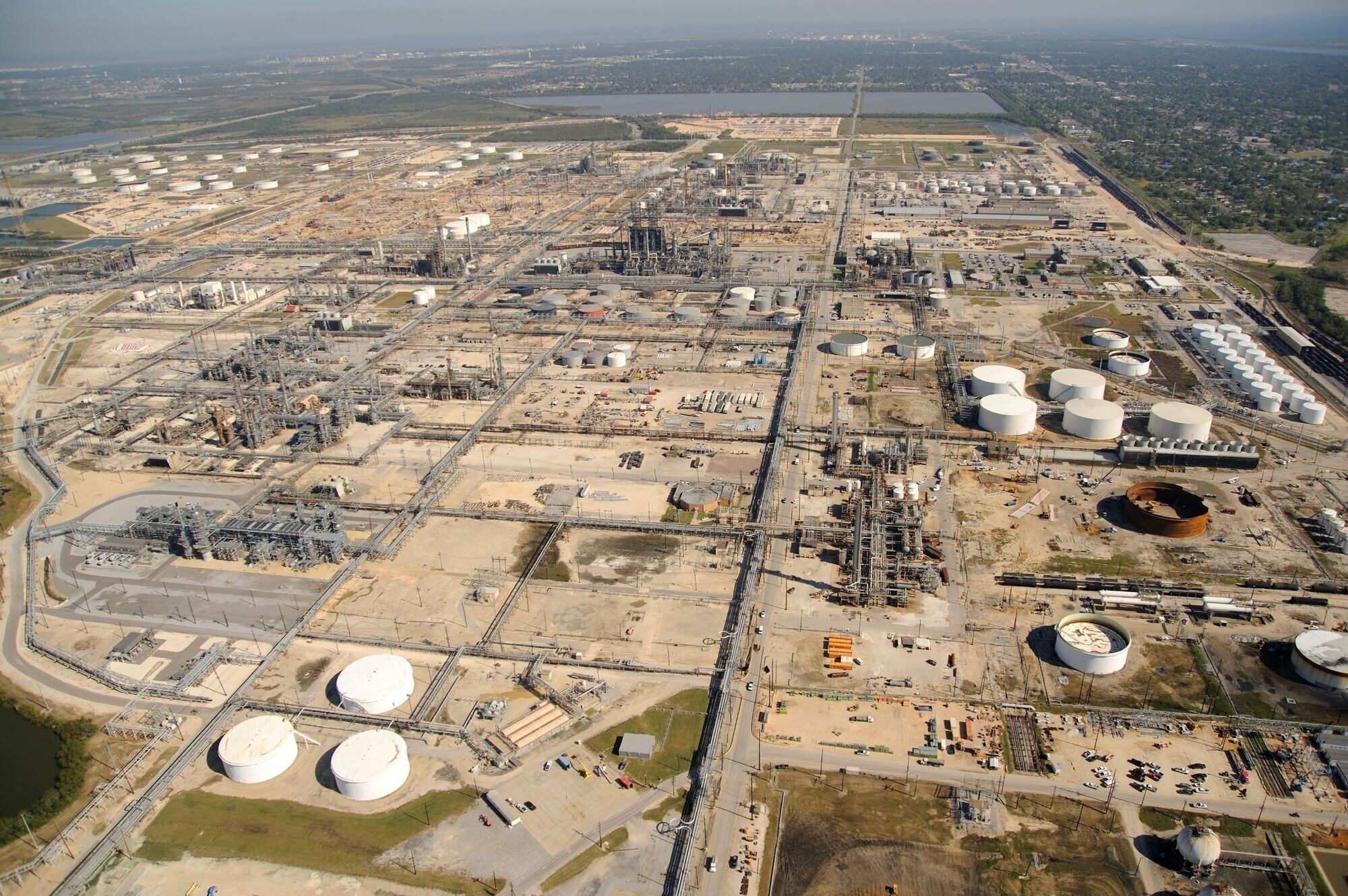
Aerial view of the Port Arthur Refinery | Source: The Center for Land Use Interpretation (date unknown)
The Motiva Port Arthur Refinery, located in Port Arthur, Texas (U.S. Gulf Coast), is the largest refinery in the United States with a crude oil nameplate processing capacity of 656,400 bpd. It is operated by Motiva Enterprises LLC, a wholly owned subsidiary of Saudi Aramco (since 2017, following the split of the former Shell–Saudi Aramco joint venture).
History
The refinery was originally built to process crude oil from the Spindletop discovery, which ignited an oil boom centered in nearby Beaumont, Texas. The refinery began in 1903 on just 25 acres of land and produced 850 barrels per day. Today, the Port Arthur Refinery has grown to encompass 1,400 acres and is North America's largest, with a total throughput of 730,000 barrels per day. As of 2024, the refinery typically produced 275,000 barrels of branded fuel every day, and 40,000 barrels of base oil per day.
Ownership
Ownership Structure:
- 1903–1998: Texaco
- 1998–2002: Star Enterprise (Texaco–Saudi Aramco JV)
- 2002–2017: Motiva Enterprises (Shell–Saudi Aramco JV)
- 2017–present: Motiva Enterprises (Saudi Aramco, 100%)
Ownership snapshot:
- Operator/Owner: Motiva Enterprises LLC (100% Saudi Aramco)
- Site workforce: ~1,400+ employees plus contractors
- Original site history: Traces back to Texaco’s 1903 Port Arthur refinery (Spindletop era), later part of the Star Enterprise and Motiva joint ventures
Crude Distillation Capacity
The refinery’s current scale stems largely from the major expansion completed in 2012 (~$10 B project), which added 325,000 bpd of crude capacity and made it the largest refinery in North America with a total crude distillation capacity of 656,400 bpd according to people familiar with plant operations (Sep 2026). Reported ADU capacity figures are:
| Unit |
Capacity |
Notes |
| VPS-5 |
350,000 bpd |
Newest unit, centerpiece of the ~$10 B,
5-year expansion completed 2012 |
| VPS-4 |
200,000 bpd |
Overhauled in March 2014 (per the 2013 article),
shut at least one month alongside the FCC |
| VPS-2 |
90,000 bpd |
Smallest C |
Conversion & Secondary Processing Units
Port Arthur is deep conversion refinery optimized for heavier/sour slates (well-suited to Middle East crude grades, consistent with Saudi Aramco ownership). Its configuration includes hydrocracking, FCC, delayed coking units, reformers, alkylation, hydrotreating, sulfur recovery, lubes/aromatics units. Some of the latest plants and capacities reported by multiple sources are:
| Unit |
Capacity |
Function |
Hydrocracker-2
(HCU-2) |
105,000 bpd |
Included in the 2012 expansion,
originally at 85,000 bpd capacity |
Fluid Catalytic Cracker 3
(FCC-3) |
81,000 bpd |
Gasoline production
from heavier feeds |
Delayed Coker-1
(DCU-1) |
57,000 bpd |
Convert residuum into lighter
products and petroleum coke |
Delayed Coker-2
(DCU-2) |
110,000 bpd |
| Hydrotreaters |
— |
Across gasoline, diesel, and other
streams for clean fuels compliance |
| Catalytic Reformer-4 |
49,000 bpd |
Octane upgrading of naphtha
for premium gasoline |
| Alkylation unit |
18,000 bpd |
High-octane gasoline
blending component |
| Sulfur Recovery |
— |
H2S processing |
| MPU-3 (lubes) |
— |
Lubricating base
oil production |
| Aromatics Complex |
— |
Notable, as most U.S. refineries
are fuels-only |
*With a base oil capacity of 40,000 barrels per day Port Arthur Refinery is the second-largest base oil producer in the world, supplying aramcoPRIMA and aramcoULTRA base oils both domestically and to more than 15 countries.