
Name
Mitsui Hypol
Owner
/ Mitsui Chemicals
Brand
Hypol

Description

The Hypol polypropylene process was developed by Mitsui Chemicals (Japan) in collaboration with Montedison (Italy, now part of LyondellBasell) between 1975 and 1996, during which period high-activity, high-stereospecificity Ziegler-Natta catalysts were jointly developed. This collaboration yielded the foundational 3rd-generation MgCl₂-supported catalyst system, and Mitsui further contributed reactor granule technology (RGT)-based 4th- and 5th-generation catalysts, enabling high yields (up to 130 kg PP/g cat), high isotacticity (II > 95%), and eliminating the need for catalyst residue or atactic polymer removal.


Hypol (first generation)

The first-generation Hypol process licensed by Mitsui in the 1980s employs two continuously stirred autoclave reactors (CSTRs) in series, operated in liquid-pool (bulk) mode at 65–75 °C and 30–35 bar with a residence time of approximately two hours. Impact copolymers are produced in a downstream stage comprising two fluidized-bed gas-phase reactors. The stirred autoclave design is considered a legacy configuration; its lower space-time yield and heat-transfer limitations relative to loop-reactor alternatives have rendered it uncompetitive in modern grassroots installations.


Hypol II (second generation)

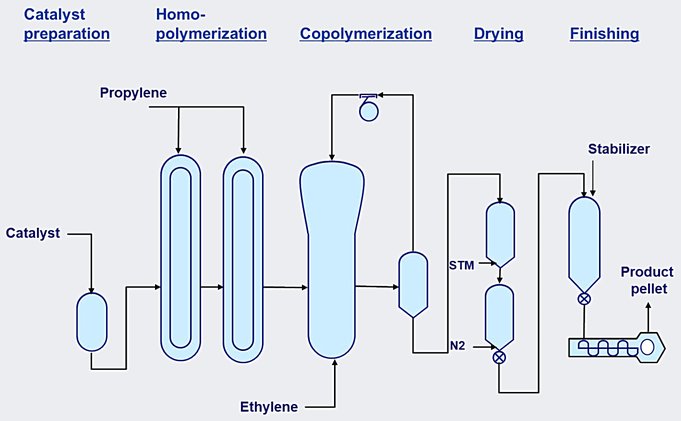
The Hypol II process replaces the stirred autoclaves with a series of two auto-refrigerated adiabatic loop reactors for the first-stage bulk polymerization, bringing its reactor configuration in line with the competing Spheripol process (LyondellBasell). Homopolymers and random copolymers are produced in the loop reactors; impact copolymers are then made in a second-stage fluidized-bed gas-phase reactor. 

Mitsui claims that its gas-phase reactor design differs from that of Spheripol through a longer residence time, which is stated to allow a higher rubber content in impact copolymers, as well as more stable operation with reduced fouling and less frequent shutdowns, resulting in longer continuous run times before cleaning is required.


Reactor Configuration

The most fundamental difference lies in the reactor design:

Feature Hypol I Hypol II
Bulk reactor
type
2 stirred autoclaves
(CSTRs) in series
2 loop reactors
(LRs) in series
Gas phase
stage
2 fluidized bed gas
phase reactors
(for impact copolymers)
1 gas phase reactor
Prepolymerization Batch system,
low degree
Miniature loop reactor
(continuous)
Operating
conditions
65–75 °C, 30–35 bar,
~2 hrs
65–75 °C, 30–35 bar,
~2 hrs


Catalyst & Prepolymerization

A key innovation in Hypol II is its use of a miniature loop reactor for continuous catalyst prepolymerization, replacing the batch prepolymerization system of the first generation. This improves catalyst particle morphology, leading to more stable and consistent polymerization. Hypol II is associated with newer, higher-generation Ziegler-Natta catalysts, enabling higher activity and better isotacticity control.


Performance & Product Range

Loop reactors in Hypol II offer significant operational advantages over the stirred autoclaves of Hypol I:

  • Higher space-time yield — loop reactors can handle higher solids concentrations (~55% solids) and higher throughput

  • Better heat removal — loop reactor geometry provides superior heat transfer

  • Stable long-term operation — reduced fouling and fewer shutdowns compared to autoclave-based designs

  • Broader product portfolio — Hypol II can produce homopolymers, random copolymers, and impact copolymers; Hypol I's multi-autoclave + gas phase design also allows impact copolymers but with a different MWD profile


Licensing Status

Hypol I is essentially a legacy process — its stirred autoclave-based design is no longer competitive with modern loop-based technologies.

Hypol II remains an actively licensed technology by Mitsui Chemicals, with plants operating at capacities up to 400,000 MT/yr. In terms of market positioning, Hypol II competes directly with Spheripol (LyondellBasell) and Sinopec ST-PP (ST-II and above), all of which use bulk loop + gas phase configurations.


References

  1.  Mitsui Chemicals Inc. License Division, 12th Sep 2018, Hypol-Ⅱ for Licensed PP Technology.
  2. TOWNSEND Solutions, 22 May 2016, Polypropylene:  Technology Review
  3. Wang, X. et al. (2019). Versatile Propylene-Based Polyolefins with Tunable Molecular Structure through Tailor-Made Catalysts and Polymerization Process. IntechOpen.

Insight Articles
Your insights will be shown here

Hypol-II Conceptual Flow Scheme https://www.scribd.com/document/500273880/HYPOL-II-pp-process
Entity Site (Country) Asset (Plant)
LSP LSP Long Son Complex PP Plant
Mitsui Chemicals Osaka Works PP Plant
NGHI NGHI Refinery PP Plant
Sinopec Henan Henan Ref & Chem PP1
TPP TPP Map Ta Phut PP Plant 1
TPP TPP Map Ta Phut PP Plant 2
TPP TPP Map Ta Phut PP Plant 3
Content provided by
Transaction Name Date
Modified by UserPic   Kokel, Nicolas 5/29/2026 8:21 AM
Added by UserPic   Kokel, Nicolas 1/11/2021 12:00 AM