
Product
Purified Terephthalic Acid
Abbreviation
PTA
Names
Terephthalic Acid; Benzene-1,4-dicarboxylic Acid
Insight Articles
#PS153
pta terephthalicacic polyester terephthalate pet
Main Product
Benzenedicarboxylic Acid
Segment
Chemicals
Main-Family
Functional Organic Products
Sub-Family
Carboxylic Acids
Physical State

Solid

Description

Purified Terephthalic Acid (PTA) is the commercial-grade, high-purity form of terephthalic acid (1,4-benzenedicarboxylic acid), produced by further refining crude terephthalic acid to remove impurities that interfere with polymerisaion into polyester.


Identity and Structure

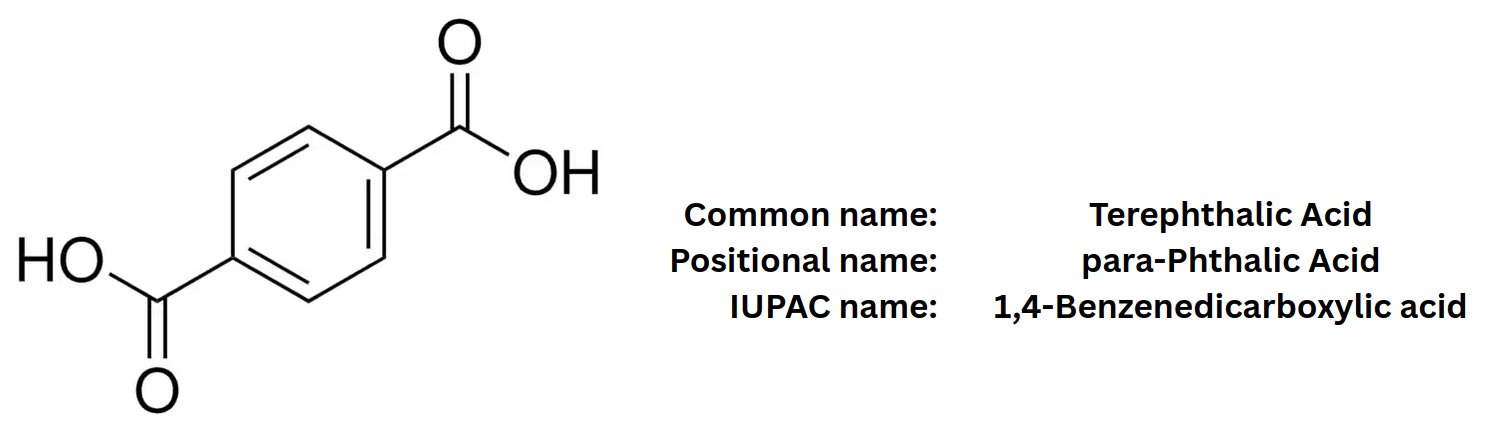
PTA has the molecular formula C₈H₆O₄ (or equivalently C₆H₄(CO₂H)₂), consisting of a benzene ring with two carboxylic acid groups in the 1,4 (para) position, and a molecular weight of 166.13 g/mol.


Physical Properties

PTA appears as a white, free-flowing crystalline powder or fine granular solid, essentially odorless and non-toxic. It has a very high melting point, sublimes/decomposes around 402–427°C rather than melting cleanly at atmospheric pressure, and has a density of roughly 1.5 g/cm³. It is only slightly soluble in water (~0.0012 g per 100 g water at 25°C) and in hot ethanol, and it is essentially insoluble in common organic solvents such as ether, chloroform, and glacial acetic acid, though it dissolves in alkaline solutions. Its vapor pressure is negligible under standard conditions.


Chemical Behavior

Being a dicarboxylic acid, PTA reacts with alcohols in an esterification reaction — most importantly with ethylene glycol to form polyethylene terephthalate (PET), the fundamental reaction underlying the entire polyester industry. It also neutralizes with bases to form terephthalate salts and is chemically stable under normal conditions, though it can react under high heat, high humidity, or with strong oxidizers.


Production and Quality Control

PTA is manufactured by oxidizing para-xylene with air over a cobalt/manganese/bromide catalyst, followed by purification steps (typically hydrogenation) to reduce key impurities — namely 4-carboxybenzaldehyde (4-CBA) and p-toluic acid — to trace levels (often below 25 ppm and 150–190 ppm respectively), since these impurities disrupt polymer chain formation during PET production. Commercial specifications also tightly control ash content, heavy metal traces (Co, Mn, Fe, Ni, Cr, Ti), moisture (typically ≤0.2 wt%), particle size (~80–115 microns), and color parameters to ensure consistent polymerization performance.


Applications

More than 90% of global PTA production is consumed in making PET for fibers, films, bottle resins, and packaging, with the remainder used in producing PTT and PBT polyesters, as well as unsaturated polyester and powder coating resins where PTA's aromatic ring imparts hardness, chemical resistance, and weathering durability.


Insight Articles
Your insights will be shown here

Terephthalic acid molecular structure and names
Identifiers

logo CAS Number
100-21-0
logo EC Number
202-830-0
logo ECHA InfoCard
100.002.573
logo IUPAC Name
Benzene-1,4-dicarboxylic acid
logo PubChem ID
7489
Chemical Data

Chemical Formula

C8H6O4

Molecular Weight (g/mol)
166.132
Melting Point (°C)
427
Sulfur Content (wt%)
0
Specific Gravity
1.51
Crude Data

API Gravity
10
Country
Product Settings

Default
Status
A
Content provided by
Transaction Name Date
Modified by UserPic   Kokel, Nicolas 7/25/2026 1:13 PM
Added by UserPic   Kokel, Nicolas 9/26/2021 7:13 AM