Trinidad and Tobago moves to bring Pointe-à-Pierre refinery back to life after eight idle Years


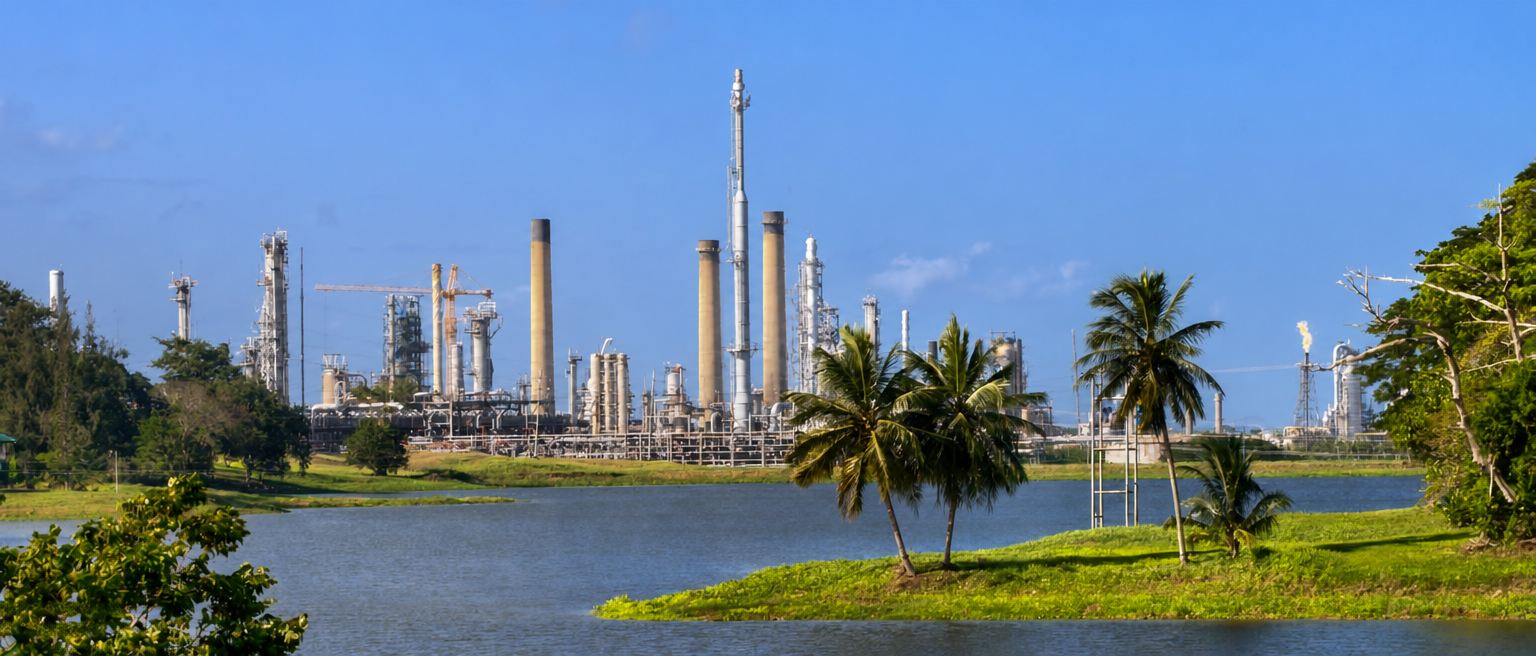
Point-à-Pierre Refinery, "Facilities in Harmony with the Landscape" — Brochure: 'Petrotrin, Investing for increased production' (July 2014)
Market Insights | ppPLUS Intelligence Series • Refining & Petrochemicals | November 2026
The push formalises the phased restart committed to in Finance Minister Davendranath Tancoo's 2026/2027 Budget presentation, in which he told Parliament: "We will restart the refinery. We are advancing the phased restart of the Guaracara Refinery at Pointe-à-Pierre. Following receipt of the Comprehensive Report of the Refinery Restart Committee, government is evaluating proposals from a shortlist of serious local and international investors."
The restart claim — and the procurement sequencing
Guaracara Refining Company — the Trinidad Petroleum Holdings Limited (TPHL) subsidiary that has held and maintained the Pointe-à-Pierre assets since the Petrotrin restructuring of December 2018 — has indicated, together with its technical personnel, that refining operations could resume within three to six months once the required investment is secured.
The timeline for selecting that investor is now the critical path. Minister in the Ministry of Finance Dr Kennedy Swaratsingh told TTT News in October that the Ministry of Energy is "putting together a process by which they'll go out and create a procurement system to be able to sift out and get the right partner for Petrotrin. But that is going to happen in this fiscal." He confirmed that exploratory conversations — involving "the Chairman of Petrotrin and others" — have already taken place, and that the coming procurement process will formalise them. The apparent sequence — informal soundings first, RFP second — means the year-end RFP will largely codify a field of candidates already under evaluation, rather than open a blank competition.
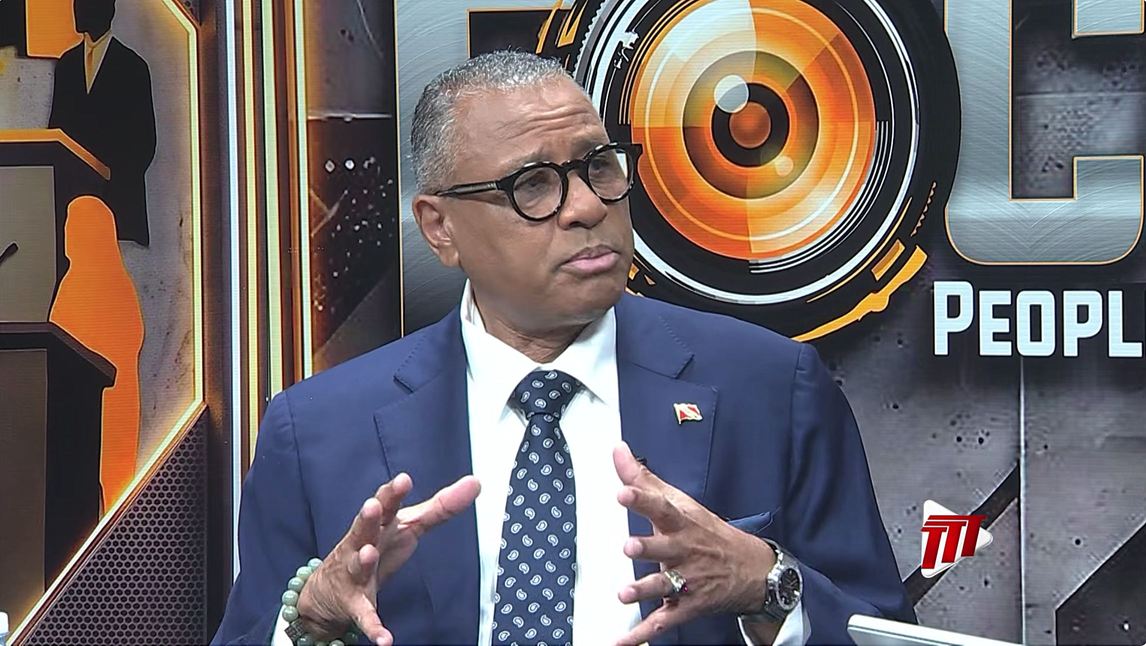
Minister in the Ministry of Finance Dr Kennedy Swaratsingh on TTT Live Online (Oct 14, 2026)
The asset
| Parameter | Value |
|---|---|
| Asset | Pointe-à-Pierre Refinery, Gulf of Paria coast, south of Port of Spain |
| Asset holder | Guaracara Refining Company Limited (subsidiary of Trinidad Petroleum Holdings Limited, 100% State) |
| Status | Idle since 30 November 2018; operated 1917–2018 (101 years) |
| Nameplate capacity | 160,000 bpd (post-1998 upgrade); up to 168,000 bpd in full-conversion service |
| Historical peak | 360,000 bpd (1970) — then among the world's largest refineries |
| Configuration | Full conversion: crude distillation train; FCCU (riser-revamped); mild hydrocracker (converted from gas-oil desulphurisation duty); two catalytic reformers; MTBE unit; ULSD unit; sulphur recovery with pelletising; bitumen production |
| Feedstock at closure | ~60,000 bpd domestic crude, balance imported Atlantic Basin barrels |
| Product slate | LPG, gasoline, jet fuel, diesel/ULSD, fuel oil, sulphur, bitumen |
The macroeconomic case — why now
The fiscal arithmetic behind the restart push is stark. Tancoo's budget speech acknowledged that since the 2018 closure, the country "moved from being a net exporter of refined products to having to import every single litre of diesel, of gasoline, of pitch oil and of engine oil used in this country." With over 70% of foreign exchange earnings coming from energy commodity exports, a fuel-import bill stacked on top of Petrotrin's legacy debt is a double drain. Swaratsingh was blunt: "We're carrying a lot of debt as well for that, and it would have also dampened our FX earnings as well." Petrotrin accumulated losses of roughly TT$8 billion in the five years before its 2018 collapse, having peaked at a TT$6.5 billion contribution to the treasury in 2008 — the asset still on the books, the earnings stream gone.
The refinery is also the most visible symbol of a broader energy-sector contraction the Government is now fighting to reverse. Tancoo told Parliament that gas supply "stands at a meagre 2.4 bcf," describing "a staggering 45 per cent collapse in our natural gas output, causing the permanent closure of Atlantic LNG Train 1 and several other petrochemical plants," with the Point Lisas industrial estate now "almost a ghost town." Against that backdrop, the budget paired the refinery restart with an upstream revival: a potential US$21 billion in oil exploration and production investment with ExxonMobil, and Heritage Petroleum's ongoing drilling and workover programme across producing fields including East Soldado and South West Soldado.
The political economy is equally pressing. The 2018 restructuring destroyed thousands of jobs concentrated in South and Central Trinidad. Tancoo framed the restart as "reinstating the very lifeline to communities, downstream contractors, micro-enterprises, doubles vendors, roti shops, etc." Economist Dr Vaalmikki Arjoon called the 2018 closure "very counter-intuitive, and if I may, a very foolhardy thing for our country," pointing to the growing imported-fuel bill. Political scientist Professor Hamid Ghany noted the refinery "remains a major political issue" because of the closure's effect on constituencies across the region. Moonilal, for his part, insisted that "no one should be allowed to block the reopening of the refinery," while stressing the process must follow laws and regulations.
The geopolitical repositioning
Three regional dynamics differentiate this restart attempt from the economics that killed the refinery in 2018:
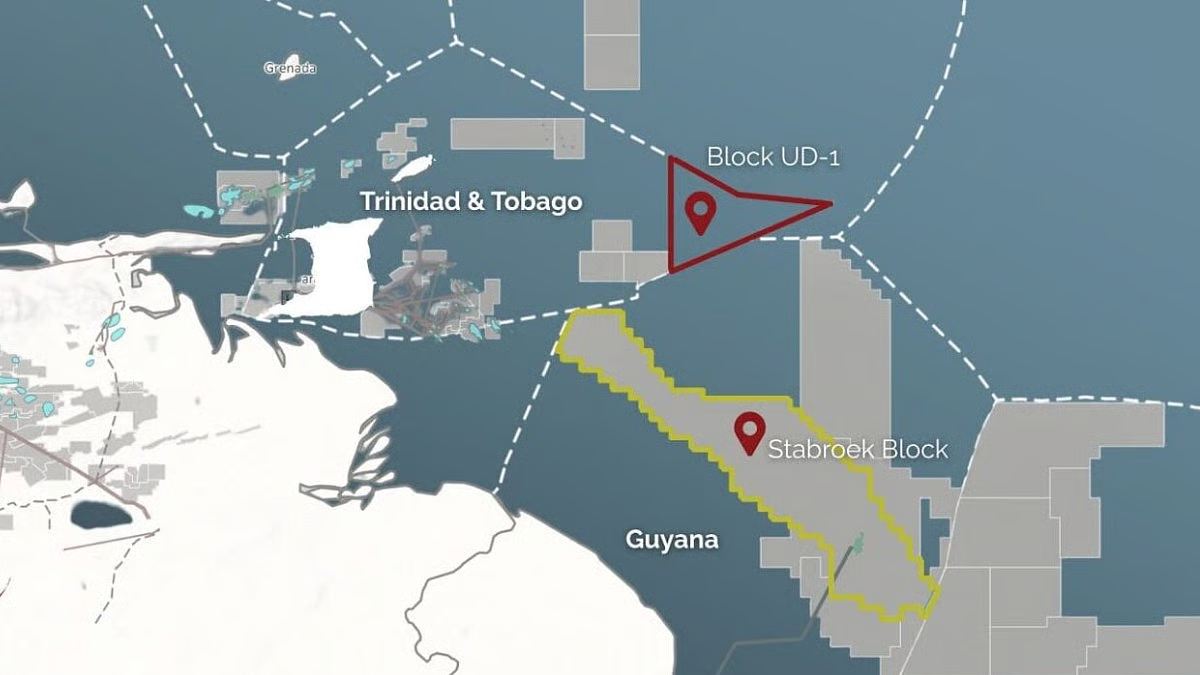
Map of offshore blocks in Trinidad and Tobago and Guyana (Jan 15, 2026) — Energy Chamber of Trinidad and Tobago (via Reuters)
- Guyana as feedstock anchor. Moonilal cited "the country's strategic location and potential access to crude oil from neighbouring Guyana and the wider region" as decisive advantages. This is the substantive change. At its final-era average run rate of ~113,000 bpd, the refinery needed imported volumes far exceeding domestic production — Petrotrin's company-wide crude output stood at only ~48,000 bpd near closure. In 2018, that import gap had to be filled from distant Atlantic Basin markets. A proximate, rapidly growing Guyanese crude supply would restructure the refinery's feedstock economics and deepen CARICOM energy integration, with the cross-border sales and term-contract structure of any Guyana allocation becoming a decisive commercial variable in the RFP.
- CARICOM product-supply restoration. The Government's stated ambition is to "restore Trinidad and Tobago's position in the international refining market by supplying gasoline, diesel and aviation fuel to Caribbean markets and other destinations." A restart would put Trinidad back into the regional product-supply role it vacated in 2018, when CARICOM demand shifted to Gulf Coast and European suppliers, and would restructure the domestic value chain currently served by TPHL's import arm, Paria Fuel Trading Company — whose role in a post-restart configuration is a structural question the RFP documents will have to address.
- The Venezuelan parallel track and Washington politics. Moonilal took the opportunity to state that he does not anticipate the Democratic gains in this month's U.S. midterm elections to affect Trinidad and Tobago's energy arrangements with Venezuela, including U.S. licences for the development of the Dragon and Loran-Manatee gas fields. The explicit linkage is telling: Port of Spain is now pursuing refinery revival and Venezuelan cross-border gas development as components of a single hydrocarbons-recovery strategy, both contingent on the stability of U.S. sanctions and licensing policy — an acknowledged exposure Moonilal felt compelled to address publicly within days of the midterms.
Reality check
The three-to-six-month restart claim deserves scrutiny. Even with Guaracara's continuous asset maintenance since 2018, industry experience with re-commissioning a full-conversion refinery idle for eight years points to catalyst inventory replacement, mechanical-integrity revalidation of fired heaters, rotating equipment and pressure systems, storage and marine-logistics reactivation, and recertification before product-on-spec production — timelines typically well beyond six months from financial close. No investment size, target run rate, capacity utilisation plan or job numbers have been disclosed; Moonilal gave no investor names, and the "phased restart" language in the budget suggests a partial or staged reactivation rather than a return to full nameplate.
The commercial bar is also explicit. Tancoo committed that the Government "will approach the restart of this national asset with fiscal discipline," seeking "a credible, commercially viable and fully financed arrangement that protects the national interest" — a clear signal that Port of Spain expects private capital to carry the risk, and that the bitter 2018 lesson (a State-owned refinery that accumulated TT$8 billion in losses against collapsing margins) will shape the deal structure. Whether any investor can underwrite a case built on Guyanese crude availability, CARICOM product netbacks and the refinery's 1998-era configuration — against a 2026-era distillate-demand landscape — is the question the RFP responses will answer.
What to watch
- Cabinet decision and the character of the approval (framework vs. named investor)
- RFP issuance before end-2026: structure — sale, lease, JV or management contract — and whether Paria Fuel Trading's role is folded in
- Identity and financing of the shortlisted investors, and relationship to the pre-RFP "exploratory conversations"
- Feedstock strategy: any Guyana crude term arrangements vs. Atlantic Basin spot sourcing
- Restart scope: which units (FCCU, mild hydrocracker, ULSD) are included in a first phase vs. deferred
- U.S. licence continuity for Dragon and Loran-Manatee as the parallel gas agenda proceeds
Sources
- Tancoo, D. — 2026/2027 National Budget presentation, House of Representatives, Parliament of the Republic of Trinidad and Tobago. Delivered on the Monday preceding the 10–13 Nov reporting cycle
- TTT News (Lalla, S.) — Pointe-a-Pierre Refinery Restart Process To Advance This Fiscal Year (Oct 13, 2026)
- TTT News — Energy Minister Says Government Taking Final Steps Towards Refinery Restart (Nov 4, 2026) —
- Trinidad Guardian — Moonilal remarks on Cabinet consideration and RFP timing (c. Nov 8, 2026)
- Petrotrin — "A Valued Partner" corporate brochure (Jan 15, 2013)
- Oil & Gas Journal — State-Oil-Company sector survey (Mar 25, 2002)
- Trinidad Petroleum Holdings Limited — corporate structure disclosures (Registrar General's Department / GLEIF)
#trinidad #tobago #pointaport #petrotrin #GuaracaraRefining #tphl #guyana #refining #refinery
|
Uwe Braun
11/13/2026 5:55 PM
Interesting project with everything that is going on in the region and globally:
Good luck to them restrating a refinery which is 8 years idle. |