Sasol's Slurry Phase Reactor

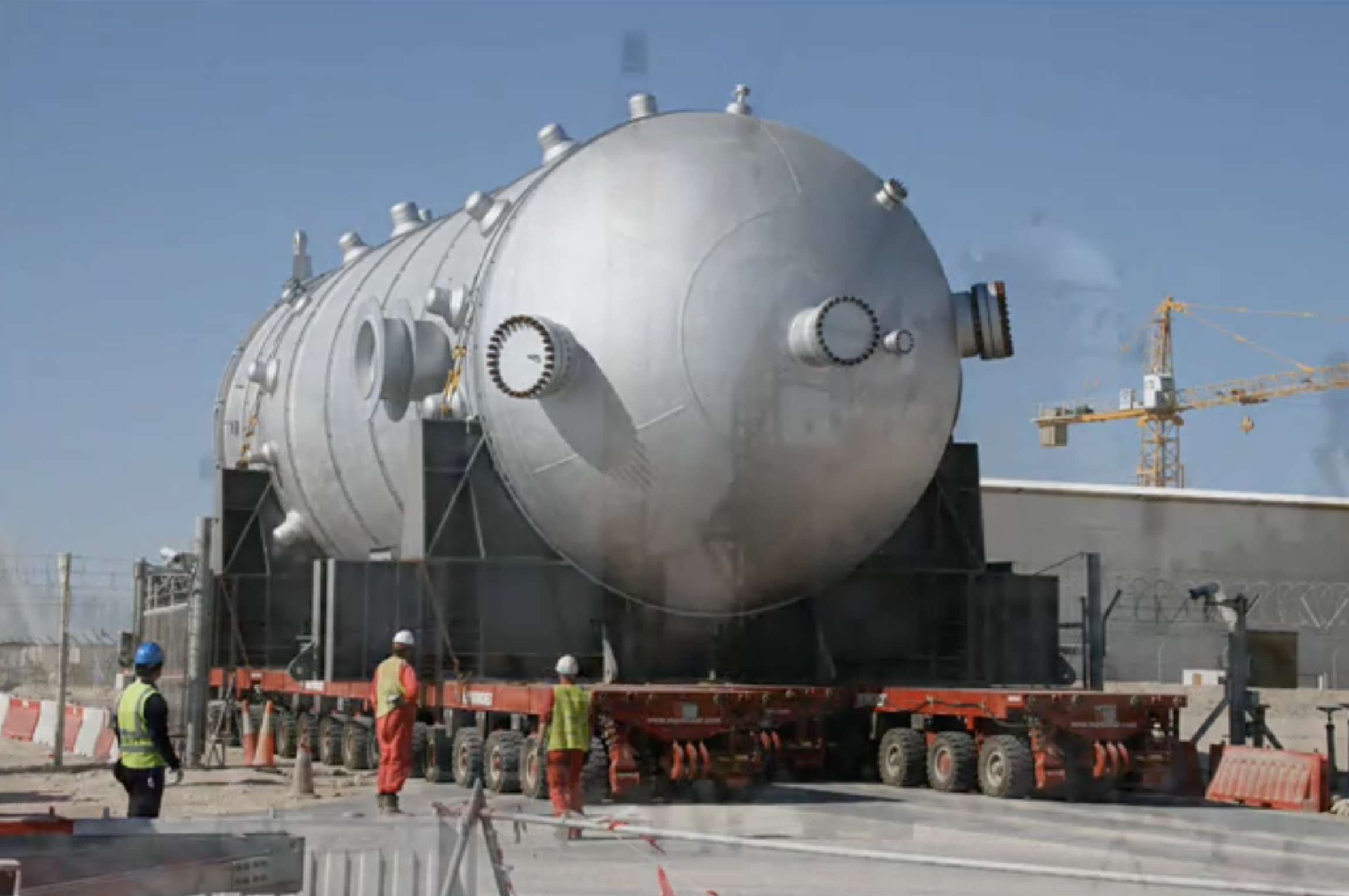
Article image credentials : https://www.youtube.com/watch?v=abHSa7BWJ3g
General information
In the early 1980s, Sasol began developing a three phases slurry reactor (SPR) for low-temperature Fischer–Tropsch (LTFT) synthesis, intended to convert coal-derived carbon monoxide into long-chain hydrocarbons in the diesel boiling range. The reactor, comprising gas, liquid wax, and suspended solid catalyst, uses a proprietary cobalt formulation. Previous fixed-bed and entrained fluidized-bed designs were hindered by wax buildup and loss of fluidization under the low-temperature, high-molecular-weight product conditions, which are characteristic of heavy Fischer–Tropsch synthesis [1].
Operation of the reactor
The SPR offers near-isothermal operation, which promotes steady and predictable product distributions while mitigating safety risks. Removal of heat generated by the reaction (up to 60 000 kJ/kgmol) is the main challenge during the design of FT reactors. Internal cooling tubes of circulating water are used to realize the task, with steam generated through absorption of heat. It also features very low pressure drop and can achieve carbon monoxide conversions of about 80%, compared with the 30–40% typically reported for fixed-bed LTFT reactors, while requiring lower catalyst inventory. Catalyst regeneration is performed continuously, improving uptime relative to fixed-bed systems. The task has its operationnal difficulties as the catalyst is located in the liquid phase and must be separated, dried and de-waxed before regeneration. Gas–solid suspension like reaction product gases of the FCCU are more easily separable through cyclones and do not face that problem [2].
Scaling-up and comissionning
Scaling up the reactor presented significant challenges as no adequate correlations had been the subject of research at the time for three phases synthesis with FT conditions. Advancing from a 5-cm laboratory tube to a 1-m demonstration reactor required nearly a decade. Gas holdup (volumetric fraction of gas in slurry) emerged as a critical operating parameter, influencing both the axial pressure profile and the allowable catalyst loading. Sasol commissioned its first commercial-scale SPR in 1993; the reactor measured roughly 5 m in diameter and 22 m in height [3].
Bibliography
[1] Espinoza, R. L., Steynberg, A. P., Jager, B., & Vosloo, A. C. (1999). Low temperature Fischer–Tropsch synthesis from a Sasol perspective. Applied Catalysis A: General, 186, 13–26. https://doi.org/10.1016/S0926-860X(99)00161-1
[2] Fox, J. M., Ogen, B. D., Chang, E., DeSate, F. F., & Summers, R. L. (1990). The slurry phase Fischer–Tropsch reactor: A comparison of slurry versus fixed-bed reactor designs for Fischer–Tropsch distillate production. Presented at the U.S. Department of Energy, Pittsburgh Energy Technology Center, Indirect Liquefaction Contractor’s Review Meeting. Bechtel Group, Inc.
[3] Huang, J.-H. R., Agee, K. L., Arcuri, K. B., & Schubert, P. F. (2004). Process for regenerating a slurry Fischer–Tropsch catalyst. (U.S. Patent No. US 6812179 B2). U.S. Patent and Trademark Office. https://patents.google.com/patent/US6812179B2/en