Regenerative Adsorption encompasses TSA, PSA and VPSA
- Technology Type
- Regenerative Adsorption (TSA, PSA, VPSA)

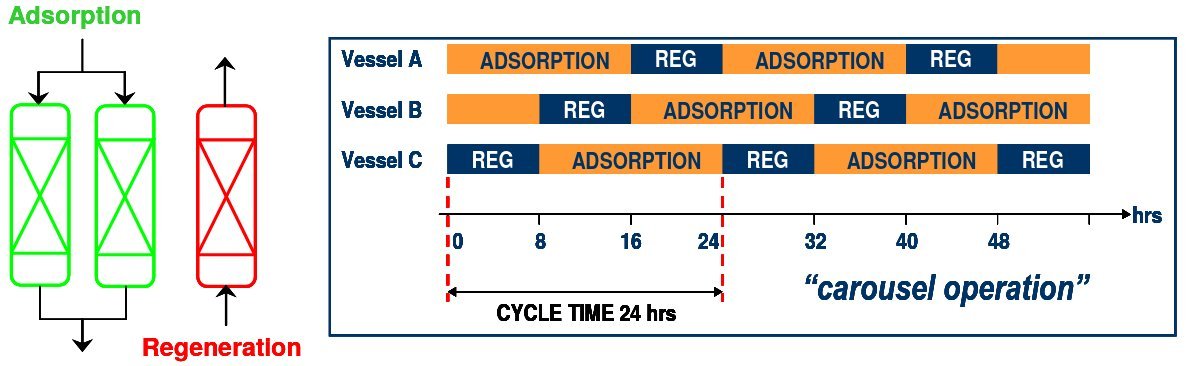
Temperature Swing Adsorption (TSA) for natural gas dehydration and purification using zeolite molecular sieves
Regenerative adsorption systems use specialized adsorbent materials that can be repeatedly cycled between adsorption and desorption states, eliminating the need for continuous adsorbent replacement and enabling economically viable continuous operation. These technologies separate gas components by exploiting the selective affinity of adsorbent materials for specific molecules under varying operating conditions, with applications spanning hydrogen purification, air separation, natural gas treatment, and industrial gas production.
Adsorptive separations exploit dissimilar physical properties of gas components including kinetic diameter (molecular size), polarity, and polarizability. Regeneration reverses the adsorption process by changing equilibrium conditions—either temperature (TAS), pressure (PSA, VPSA), or both—causing adsorbed molecules to desorb from active sites and restoring the adsorbent's original capacity. This regenerative capability transforms what would be a batch process into a continuous, economically sustainable operation.
#swingadsorption #tsa #psa #vpsa #gastreatment #gaspurification #hydrogenseparation #airseparation #asu #carboncapture #naturalgasdehydration #acidgasremoval