Automating Inspections and Thermal Profiling of Naptha Cracker Heater Tubes to prevent Hotspots
- Technology Type
- Steam Cracking


Introduction :
In high-severity fired heaters—including refinery reformers, DCU pass heaters, and cracker furnaces—accurate Tube Skin Temperature (TTST) monitoring and comprehensive thermal profiling are critical to ensuring asset integrity, operational safety, and sustained throughput stability.
Legacy inspection practices and manual SOPs—dependent on sparse thermocouples, line-of-sight infrared pyrometry, and periodic thermal camera surveys—lack continuous, full-length visibility. These approaches introduce delayed detection and blind zones, allowing hotspots, heat-flux imbalances, and early-stage tube degradation to go unnoticed.
The Problem:
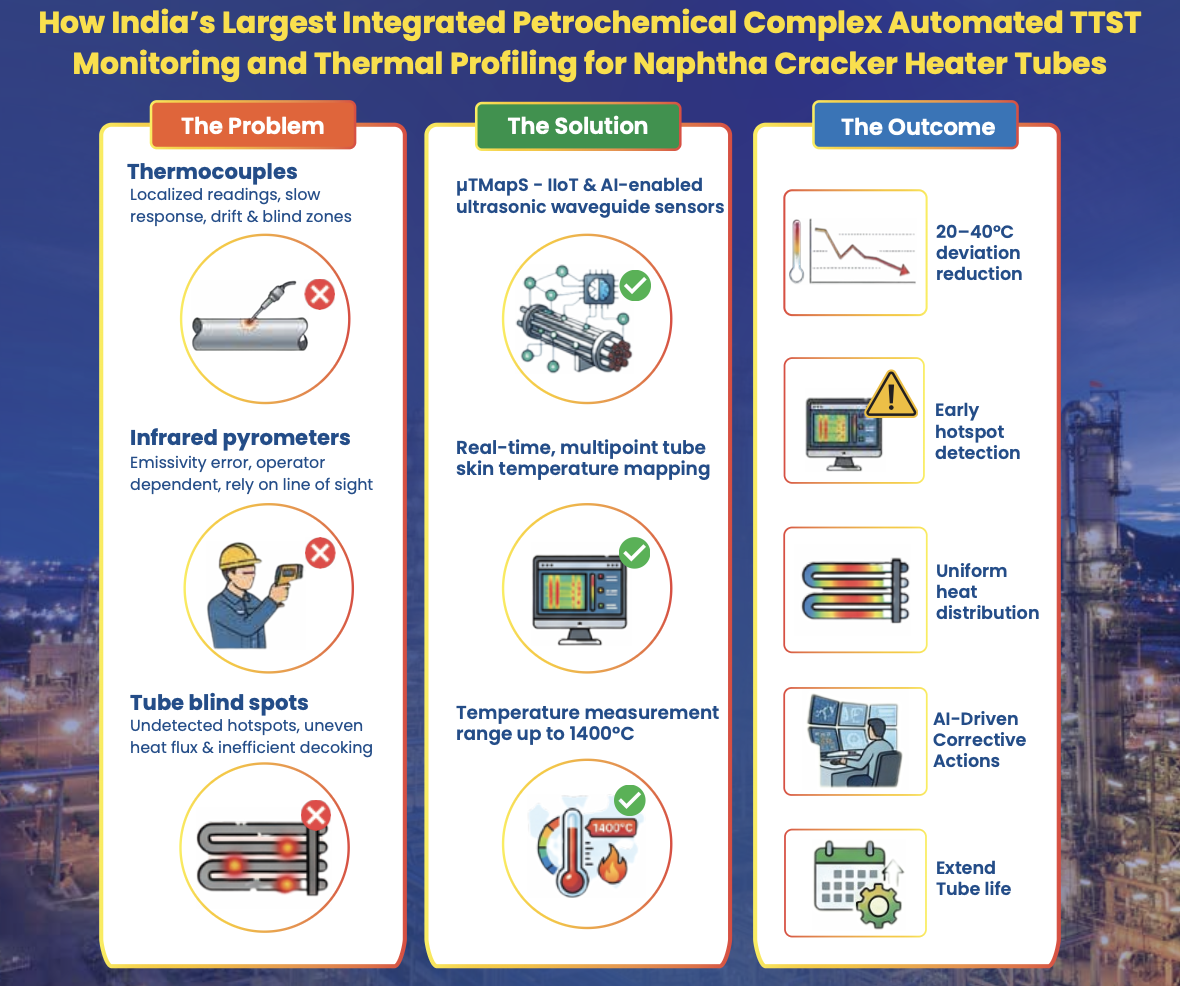
- Thermocouples: Localized readings, slow response, drift & blind zones
- Infrared pyrometers: Emissivity error, operator dependent, line-of-sight limitations
- Tube blind spots: Undetected hotspots, uneven heat flux & inefficient decoking
The Solution:
- µTMapS – IIoT & AI-enabled ultrasonic waveguide sensors
- Real-time multipoint tube skin temperature mapping
- Measurement range up to 1400°C
The Outcome:
- 20–40°C deviation reduction
- Early hotspot detection
- Uniform heat distribution
- AI-driven corrective actions
- Extended tube life
Operational Value for Refineries & Petrochemical Plants:
- Predictive maintenance enablement
- Higher asset availability and lifecycle extension
- Early intervention before thermal runaway
- Reduced tube failure risk and unplanned shutdowns
- Improved furnace efficiency and fuel optimization
Deployment Highlights:
- Installed at IOCL Panipat Naphtha Cracker Unit
- Continuous monitoring above 900°C
- Measurement up to 1400°C
- Pilot deployment on NCU Heater 200 for 3 months
- Integrated with plant historian and control systems
Result:
The deployment demonstrated improved safety and reliability, including 20–40°C reduction in temperature deviation and elimination of manual inspections in hazardous zones.