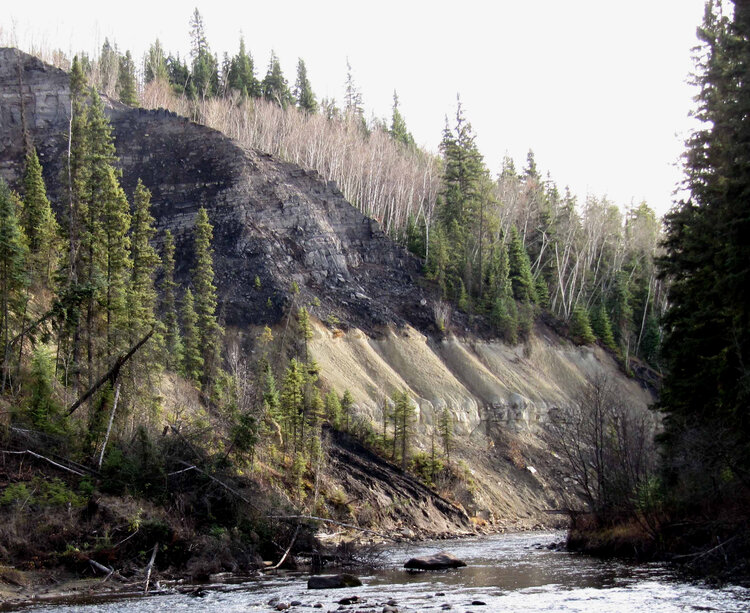
Oil sands, also known as tar sands, are a naturally occurring mixture of sand, clay, water, and bitumen—a dense, highly viscous form of petroleum. Bitumen is the hydrocarbon component that makes these deposits valuable as an energy resource, though its extremely thick consistency requires specialized extraction and processing methods before it can be refined into usable fuels.
Formation
Oil sands formed millions of years ago through processes similar to conventional crude oil development. Ancient marine organisms deposited on sea floors were buried under layers of sediment, where heat and pressure at temperatures between 50°C and 150°C transformed this organic material into petroleum. Over time, lighter hydrocarbon fractions either evaporated or were consumed by bacteria, leaving behind the heavy bitumen that characterizes oil sands today. These deposits are typically found at or near the surface, often close to fresh water sources that supplied the microbes responsible for bitumen degradation.
Global Distribution and Reserves
Significant oil sands deposits are located worldwide, with major concentrations in Canada, Venezuela, Russia, Kazakhstan, and the United States. Alberta, Canada, holds the most developed oil sands region globally, containing over 70% of the world's proven bitumen reserves—approximately 176.8 billion barrels. The Athabasca deposit in northeastern Alberta is the world's largest producing oil sands field, comprising mixtures containing 10-12% bitumen. Globally, total natural bitumen reserves are estimated at approximately 249.67 billion barrels, with proven reserves around 100 billion barrels.
Extraction Methods
Two primary extraction approaches are employed depending on deposit depth:
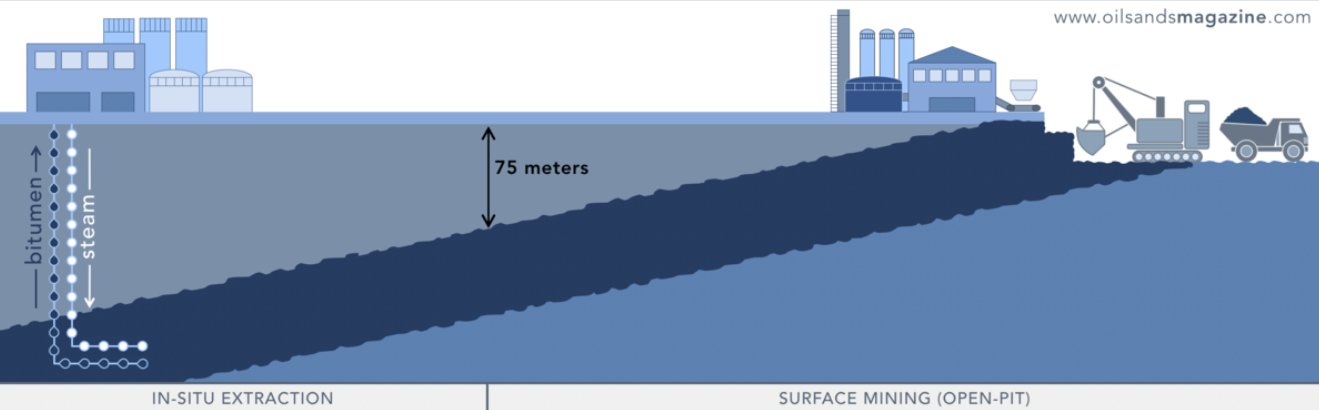
Surface Mining involves open-pit extraction similar to coal mining, viable when deposits are shallow. Large shovels excavate oil sands, which are then crushed and mixed with hot water to form a slurry. This mixture is pumped to separation vessels where bitumen froth rises to the surface and is separated from sand and clay.
In Situ Extraction is used for deeper deposits. The most widespread method is Steam Assisted Gravity Drainage (SAGD), which involves drilling two horizontal wells through the deposit. Steam injected into the upper well heats the bitumen, reducing its viscosity so it flows to the lower well where it is pumped to the surface. Alternative in situ methods include cyclic steam stimulation and solvent-based approaches.
Figure 1 - Oil Sands in-situ Extraction of Bitumen and Oil Sands Mining
Processing and Conversion
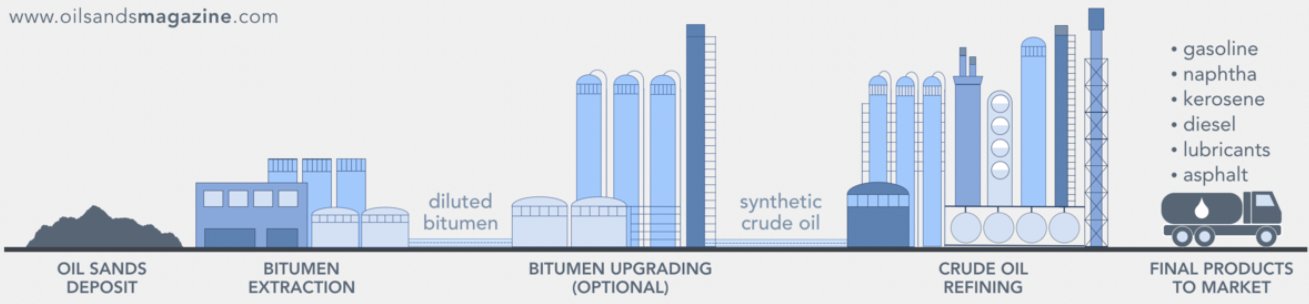
Raw bitumen cannot be directly refined into conventional fuels due to its viscosity. The extracted bitumen undergoes upgrading—a process that breaks down heavy hydrocarbon molecules into smaller components and removes impurities such as hydrogen sulfide. This upgrading converts bitumen into synthetic crude oil, which can then be transported via pipeline to refineries for conventional fractional distillation into gasoline, diesel, and other products.
Figure 2 - Oils Sands Process
Economic and Environmental Significance
Alberta's oil sands contain the fourth-largest proven oil reserves globally at 158.9 billion barrels, contributing substantially to Canada's energy security and economy. However, the industry faces significant environmental challenges. Oil sands production is energy-intensive and water-intensive compared to conventional oil extraction. Carbon emissions from oil-sands-derived crude are approximately 31% higher than from conventional oil, and in Canada, oil sands production has been the largest contributor to increasing greenhouse gas emissions since 2005. Open-pit mining also generates substantial waste requiring landscape reclamation, and produces tailings that may threaten nearby water supplies. Current mitigation efforts include transitioning toward in situ methods to reduce land disturbance, implementing carbon capture technologies, and adopting recycled water in processing operations.
References
- Energy Education Canada. Oil Sands. (Accessed Nov 23, 2025)
- Wikipedia. Oil Sands. (Page updated: Nov 6, 2025)
- Alberta. Oil Sands. (Accessed Nov 23, 2025)
- EBSCO. Howard Bromberg. 2024. Athabasca Oil Sands
- Natural Resources Canada. Jan 16, 2025. Oil Sands Extraction and Processing
- Oil and Gas Overview. Feb 8, 2021. How Is Oil Extracted From Oil Sands
- American Geosciences Institute. Christopher Keane. What are tar sands? (Accessed Nov 23, 2025)