🎬 Live Stream: DREAM Refinery — India | Project Introduction and Configuration
📢 Live Stream Announcement
🔴 LIVE SESSION: "A New Integrated Refining Complex for India – The ppPLUS Dream Project Configuration"
We’re excited to invite you to our very first Molecules to Market live session, where we unveil the Virtual Refinery “Dream Project” built on the ppPLUS platform!
JoinSanjay Gupta,Uwe Braun, andDr. Nicolas Kokelas they walk you through a fully integrated refining complex for India – configured, visualized, and analyzed live on ppPLUS, our open, collaborative platform for the process industries.
📅 Date: Saturday, September 5th
🕐 Time:
17:30 hrs (India)
16h00 hrs (UAE)
15:00 hrs (KSA)
14:00 hrs (CEST)
13:00 hrs (UK)
08:00 hrs (EDT)
⏱️ Duration:
~1 hour (with extended Q&A)
📍 Streaming live on
What’s on the agenda
✅ Introduction to ppPLUS – open access, collaborative, building a model of the global refining and chemical industry
✅ The Dream Project on ppPLUS – entity & site pages, mass balances, and site configuration visualization
✅ Live configuration deep-dive with the ppPLUS Configurator:
• Core refinery
• Olefins and aromatics integration
✅ Interactive discussion – bring your questions!
This session is interactive – we’ll be answering your questions live throughout the stream, so come curious!
Whether you’re in refining, petrochemicals, technology licensing, engineering, or project development – this is your chance to see how a complex industrial site can be configured, analyzed, and shared collaboratively in the open.
👉 Save the date, set your reminder, and join us live!
👉 Like what you see? Register on ppPLUS and comment on the project yourself.
ppPLUS use cookies essential for this site to function well.
Learn about our use of cookies, and collaboration with selected social media and trusted analytics partners here.
From feedstocks to intermediate products, bulk commodities to specialty chemicals,
off-gases to recycling streams—our ppPLUS repository captures the full spectrum of chemical products.
This comprehensive database is the backbone of our process flow modelling.
By integrating product data into dynamic simulations,
we enable smarter decisions and more accurate forecasting across the chemicals value chain.
ppPLUS is mapping out the whole process and value chain looking
at Technology specifics, the technology providers and the global deployment.
We invite you to be part of this evolving ecosystem. Contribute your insights, enrich the data, and help shape a true, interconnected picture of the chemicals universe.
Solution-Reference: #PM242
ppPLUS Solutions - Expert Services
Enquire with us for information on the technology, processes and where it is deployed.
ppPLUS Experts cover a range of expertise providing insights for your enquiries
Explore ppPLUS Solutions for expert services
or monetize your own expertise
Carbon black is produced by the thermal decomposition method or the partial combustion method in a limited supply of air using carbocenaous feedstock. Carbon black products are direct descendants of earlier “lamp blacks,” a black pigment produced and used by various civilizations to create rock paintings more than 3,000 years ago. For a long time, black pigment was obtained by charring organic materials such as wood or bone or collecting soot from burning oils in wick lamps. These early blacks were not very pure and differed greatly in their chemical composition from present-day carbon blacks, which are almost pure carbon.
Feedstock base for all carbon blacks are hydrocarbons like aromatic oils based on coal tar or crude oil. Main coal tar distillate for carbon black production is for example anthracene oil. Both groups have a high content of aromatic hydrocarbons in common. Further feedstocks are heavy petroleum fraction, distillation residues form oil refineries, and different oil mixtures. Over feedstocks that can also be used for the production of carbon black are natural gas, naphtha, gas oil and acetylene and vegetal matter.
Carbon black used to be called "soot" in the west and "shouen" in the east of the United States, where plant production started in 1740's. Because of the production method used, it was then called "lampblack”. In the 1870's, products manufactured from natural gas were sold under the name “carbon black”.
Made in specially designed reactors, operating at internal temperatures in the range of 2600° to 3600°F, different grades of carbon black can be produced with varying aggregate size and structure. As the characteristics of carbon black vary depending on the manufacturing process, carbon black is classified according to the process by which it is made, with subtypes acetylene black, channel black, gas black, furnace black, lamp black and thermal black. Above 98% of the world’s annual carbon black production is covered by the furnace black process. Carbon black produced with this process is called “furnace black”, distinguishing it from carbon black, which is manufactured with other processes.
Carbon black is not the undesired by-product soot, which is known from chimneys or exhausts, from which it is dissimilar in its much higher surface-area-to-volume ratio and significantly lower (negligible and non-bioavailable) polycyclic aromatic hydrocarbon (PAH) content.
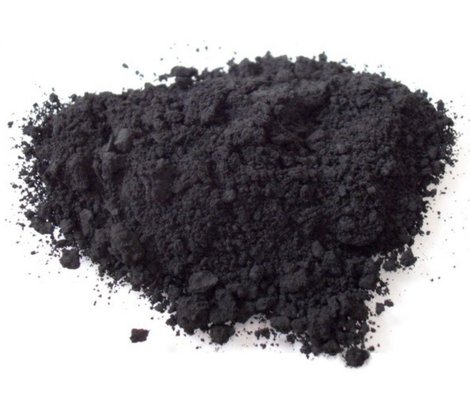
Chemically, carbon black is a colloidal form of elemental carbon consisting of 95 to 99% carbon—with minimal quantities of oxygen, hydrogen and nitrogen—in the form of colloidal particles, a form of paracrystalline carbon that has a high surface-area-to-volume ratio, albeit lower than that of activated carbon. Its physical appearance is that of a black, finely divided pellet or powder.
Carbon black is an industrial produced raw material with clearly defined properties. The main properties of carbon black are primary particle size and particle size distribution, particle structure, specific surface area and surface chemistry, conductivity and color.
Carbon black is used as a filler or modifyer in the manufacture of rubbers, plastics, paints and pigments. Its main use is in the rubber industry as a reinforcement and filler. The addition of carbon black to rubber improves the wear resistance of tires and other properties. The stability against UV radiation is also enhanced since the black pigment blocks light transmission. The content of carbon black is the reason why so many rubber products are black. Carbon black in rubbers and plastics not only makes the substance black, but it also make them UV stable and heat conducting: taking heat away from the tread and thus producing less static electricity. Practically all rubber products where tensile and abrasion wear properties are important use carbon black as a reinforcing material. Rubber such as styrene butadiene rubber (SBR) may be blended with up to 50 percent by weight (wt %) of carbon black to improve its tensile strength and wear resistance.
References
D. Alwarid, 2022-2023 Lecture, Properties of Petroleum Products, 3rd Stage, Carbon Black, Ministry of Higher Education and Scientific Research, Al-Mustaqbal University College, Department of Chemical Engineering and petroleum Industrials.
We operate the only free, open-access platform dedicated to mapping the Energy and Petrochemicals industry.
Our mission: to create a holistic, integrated, and complete picture of the sector, its assets, processes, and players.
Community
This ambitious project thrives on community contributions.
Join our Expert-Community and benefit by bringing content to the platform.
Discover our flexible tools to adding your Insights to Technologies, Companies and industry trends.
Contribute and Support
If you believe in transparency, collaboration, and accessible knowledge.
With your payment you support the content contributors and the platform.
Every contribution fuels the development of this unique platform and will be shared between the Content-Authors and the platform.
Share your insights with the community
ppPLUS Communicator
Add company news, business events,
operational updates, etc
Collaborator Assigned with registration
Data Modelling
Update Descriptions of Companies, Technologies, Products...
Model Mass Balances and visualize Processes
Create Indicators and much more
Modeler
Insights
Create your own Expert-Profile
Publish comprehensive insights, new articles
Create ppPLUS Solutions Services (See Solutions)
Modeler with Expert-Status
Go here
if you haven't registered yet and we will contact you.
For any questions email us.
Earn Appreciation Directly From Your Audience
With the ppPLUS Donation Feature, your readers can show their appreciation by contributing a small monetary “thank you” for the insights you share. It’s a simple, transparent way to reward your expertise and support your work.
Readers can make voluntary Donations on your content.
You receive 80% of every contribution.
ppPLUS retains 20% to support platform operations and continuous improvement.
Your earnings are collected and paid out to you within 30 days.
You stay in control
Opt in whenever you’re ready.
Opt out at any time — no obligations, no lock‑ins.
Future updates to the program will always be communicated clearly.
Why Experts love it
It’s effortless: no setup, no maintenance.
It rewards quality and expertise.
It strengthens your connection with your audience.
It creates a new income stream without changing how you publish.
By selecting "Accept" you are accepting the Terms and Conditions for our Donation-Model.
An Email will be send to you asking for your Banking Details.
Share your insights
Open
We operate the only free, open-access platform dedicated to mapping the Energy and Petrochemicals industry.
Our mission: to create a holistic, integrated, and complete picture of the sector, its assets, processes, and players.
Community
This ambitious project thrives on community contributions.
Join our Expert-Community and benefit by bringing content to the platform.
Discover our flexible tools to adding your Insights to Technologies, Companies and industry trends.
Contribute and Support
If you believe in transparency, collaboration, and accessible knowledge.
With your payment you support the content contributors and the platform.
Every contribution fuels the development of this unique platform and will be shared between the Content-Authors and the platform.
Advertise with us
The platform where industry experts meet
Advertise where the industry actually gathers — thousands of specialists, operators,
and consultants use ppPLUS every day to research, analyse, and connect.
Link your brand directly to technologies, assets, and operators
Place your message right next to the objects professionals work with — from technologies to value‑chain assets
— and reach users at the exact moment they explore your domain.
Configure your advert and campaign together with us
Shape a tailored campaign with our team — from messaging to placement —
ensuring your brand reaches the right audience with maximum relevance and impact.