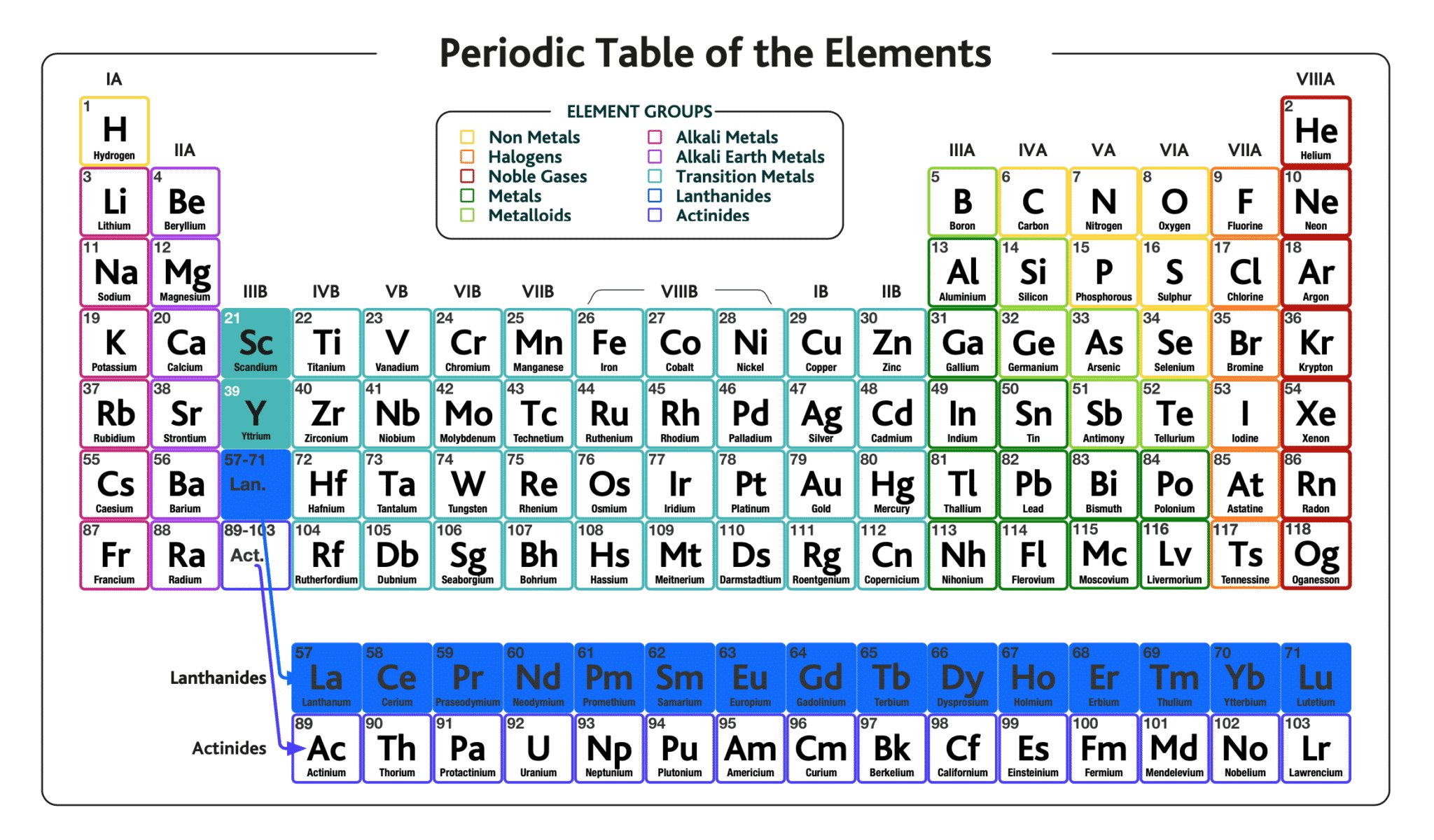
Rare earth elements (REEs) are a group of 17 chemically similar metallic elements consisting of the 15 Lanthanides plus Scandium and Yttrium. Despite their name, they are relatively abundant in Earth's crust but rarely found in concentrated, economically exploitable deposits.
These elements are not found in nature in pure metallic form and must be extracted from rare eart-containing ores through complex chemical processing. The conversion process involves concentrating the elements from ore, separating them individually, converting them to oxides, then to fluorides or chlorides, and finally reducing these salts to pure metals through metallothermic or electrolytic methods.
Rare earth elements in their metallic form are silvery to iron-grey metals with distinctive physical and chemical characteristics that set them apart from other metallic elements.
Physical Appearance and General Properties
In their pure elemental state, rare earth metals appear as soft, silvery-white to iron-grey materials that are relatively malleable. They are notably reactive and oxidize quickly when exposed to air. Some elements like Terbium and Ytterbium are pyrophoric in finely dispersed form, meaning they can spontaneously ignite.
Structural Characteristics
Most rare earth metals crystallize in close-packed structures, with the exception of Europium. As you progress through the Lanthanide series from Lanthanum to Lutetium, the crystal structures transition from face-centered cubic (fcc) to hexagonal close-packed (hcp), with intermediate mixed structures. Several elements exhibit multiple crystal structures depending on temperature.
Physical Property Ranges
The rare earth metals display significant variation in their physical properties despite their chemical similarities:
- Melting points: Vary by nearly a factor of two across the series
- Vapor pressures: Differ by more than a billion-fold
- Density: Ranges from Europium (the least dense at 5.166 g/cm³) to Lutetium (the densest at 9.849 g/cm³)
- Mechanical strength: Ultimate tensile strength ranges from about 120 to 160 MPa with modest ductility of 15-35 percent
Magnetic Properties
Rare earth metals possess exceptional magnetic characteristics due to their unique electronic configuration, particularly the 4f orbital electrons. Elements with unpaired 4f electrons exhibit strong paramagnetic susceptibility, large magnetic saturation intensity, magnetic anisotropy, and magnetostriction. Those without unpaired electrons (Scandium, Yttrium, Lanthanum, and Lutetium) are only weakly magnetic.
Chemical Reactivity
The metals are generally quite reactive, with Cerium considered the most reactive among rare earth metals except for Europium. Their powdered forms oxidize easily in air, and most are soluble in acids. Gadolinium is relatively stable in dry air but tarnishes in humid conditions.
References
- Tradium GmbH. Find out Everything About Rare Earths
- Ames National Laboratory. Researchers develop a new, non-toxic method for rare earth metal processing (May 8, 2005)
- Karati A, Parmar H, Riedemann T, Besser M, Prodius D, Nlebedim IC. Rare earth metals production using alternative feedstock that eliminates HF (May 15, 2025). Nat Commun. 16(1):4528. DOI: 10.1038/s41467-025-59468-w. PMID: 40374614; PMCID: PMC12081694
- Wikipedia. Rare-earth element
- Jordan, FTM Machinery. What Are Rare Earth Elements - Physical Properties and Uses (Mar 20, 2023)
- Edgetech Industries LLC. The main physical properties of rare earth metals
- Gschneidner, K. A. et al., Encyclopaedia Britannica. Properties of the metals rare-earth element (Feb 2, 2026)
- McClements D. and Keane P., Xometry. Rare-Earth Metals: Definition, Properties, Use, and Types (May 3, 2025)