
Product
Neodynium
Abbreviation
Nd
Insight Articles
#PS737
Main Product
Rare Earth Metals
Segment
Chemicals
Main-Family
Inorganics
Sub-Family
Metals
Physical State

Solid

Description

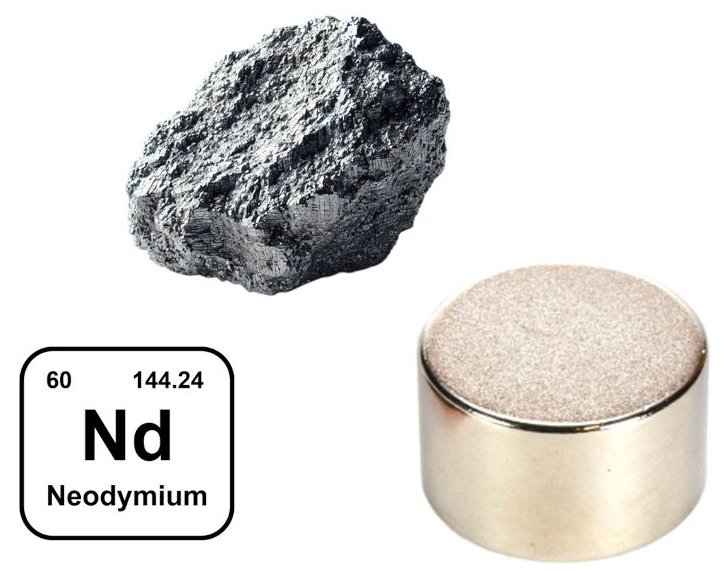
Neodymium is a rare earth element with atomic number 60 and atomic weight 144.24, classified as a lanthanide in the periodic table. It is a soft, ductile, and malleable metal that must be extracted from mineral ores through complex chemical processing, as it does not occur naturally in pure metallic form. It is the most commercially relevant rare earth metal, accounting for approximately 33% of total rare earth element demand.

Physical Appearance

Metallic Neodymium exhibits a bright, silvery metallic luster with a slight yellowish tinge. The metal is highly reactive and oxidizes readily in air, forming a flaky oxide layer (Nd₂O₃) that easily spalls off, exposing fresh metal to further oxidation. Due to this reactivity, Neodymium requires protective coatings or must be stored under inert conditions.

Crystal Structure and Thermal Properties

Neodymium exists in two allotropic forms:

  • α-phase (alpha): Double close-packed hexagonal structure stable at room temperature up to approximately 863°C
  • β-phase (beta): Body-centered cubic structure that forms above 863°C

The metal has a melting point of 1,021-1,024°C and a boiling point of 3,074°C. Its density is 7.01 g/cm³ at room temperature, decreasing to 6.89 g/cm³ in the liquid state.

Magnetic Properties

Neodymium displays complex magnetic behavior that is fundamental to its commercial importance:

  • At room temperature, it is paramagnetic
  • Below 20 K (-253.2°C), it becomes antiferromagnetic and exhibits complex magnetic phases with long spin relaxation times and spin glass behavior​
  • When alloyed with iron (a ferromagnet), it forms Nneodymium-Iron-Boron (NdFeB) magnets, the strongest commercially available permanent magnets

Mechanical and Electrical Properties

Neodymium exhibits moderate mechanical strength with a Vickers hardness of 343 MPa and Brinell hardness of 265 MPa. Its Young's modulus is 41.4 GPa, shear modulus is 16.3 GPa, and bulk modulus is 31.8 GPa. The metal has an electrical resistivity of 64 nΩ·m at 25°C and thermal conductivity of 16.5-17 W/m·K.

Chemical Properties

Neodymium predominantly exhibits a +3 oxidation state, though +2 and +4 states are possible under specific conditions. The metal reacts gradually with mineral acids, except hydrofluoric acid, in which it forms a protective trifluoride layer (NdF₃). It forms various compounds including Neodymium oxide (Nd₂O₃), Neodymium chloride (NdCl₃), and Neodymium nitrate (Nd(NO₃)₃), which are used in pigments, catalysts, and specialized alloys.

Critical Role in Modern Technology

Neodymium's commercial significance stems from its unique magnetic properties when combined with iron and boron to create neodymium-iron-boron (NdFeB) magnets, the strongest commercially available permanent magnets. These magnets are indispensable components in motors and generators powering electric vehicles, wind turbines, consumer electronics, medical devices, drones, and industrial robots. They enable miniaturization and efficiency gains that are fundamental to the expansion of green energy industries.

Market Size and Growth

The Neodymium market demonstrates its commercial dominance with substantial economic value:

  • Global Neodymium market size was valued at $5.52 billion in 2023 and is projected to reach $8.77 billion by 2032, growing at a CAGR of 5.3%​
  • Another projection estimates the market will reach $7.30 billion by 2030, expanding at a CAGR of 6.7% from 2025 to 2030​
  • Magnet applications accounted for over 60% of Neodymium's revenue share in 2024​
  • The automotive sector alone held over 33% of the global neodymium market in 2024​

Strategic Importance

Neodymium is classified as a critical raw material by the United States, European Union, and United Kingdom due to its essential role in the energy transition and high-tech industries. The global market situation is considered critical because China dominates both mining (around 60%) and further processing into products like permanent magnets, creating supply chain vulnerabilities. This has prompted international efforts to diversify production sources and develop more independent value chains.

Other Applications

Beyond magnets, Neodymium is used in neodymium-doped yttrium aluminum garnet (Nd:YAG) lasers, which are essential in medical and industrial fields for cutting, welding, and engraving.


References

  1. Stanford Advanced Materials. Neodymium: Element Properties and Uses (Dec 9, 2025, retrieved via the Web Archive)
  2. Encyclopedia Britannica. neodynium
  3. SFA Oxford. NEODYNIUM
  4. Natural Resources Canada. Rare earth elements facts
  5. Wikipedia. Neodynium
  6. Stanford Advanced Materials. Neodymium: Properties and Applications
  7. Advanced Engineering Materials Limited. Neodymium Properties Explained: From Atomic Structure to Real-World Uses (Aug 15, 2025)
  8. Periodictable.com. Technical data for Neodymium
  9. Royal Society of Chemistry. Neodynium
  10. Periodická soustava prvků. Neodynium
  11. Ruid M., Global X. Rare Earth Elements, Explained (Jul 13, 2023)
  12. SFA Oxford. Navigating the Neodymium Market
  13. Fortune Business Insights. Report ID: FBI107678: Neodymium Market Size, Share & Industry Analysis (Jan 26, 2026)
  14. Grand View Research. Neodymium Market Size To Reach $7.30 Billion By 2030 (May 2025)
  15. Rare Earths. The Element Neodymium

Insight Articles
Your insights will be shown here

What are Neodynium magnets? https://briandcolwell.com/interesting-facts-about-neodymium-a-rare-earth-element-ree-and-critical-raw-material/
Identifiers

logo CAS Number
7440-00-8
logo EC Number
231-109-3
logo ECHA InfoCard
100.028.281
logo IUPAC Name
neodymium
logo PubChem ID
23934
Chemical Data

Chemical Formula

Nd

Molecular Weight (g/mol)
144.24
Boiling Point (°C)
3074
Melting Point (°C)
1021
Sulfur Content (wt%)
0
Specific Gravity
7.00
Crude Data

API Gravity
-111.29
Country
Product Settings

Default
Status
A
Content provided by
Transaction Name Date
Modified by UserPic   Kokel, Nicolas 2/10/2026 12:21 PM
Added by UserPic   Kokel, Nicolas 2/10/2026 9:26 AM