Product
Light Metals (Al, Mg, Ti, Be, Li)
Segment
Chemicals
Main-Family
Inorganics
Sub-Family
Metals
Link
Insight Articles
#PS751

Description

Light metals are metallic elements or alloys characterised by a relatively low density — conventionally defined as a density below 5.0 g/cm³ — combined with a high strength-to-weight ratio. This combination of low weight and structural performance makes them indispensable across aerospace, automotive, construction, electronics, and biomedical industries, wherever weight reduction without loss of mechanical integrity is a primary design requirement.

Definition

A chemical element qualifies as a light metal if it satisfies two conditions:​

  1. It exhibits metallic properties (conductivity, malleability, ductility, luster)
  2. It has a density of ≤ 4.99 g/cm³

By contrast, heavy metals are defined as those with a density exceeding 5.0 g/cm³, such as iron (7.87 g/cm³), copper (8.96 g/cm³), and lead (11.3 g/cm³).​

Commercially Significant Members

While the light metals group technically encompasses all metallic elements below the 5.0 g/cm³ threshold — including alkali metals (lithium, sodium, potassium) and alkaline earth metals (calcium, beryllium, magnesium) — only three are of primary industrial and structural significance:

Metal Symbol Density (g/cm³) Key Characteristics
Aluminium Al 2.70 Most widely used light metal; excellent corrosion resistance; highly recyclable; dominant in packaging, transport, construction
Magnesium Mg 1.74 Lightest structural metal; excellent machinability; used in automotive and aerospace alloys
Titanium Ti 4.51 Highest strength-to-weight ratio; outstanding corrosion resistance; used in aerospace, medical implants, and chemical processing
Beryllium Be 1.85 Exceptionally stiff and thermally stable; specialist applications in aerospace, defence, and nuclear industries

Shared Properties

Light metals share a distinctive combination of properties that collectively justify their classification as a group:

  • Low density — ranging from 19 to 56% of the density of iron and copper
  • High strength-to-weight ratio — enabling structural applications where mass is critical
  • Good corrosion resistance — typically through formation of a passive oxide surface layer
  • Electrical and thermal conductivity — useful in electrical and heat management applications
  • Malleability and machinability — amenable to casting, rolling, extrusion, and machining
  • Alloying versatility — easily combined with other elements to tailor mechanical properties

Distinction from Related Metal Groups

Category Key Members Defining Characteristic
Light
Metals
Aluminium, Magnesium, Titanium, Beryllium Density < 5.0 g/cm³;
structural applications
where weight is critical
Ferrous Metals Iron, Steel, Cast Iron,
Wrought Iron
Iron-based; magnetic;
subject to corrosion
Base
Metals
Copper, Zinc, Lead,
Nickel, Tin, Cobalt
Non-ferrous; common,
widely traded industrial metals
Precious Metals Gold, Silver, Platinum, Palladium, Rhodium,
Iridium, Ruthenium, Osmium
High economic value;
corrosion-resistant; rare
Rare Earth Metals 15 Lanthanides + Scandium
+ Yttrium
Critical for electronics,
magnets, catalysis
Refractory Metals Tungsten, Molybdenum, Niobium, Tantalum,
Rhenium
Extremely high melting
points (>2,000°C);
high-temperature applications
Alkali
Metals
Lithium, Sodium, Potassium,
Caesium, Rubidium
Highly reactive; Group 1;
chemical and industrial uses
Alkaline Earth Metals Calcium, Strontium,
Barium, Radium
Group 2; reactive but less so
than alkali metals; construction and chemical uses
Actinide Metals Uranium, Thorium,
Plutonium
Radioactive; nuclear fuel
and energy applications

Industrial Applications

Light metals and their alloys are critical structural materials across multiple sectors:

  • Aerospace & aviation — airframes, engine components, structural panels (aluminium, titanium, magnesium alloys)
  • Automotive — body panels, engine blocks, wheels, gearboxes (aluminium, magnesium)
  • Packaging — beverage cans, foil, food containers (aluminium)
  • Construction — window frames, curtain walling, roofing (aluminium)
  • Medical devices — implants, prosthetics, surgical instruments (titanium)
  • Electronics — casings, heat sinks, battery technology (aluminium, magnesium, lithium)
  • Energy storage — lithium-ion batteries for EVs and grid storage (lithium)

References

  1. Godden A., Metal Men Recycling (Jun 30, 2020). What Are The Five Groups Of Metals? (Periodic Table Edition)
  2. Wikipedia. Metals (pagge version Feb 20, 2026)

Insight Articles
Your insights will be shown here

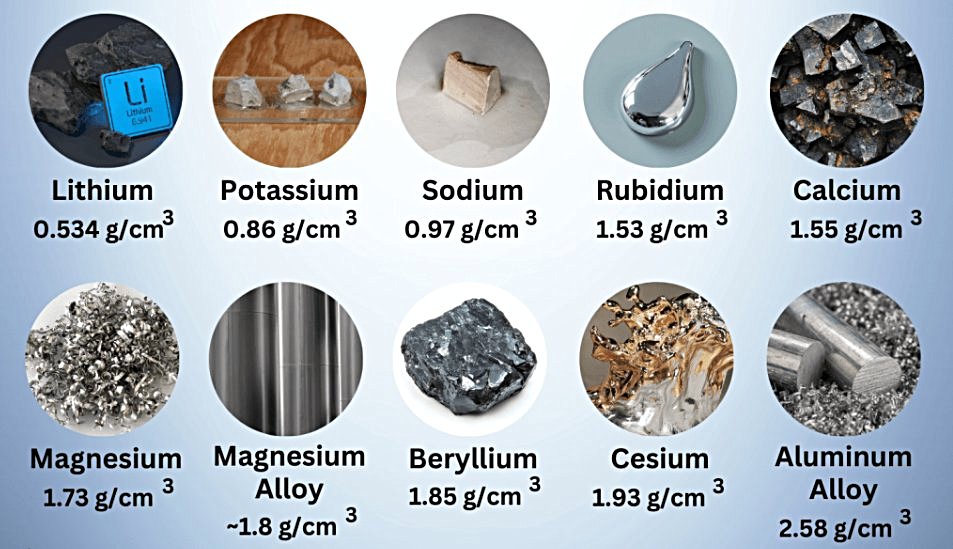
Three metals (Al, Mg, Be) from four light structural metals belong to the 10 lightest metals, together with alkali metals (Na, K, Cs, Rb) and the alkaline earth Calcium https://sciencenotes.org/what-is-the-lightest-metal/
Settings

Status
A
Unit of Measure
Metric Ton
Physical State

Solid

Content provided by
Transaction Name Date
Modified by UserPic  Kokel, Nicolas 2/24/2026 1:20 PM
Added 2/24/2026 7:28 AM