Liquid aromatic aldehydes represent a broad class of organic compounds built around a benzene or fused-aromatic ring bearing a formyl (-CHO) group directly attached to the ring carbon. Their liquid state at room temperature arises primarily from molecular symmetry, limited hydrogen-bonding capacity, and moderate molecular weight — factors that keep intermolecular packing forces weak enough to prevent crystallization under ambient conditions.
General Character and Behavior
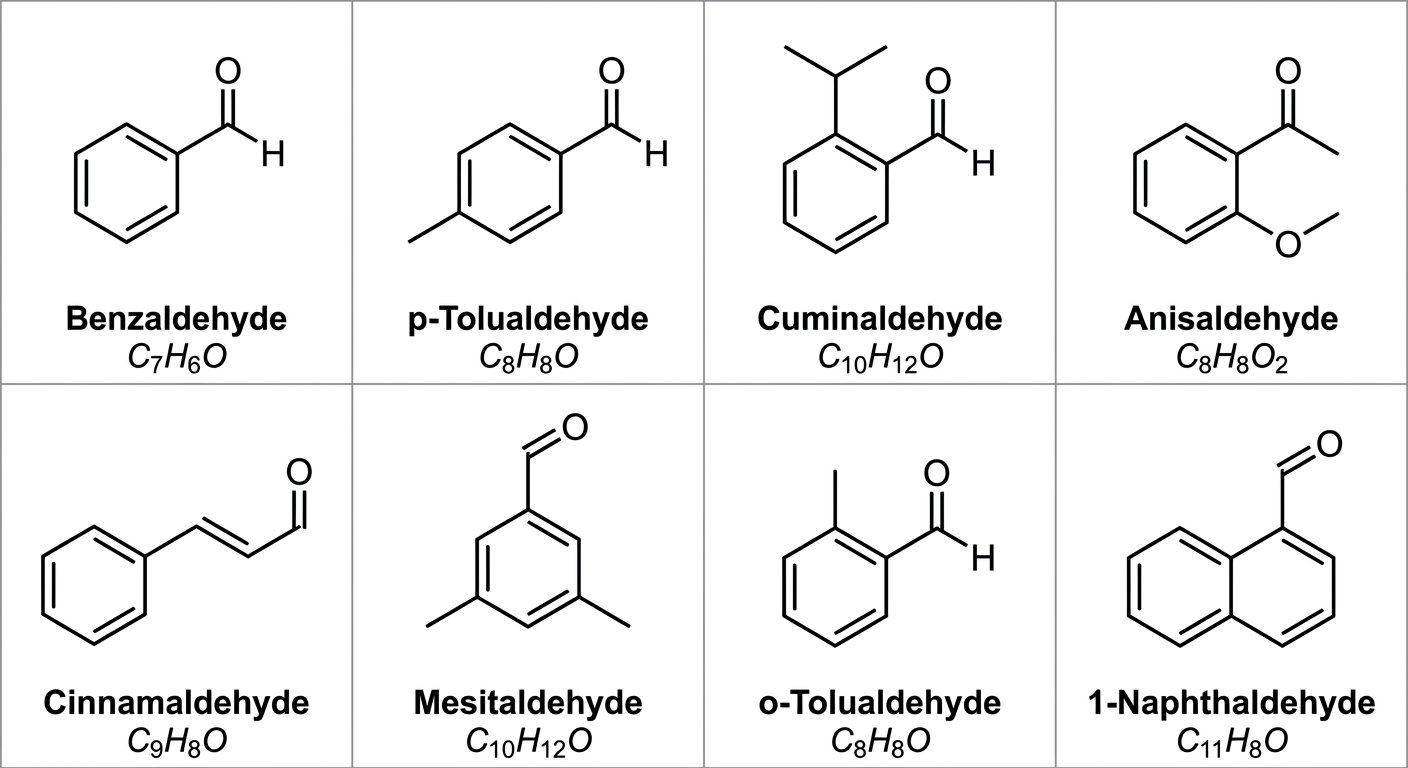
The parent compound of this family is benzaldehyde, a colorless, mobile liquid with a characteristic bitter-almond odor that serves as the foundational reference structure for the entire class. When alkyl or alkoxy substituents are introduced onto the ring — such as a methyl group in p-tolualdehyde or a methoxy group in anisaldehyde — the resulting molecules typically remain liquid, since these substituents are relatively small, non-polar, and do not promote the kind of directional intermolecular hydrogen-bonding that raises melting points in solid analogs.
Liquid aromatic aldehydes are generally pale yellow to colorless, mobile to slightly oily fluids with pleasant, often fruity, nutty, or spicy odors. This organoleptic character is precisely why so many of them are commercially significant as fragrance and flavor compounds rather than purely as industrial intermediates. Their boiling points tend to fall in a moderate range, commonly between 175°C and 260°C, reflecting the balance between the polar carbonyl group (which raises boiling point through dipole interactions) and the nonpolar aromatic ring (which limits it).
Common Liquid Aromatic Aldehydes
| Chemical Name |
Melting
Point (°C) |
CAS Number |
Description |
| Benzaldehyde |
-57 |
100-52-7 |
The simplest and most fundamental aromatic aldehyde, a colorless mobile liquid with a bitter-almond odor; widely used as a flavor and fragrance agent and as a building block in dye and pharmaceutical synthesis |
| p-Tolualdehyde (4-methylbenzaldehyde) |
-6 |
104-87-0 |
A clear colorless liquid with a methyl group para to the aldehyde; used as a pharmaceutical, agricultural, and resin intermediate, and appears as a partial-oxidation intermediate in aromatic-acid production processes |
| m-Tolualdehyde (3-methylbenzaldehyde) |
-44 (approx.) |
620-23-5 |
A colorless to pale yellow liquid isomer of tolualdehyde, used mainly as a fine-chemical and fragrance intermediate |
| o-Tolualdehyde (2-methylbenzaldehyde) |
-6 |
529-20-4 |
A colorless liquid with the methyl group adjacent to the aldehyde, giving it slightly different reactivity from its para isomer; used in specialty organic synthesis |
| p-Ethylbenzaldehyde |
-4 (approx.) |
4748-78-1 |
A clear colorless liquid with an ethyl substituent; used as an additive for resins and as a pharmaceutical and agricultural intermediate |
| Cuminaldehyde (4-isopropylbenzaldehyde) |
-8 (approx.) |
122-03-2 |
A clear colorless liquid with a spicy, herbal odor reminiscent of cumin; widely used in flavor and fragrance formulation |
| 2,4-Dimethylbenzaldehyde |
Below room temperature |
15764-16-6 |
A clear colorless liquid bearing two methyl substituents; used as a resin additive and fine-chemical intermediate |
| 3,4-Dimethylbenzaldehyde |
Below room temperature |
5973-71-7 |
A clear colorless liquid isomer used in fragrance and pharmaceutical intermediate applications |
| Mesitaldehyde (2,4,6-trimethylbenzaldehyde) |
Below room temperature |
487-68-3 |
A clear, sterically hindered liquid aldehyde with three methyl groups surrounding the ring; used in fine-chemical and fragrance synthesis |
| Anisaldehyde (4-methoxybenzaldehyde) |
-1 (para isomer, low-melting) |
123-11-5 |
A colorless to pale yellow liquid with a sweet, hawthorn-like odor; one of the most important fragrance and flavor aldehydes, also used in pharmaceutical synthesis |
| Cinnamaldehyde |
-7.5 |
104-55-2 |
A yellowish, oily liquid with an unsaturated side chain conjugated to the ring, giving the characteristic cinnamon aroma; used extensively in flavoring and fragrance industries |
| 3-Methoxybenzaldehyde |
Below room temperature |
591-31-6 |
A colorless to pale yellow liquid, a positional isomer of anisaldehyde used in flavor and fine-chemical synthesis |
| 1-Naphthaldehyde |
34 (borderline solid/liquid near room temperature) |
66-77-3 |
A pale yellow liquid or low-melting solid built on a naphthalene backbone rather than a simple benzene ring; used as an organic synthesis intermediate |
Chemical Reactivity and Handling
Structurally, the aldehyde group in these compounds is conjugated with the aromatic ring, which stabilizes the molecule and moderates its reactivity compared to aliphatic aldehydes — they oxidize more slowly in air but can still form the corresponding carboxylic acid over time upon prolonged exposure. This oxidative sensitivity means liquid aromatic aldehydes are often stored under inert atmosphere or with added stabilizers to prevent autoxidation and discoloration.
In an industrial process context, such as petrochemical oxidation routes producing aromatic acids, liquid aromatic aldehydes frequently appear as reaction intermediates or partial-oxidation byproducts. Because they remain in the liquid phase, they behave very differently from solid aromatic aldehyde derivatives during separation steps — liquids tend to partition into organic solvent phases or volatilize into vapor streams, whereas solid derivatives co-precipitate with the main crystalline product and require different purification strategies such as hydrogenation or selective crystallization.
Structural Diversity Within the Liquid Class
Despite sharing the same core reactivity, liquid aromatic aldehydes show meaningful structural diversity: some carry a single substituent para to the aldehyde group (like p-tolualdehyde), some carry an extended conjugated side chain (like cinnamaldehyde, which is technically an aromatic-aliphatic hybrid), and others carry electron-donating alkoxy groups that soften the carbonyl's electrophilicity (like anisaldehyde). This structural range explains why the group as a whole covers uses spanning fragrances, flavor compounds, dye intermediates, and fine chemical synthesis building blocks, even though they are unified by the same liquid physical behavior at room temperature.