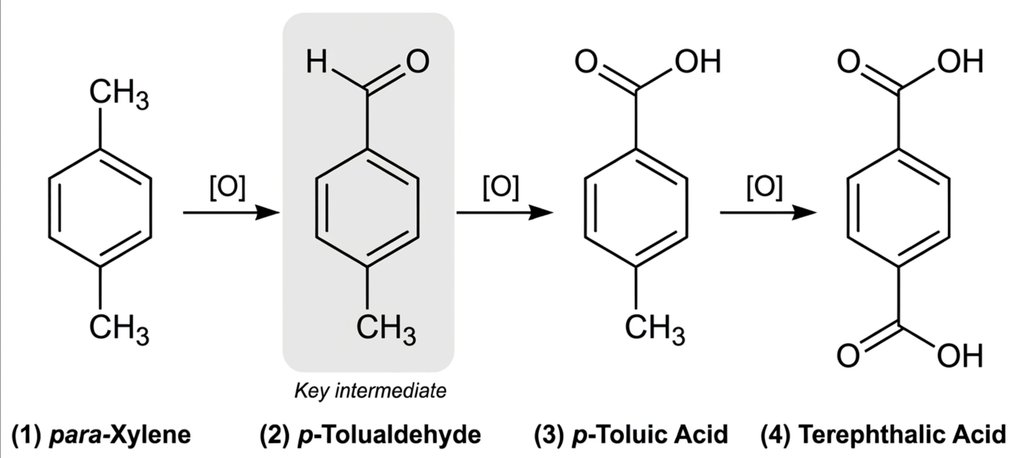

p-Tolualdehyde, also known chemically as 4-methylbenzaldehyde, is a member of the tolualdehyde family in which a single methyl group occupies the position directly opposite (para to) the aldehyde functional group on the benzene ring. Structurally, it can be viewed as benzaldehyde with a methyl substituent, and this small structural addition is enough to shift its odor, reactivity, and industrial applications away from the simpler parent compound while keeping it firmly in the liquid state at room temperature.
Physical Appearance and Sensory Character
At room temperature, p-tolualdehyde exists as a clear, colorless to pale yellow liquid, occasionally described as having a slight tint depending on purity and storage conditions. Its odor is distinctive and complex: it carries a sweet, fruity-cherry note layered with herbaceous and bitter-almond undertones, and is generally described as less pungent but warmer and more herbaceous than benzaldehyde itself. At very low concentrations (below roughly 500 ppm), tasters describe it as intensely sweet and warm-fruity, which explains its long-standing use in the flavor and fragrance industry.
Key Physical and Thermodynamic Properties
The compound has a melting point of -6°C, placing it well within the liquid range under virtually all ambient and process-relevant temperatures, and a boiling point of approximately 204-205°C at atmospheric pressure. It has a density of about 1.019 g/mL at 25°C and a moderate vapor pressure of roughly 0.33 hPa at the same temperature, indicating relatively low volatility for a liquid aldehyde of its size. Its refractive index of 1.545 and moderate viscosity around 1.72 mm²/s are both consistent with a lightly viscous, oil-like liquid rather than a thin, highly mobile one. Water solubility is limited, at only about 0.25 g/L at 25°C, though it dissolves readily in common organic solvents such as alcohol and ether.
Chemical Behavior and Reactivity
Like other aromatic aldehydes, p-tolualdehyde's reactivity centers on its formyl (-CHO) group, which is conjugated with the aromatic ring and therefore somewhat stabilized compared to purely aliphatic aldehydes, though it remains reactive enough to participate in typical aldehyde chemistry such as condensation reactions. It is known, for example, to undergo condensation with certain organometallic complexes to form carbyne-type products in specialized synthetic chemistry. Its methyl substituent is chemically important in industrial oxidation contexts, since this same methyl group can itself be further oxidized — a transformation that links p-tolualdehyde directly to the broader oxidation pathway from para-xylene toward terephthalic acid, where it appears as a transient partial-oxidation intermediate.
Industrial and Commercial Relevance
Commercially, p-tolualdehyde serves as an important intermediate in organic synthesis, most notably in the manufacture of fragrance compounds and triphenylmethane-class dyes. It also carries recognized flavor-industry status, holding both a FEMA number (3068, grouped under mixed tolualdehyde isomers) and a FLAVIS number (05.029), reflecting its formal approval and established use as a food-flavoring substance in regulated markets. Beyond its synthetic and flavoring roles, it has also been identified as a naturally occurring metabolite, appearing for instance in some alcoholic beverages as a minor flavor-contributing component, and it has additionally been documented as a byproduct generated during photo-induced oxidation of para-xylene under UV light, mechanistically linking it to broader aromatic oxidation chemistry relevant to industrial processes.
Handling Considerations
From a safety standpoint, p-tolualdehyde is classified with moderate hazard warnings, including acute oral toxicity, eye irritation, and skin irritation classifications, and it carries a flash point in the range of roughly 72-80°C (closed cup), meaning it should be handled with normal combustible-liquid precautions and stored below 30°C to maintain stability and avoid excessive vapor buildup.