🎬 Live Stream: DREAM Refinery — India | Project Introduction and Configuration
📢 Live Stream Announcement
🔴 LIVE SESSION: "A New Integrated Refining Complex for India – The ppPLUS Dream Project Configuration"
We’re excited to invite you to our very first Molecules to Market live session, where we unveil the Virtual Refinery “Dream Project” built on the ppPLUS platform!
JoinSanjay Gupta,Uwe Braun, andDr. Nicolas Kokelas they walk you through a fully integrated refining complex for India – configured, visualized, and analyzed live on ppPLUS, our open, collaborative platform for the process industries.
📅 Date: Saturday, September 5th
🕐 Time:
17:30 hrs (India)
16h00 hrs (UAE)
15:00 hrs (KSA)
14:00 hrs (CEST)
13:00 hrs (UK)
08:00 hrs (EDT)
⏱️ Duration:
~1 hour (with extended Q&A)
📍 Streaming live on
What’s on the agenda
✅ Introduction to ppPLUS – open access, collaborative, building a model of the global refining and chemical industry
✅ The Dream Project on ppPLUS – entity & site pages, mass balances, and site configuration visualization
✅ Live configuration deep-dive with the ppPLUS Configurator:
• Core refinery
• Olefins and aromatics integration
✅ Interactive discussion – bring your questions!
This session is interactive – we’ll be answering your questions live throughout the stream, so come curious!
Whether you’re in refining, petrochemicals, technology licensing, engineering, or project development – this is your chance to see how a complex industrial site can be configured, analyzed, and shared collaboratively in the open.
👉 Save the date, set your reminder, and join us live!
👉 Like what you see? Register on ppPLUS and comment on the project yourself.
ppPLUS use cookies essential for this site to function well.
Learn about our use of cookies, and collaboration with selected social media and trusted analytics partners here.
From feedstocks to intermediate products, bulk commodities to specialty chemicals,
off-gases to recycling streams—our ppPLUS repository captures the full spectrum of chemical products.
This comprehensive database is the backbone of our process flow modelling.
By integrating product data into dynamic simulations,
we enable smarter decisions and more accurate forecasting across the chemicals value chain.
ppPLUS is mapping out the whole process and value chain looking
at Technology specifics, the technology providers and the global deployment.
We invite you to be part of this evolving ecosystem. Contribute your insights, enrich the data, and help shape a true, interconnected picture of the chemicals universe.
Solution-Reference: #PM89
ppPLUS Solutions - Expert Services
Enquire with us for information on the technology, processes and where it is deployed.
ppPLUS Experts cover a range of expertise providing insights for your enquiries
Explore ppPLUS Solutions for expert services
or monetize your own expertise
Steam is a highly effective heat transfer medium due to its unique properties, particularly its ability to release large amounts of energy through condensation. When used in heat transfer applications, steam offers rapid, even heating and precise temperature control through pressure adjustment.
Steam Generation
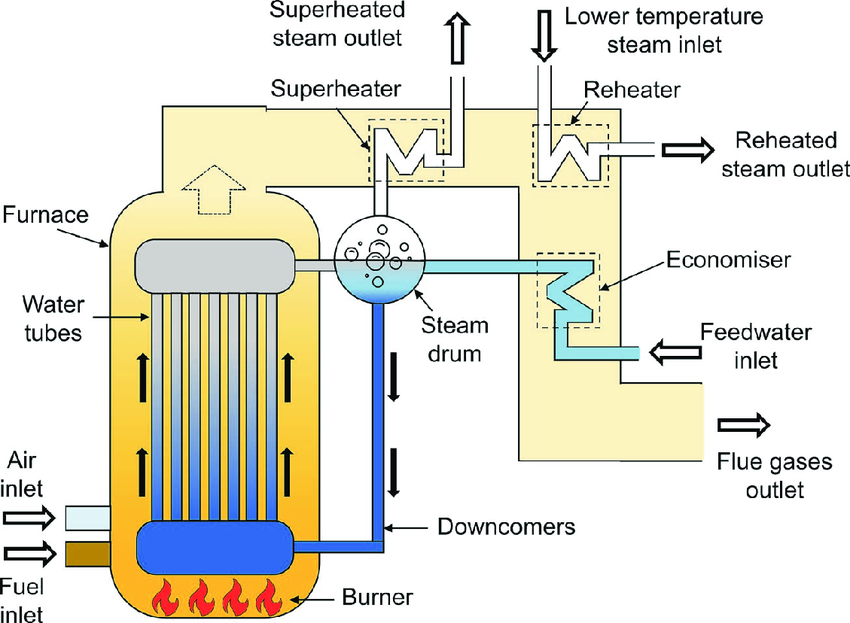
Steam is generated by heating water to its boiling point, typically in a boiler. The process involves:
Heating water: A heat source (e.g., burning coal, natural gas, or nuclear reactions) is applied to water in a boiler.
Vaporization: As the water reaches its boiling point, it transforms from liquid to gas, expanding in volume by about 1,700 times.
Pressure control: The steam's pressure and temperature are regulated within the boiler system.
Superheating: In some cases, steam is further heated beyond its saturation point to create superheated steam, which contains more energy.
Distribution: The generated steam is then directed through pipes to its intended use, such as powering turbines for electricity generation or providing heat for industrial processes.
The efficiency and characteristics of the steam produced depend on factors like the heat source, boiler design, and intended application.
Types of Steam
Steam exists in several forms, each with distinct properties:
Wet Steam (Saturated Steam):
Contains water droplets suspended in vapor.
It forms when water begins to evaporate but hasn't fully converted to vapor.
Wet steam has less usable heat energy than dry saturated steam, with its energy content determined by its dryness fraction.
It can cause corrosion and decrease heat transfer efficiency.
Dry Saturated Steam:
Steam at the saturation temperature with no water droplets.
It occurs when all water has evaporated but the temperature hasn't increased beyond the boiling point for the given pressure.
Rapid and even heating, high heat transfer coefficient, precise temperature control through pressure adjustment.
Used for general heating, process heating.
Superheated Steam:
Steam heated beyond its saturation temperature.
It contains more energy than saturated steam and behaves more like a gas, obeying gas laws.
Resistant to condensation, higher temperatures, lower density.
Used in power generation, turbine operation
Pressure Classifications and Ranges
The following pressure classes are obtained from multiple sources but can vary between industries and specific facilities. When selecting steam pressure for process applications, it is recommended to find the equivalent steam pressure for the required temperature in steam tables, then add approximately 45 psi to ensure adequate heat transfer.
Low Pressure (LP) Steam
Type: Typically saturated steam
Pressure Range: Less than 0-15 psig (0-1.03 barg)
Temperature Range: 212-250°F (100-121°C)
Applications: Water heating, unit heaters, space heating, comfort heating
Note: Always recommended for general heating applications
Medium Pressure (MP) Steam
Type: Typically saturated steam
Pressure Range: 15-150 psig (1.03-10 barg)
Temperature Range: 250°F-366°F (121°C-186°C)
Applications: Process heating, sterilization
High Pressure (HP) Steam
Type: Can be saturated or superheated
Pressure Range: 150-600 psig (10-40 barg)
Temperature Range: 366°F-482°F (186°C-250°C)
Applications: Process applications requiring higher temperatures
The energy content of steam is calculated differently depending on its state:
For Wet Steam
Energy content depends on the dryness fraction (ζ):
ht = hs·ζ + (1-ζ)·hw
Where:
ht= enthalpy of wet steam (kJ/kg)
hs = enthalpy of dry saturated steam (kJ/kg)
hw = enthalpy of saturated water (kJ/kg)
ζ = dryness fraction
For Dry Saturated Steam
hg = hf + hfg
Where:
hg = Total enthalpy (kJ/kg)
hf = Sensible heat (kJ/kg), the energy required to raise water from reference temperature (0°C) to boiling point.
hfg = Latent heat (kJ/kg),the energy required to convert saturated water to saturated steam.
At atmospheric pressure:
Sensible heat (hf) = 419 kJ/kg
Latent heat (hfg) = 2257 kJ/kg
Total enthalpy (hg) = 2676 kJ/kg
For Superheated Steam
hs = hg + Cps.(Ts - Tf)
Where:
hs = enthalpy of superheated steam (kJ/kg)
hg = enthalpy of dry saturated steam (kJ/kg)
Cps = specific heat of steam at constant pressure (≈1.860 kJ/kg°C)
Ts = superheated steam temperature (°C)
Tf = saturation temperature (°C)
The enthalpy values for superheated steam at various pressures and temperatures can be found in steam tables, such as:
At 15 bar, 300°C: 3039 kJ/kg
At 20 bar, 300°C: 3025 kJ/kg
At 30 bar, 300°C: 2995 kJ/kg
Advantages as Heat Transfer Medium
Steam offers several advantages over other heat transfer fluids:
High Energy Density: Steam releases 5-10 times more energy per unit mass than hot water through latent heat transfer.
Constant Temperature: Condensation occurs at constant temperature, enabling even heating across the entire heat transfer surface.
Precise Control: Temperature can be precisely controlled by adjusting pressure.
High Heat Transfer Coefficient: 6000-15000 W/(m²°C) compared to 1000-6000 W/(m²°C) for hot water.
These properties make steam particularly valuable in applications requiring rapid, uniform heating such as power generation, industrial processes, sterilization, and district heating systems.
References
Perplexity A.I. assisted description generation, 31st Mar 2025.

We operate the only free, open-access platform dedicated to mapping the Energy and Petrochemicals industry.
Our mission: to create a holistic, integrated, and complete picture of the sector, its assets, processes, and players.
Community
This ambitious project thrives on community contributions.
Join our Expert-Community and benefit by bringing content to the platform.
Discover our flexible tools to adding your Insights to Technologies, Companies and industry trends.
Contribute and Support
If you believe in transparency, collaboration, and accessible knowledge.
With your payment you support the content contributors and the platform.
Every contribution fuels the development of this unique platform and will be shared between the Content-Authors and the platform.
Share your insights with the community
ppPLUS Communicator
Add company news, business events,
operational updates, etc
Collaborator Assigned with registration
Data Modelling
Update Descriptions of Companies, Technologies, Products...
Model Mass Balances and visualize Processes
Create Indicators and much more
Modeler
Insights
Create your own Expert-Profile
Publish comprehensive insights, new articles
Create ppPLUS Solutions Services (See Solutions)
Modeler with Expert-Status
Go here
if you haven't registered yet and we will contact you.
For any questions email us.
Earn Appreciation Directly From Your Audience
With the ppPLUS Donation Feature, your readers can show their appreciation by contributing a small monetary “thank you” for the insights you share. It’s a simple, transparent way to reward your expertise and support your work.
Readers can make voluntary Donations on your content.
You receive 80% of every contribution.
ppPLUS retains 20% to support platform operations and continuous improvement.
Your earnings are collected and paid out to you within 30 days.
You stay in control
Opt in whenever you’re ready.
Opt out at any time — no obligations, no lock‑ins.
Future updates to the program will always be communicated clearly.
Why Experts love it
It’s effortless: no setup, no maintenance.
It rewards quality and expertise.
It strengthens your connection with your audience.
It creates a new income stream without changing how you publish.
By selecting "Accept" you are accepting the Terms and Conditions for our Donation-Model.
An Email will be send to you asking for your Banking Details.
Share your insights
Open
We operate the only free, open-access platform dedicated to mapping the Energy and Petrochemicals industry.
Our mission: to create a holistic, integrated, and complete picture of the sector, its assets, processes, and players.
Community
This ambitious project thrives on community contributions.
Join our Expert-Community and benefit by bringing content to the platform.
Discover our flexible tools to adding your Insights to Technologies, Companies and industry trends.
Contribute and Support
If you believe in transparency, collaboration, and accessible knowledge.
With your payment you support the content contributors and the platform.
Every contribution fuels the development of this unique platform and will be shared between the Content-Authors and the platform.
Advertise with us
The platform where industry experts meet
Advertise where the industry actually gathers — thousands of specialists, operators,
and consultants use ppPLUS every day to research, analyse, and connect.
Link your brand directly to technologies, assets, and operators
Place your message right next to the objects professionals work with — from technologies to value‑chain assets
— and reach users at the exact moment they explore your domain.
Configure your advert and campaign together with us
Shape a tailored campaign with our team — from messaging to placement —
ensuring your brand reaches the right audience with maximum relevance and impact.