
Product
Associated Gas
Abbreviation
APG
Names
Associated Petroleum Gas
Insight Articles
#PS161
naturalgas associatedgas apg lightalcanes lightgases
Main Product
Natural Gas
Segment
Extractive Industry Products
Main-Family
Fossil Hydrocarbons
Sub-Family
Gaseous Feedstock
Physical State

Gas

Description

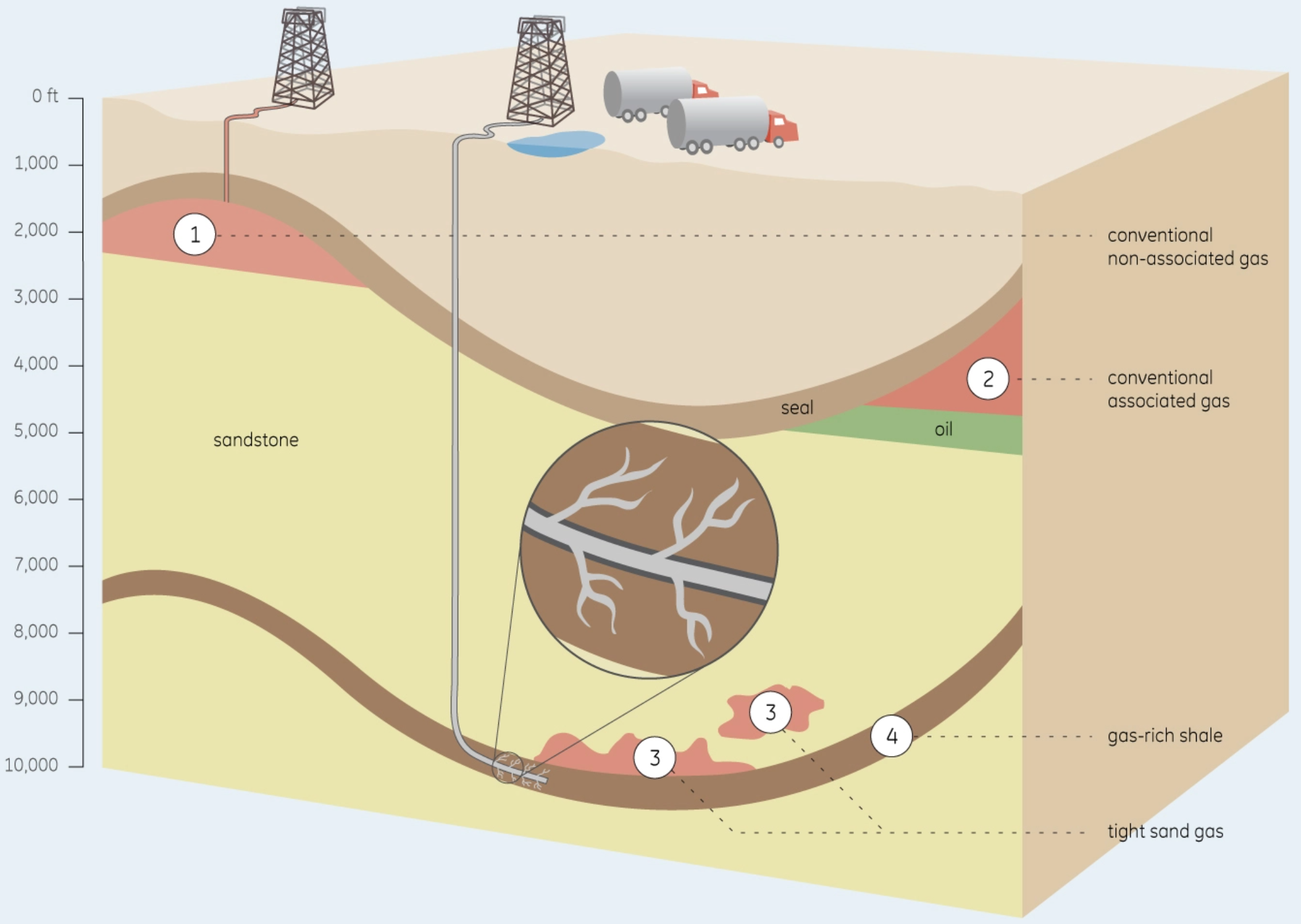
Associated gas (also called associated petroleum gas or APG) is natural gas that occurs together with crude oil in a petroleum reservoir, produced as a co-product or by-product of oil extraction.

Occurrence in the Reservoir

Within the reservoir, associated gas exists in two distinct forms:​

  • Free gas (gas cap): Gas that exists separately above the oil as a pressurized cap in the reservoir formation
  • Dissolved gas: Gas dissolved directly into the crude oil under high reservoir pressure, which is released when oil is brought to the surface (similar to carbonation escaping from a pressurized bottle)​

Composition

Associated gas is primarily a mixture of alkane hydrocarbons. Its typical composition includes:

Because it often contains light liquid hydrocarbons like propane and butane, associated gas is sometimes referred to as "wet gas".​

Properties

Based on the typical APG composition reported in the literature, the following values can be derived:​

Molecular Weight

The average molecular weight of APG is calculated as the mole-fraction-weighted sum of component MWs. Using the typical composition (81% methane, 6.6% propane, 5.5% ethane, 4% butane, 1.4% pentane, 1% N₂, 0.17% CO₂): ~ 21.3 g/mol

This is notably higher than pure methane (16.04 g/mol) due to the heavier C₂–C₅ hydrocarbon content, and lower than air (28.97 g/mol), confirming APG is lighter than air.

Specific Gravity (Relative to Air)

Gas-phase specific gravity is defined relative to air at the same conditions: 21.3 / 28.97 ~ 0.73

This value reflects a rich/wet gas character. Leaner APG streams (higher methane content) would have SG values closer to 0.55–0.65, while richer streams with more C₃+ content can push SG above 0.80.​

In practice, APG composition — and therefore its MW and SG — varies significantly by field and reservoir. Fields with high liquid content (condensate-rich) will show higher MW and SG, while gas-cap gas dominated by methane behaves closer to dry natural gas (SG ≈ 0.55–0.65).

Distinction from Non-Associated Gas

Associated gas comes from oil wells, whereas non-associated gas is produced from dedicated gas or condensate wells where little or no crude oil is present. The U.S. EIA uses a gas-oil ratio (GOR) threshold of 6,000 cubic feet per barrel to classify a well as an oil well — any gas produced from such a well is classified as associated gas.

Utilization and Disposal

After separation from the crude oil at the wellhead, associated gas can be handled several ways:​

  • Sold into natural gas distribution networks (after processing)
  • Reinjected into the reservoir for pressure maintenance and enhanced oil recovery (EOR)
  • Used on-site for power generation (engines or turbines)
  • Processed into LNG or petrochemical feedstocks
  • Flared or vented — historically the most common fate in regions lacking gas infrastructure, though this is increasingly regulated​

Associated gas is generally considered an undesirable by-product of oil production, as field development costs are primarily justified by the crude oil revenue rather than the gas.


Insight Articles
Your insights will be shown here

The geology of natural gas| Source: U.S. Energy Information Administration and U.S. Geological Survey
Identifiers

No Identifiers defined

Chemical Data

Molecular Weight (g/mol)
21.3
Specific Gravity
0.73
Crude Data

API Gravity
62.34
Country
Product Settings

Default
Status
A
Content provided by
Transaction Name Date
Modified by UserPic   Kokel, Nicolas 4/14/2026 8:39 AM
Added by UserPic   Kokel, Nicolas 9/28/2021 9:51 AM