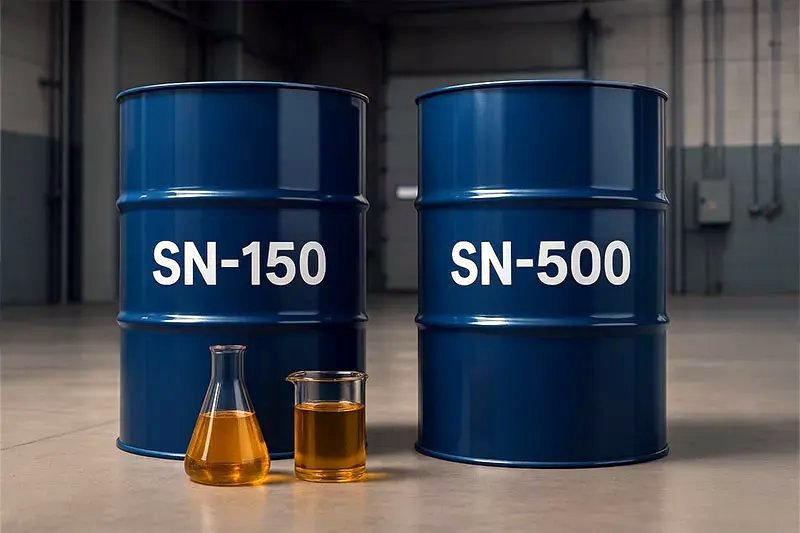
Solvent Neutral (SN) base oils are Group I mineral lubricant base oils produced through traditional solvent refining processes to remove undesirable components and improve performance characteristics. SN base oils represent the most widely produced and cost-effective category of lubricant base stocks globally, serving as the foundation for conventional automotive and industrial lubricant formulations.
Nomenclature and Classification
The term "Solvent Neutral" derives from the refining methodology and chemical characteristics:
"Solvent": Refers to the use of selective solvents—typically furfural, phenol, N-methylpyrrolidone (NMP), or historically sulfuric acid—during the extraction stage to remove aromatic compounds, polar impurities, and low-viscosity-index components from the vacuum distillate fractions.
"Neutral": Indicates that the refined oil exhibits neutral pH characteristics and moderate polarity, distinguishing it from acidic or highly polar petroleum fractions.
Numerical suffix: The number following "SN" (such as 150, 300, 500) represents the approximate Saybolt Universal Seconds (SUS) viscosity measured at 100°F (37.8°C). This viscosity-based nomenclature provides immediate identification of the oil's flow characteristics and typical application range.
Common commercial grades include:
- SN 80/SN 100: Lightest grades for spindle oils and low-viscosity applications
- SN 150: Light neutral oil (~4-5.4 cSt at 100°C)
- SN 300: Medium neutral oil (~6-7 cSt at 100°C)
- SN 500: Heavy neutral oil (~9.5-11.2 cSt at 100°C, most widely traded grade)
- SN 600: Very heavy neutral oil (~11-13 cSt at 100°C)
- SN 650: Heaviest neutral oil grade (~12-14 cSt at 100°C)
Production Process
Solvent Neutral (SN) base oils are manufactured through a sequential refining process applied to vacuum distillate fractions from crude oil. The production route consists of three primary stages:
Figure 1 - Manufacturing of Solvent Neutral (SN) base oil [2]
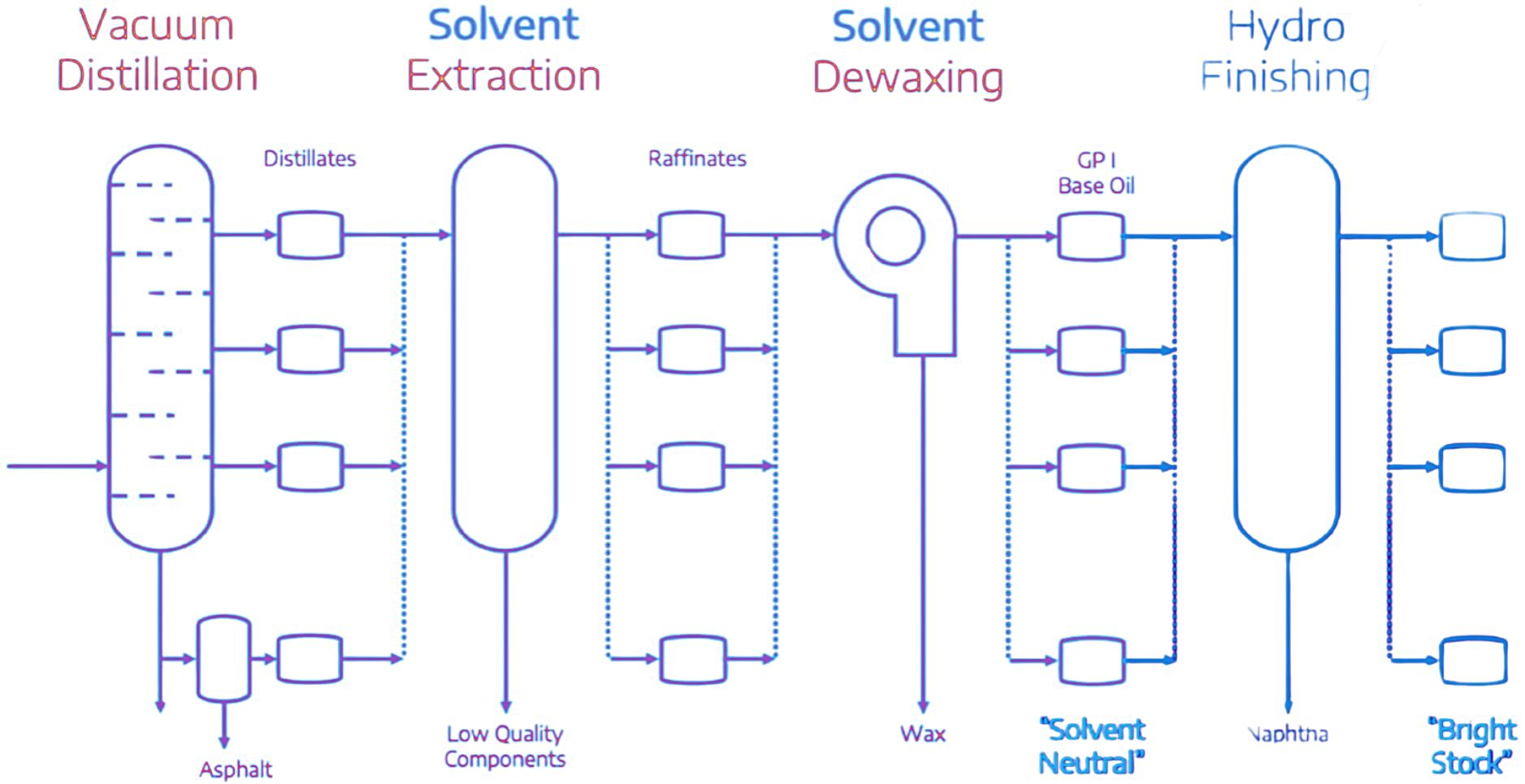
- Crude Oil Distillation: Crude oil undergoes atmospheric distillation followed by vacuum distillation of the atmospheric residue. Vacuum distillation at reduced pressure (50-100 mmHg) and elevated temperature (350-400°C) separates multiple vacuum gas oil (VGO) cuts with different boiling ranges, each corresponding to a specific base oil viscosity grade (SN 150, SN 300, SN 500, etc.).
- Solvent Extraction: The VGO fractions are treated with selective solvents (furfural, phenol, or N-methylpyrrolidone) that preferentially dissolve aromatic compounds while leaving paraffinic and naphthenic hydrocarbons in the raffinate phase. This step removes 10-30% of the feed as aromatic extract, significantly improving the viscosity index, oxidation stability, and color of the remaining raffinate.
- Solvent Dewaxing: The raffinate is mixed with dewaxing solvent (typically methyl ethyl ketone/toluene), chilled to -10°C to -30°C to crystallize waxy n-paraffins, and filtered to remove wax crystals. This reduces the pour point to -9°C to -18°C depending on grade specifications. The separated wax (10-25% yield) is processed into slack wax products.
This three-stage solvent refining route produces Group I base oils with 60-85% saturates, 0.2-0.5% sulfur, and viscosity index of 90-105, meeting requirements for a wide range of automotive and industrial lubricant applications. Unlike Bright Stock, Solvent Neutral base oils do not undergo hydrofinishing—this is the key distinction between these two Group I product categories.
Chemical Composition and Properties
This conventional solvent refining route produces Group I base oils with 60-85% saturates, 0.2-0.5% sulfur, and viscosity index of 90-105, meeting requirements for a wide range of automotive and industrial lubricant applications.
Group I Classification (API specifications):
- Saturates content: <90% (typically 60-85%)
- Sulfur content: >0.03% (typically 0.2-0.5%)
- Viscosity Index: 80-110 (typically 90-105)
- Aromatics: 10-30% (depending on extraction severity)
Hydrocarbon composition:
- Paraffinic compounds (40-60%): Linear and branched alkanes providing oxidation resistance and high VI
- Naphthenic compounds (15-30%): Cycloalkanes contributing to low-temperature fluidity and solvency
- Aromatic compounds (10-30%): Residual aromatics providing additive solvency but limiting oxidation stability
The moderate aromatic content (compared to Group II/III which have <10% or <1%) provides excellent solvency for additive packages—a key advantage for formulating complex lubricant blends.
Comparison between SN and Higher Group Base Oils
Comparative table, SN (Group I) vs. Group II and Group III Base Oils:
| Characteristic |
SN (Group I) |
Group II |
Group III |
| Saturates, % |
<90 |
≥90 |
≥90 |
| Sulfur, % |
>0.03 |
≤0.03 |
≤0.03 |
| Viscosity Index |
80-110 |
80-120 |
≥120 |
| Aromatics, % |
10-30 |
5-10 |
<1 |
| Color |
Amber/yellow |
Light/clear |
Water-white |
| Oxidation stability |
Good |
Very good |
Excellent |
| Additive solvency |
Excellent |
Good |
Fair |
| Cost (relative) |
1.0x |
1.2-1.4x |
1.5-2.0x |
Key advantages of SN base oils:
- Lowest cost: Most economical base oil option
- Excellent additive solvency: Aromatic content enhances compatibility with additive packages
- Global availability: Produced by refineries worldwide
- Proven performance: Decades of field experience and established formulations
- Adequate for many applications: Meets requirements where Group II/III advantages are not critical
Limitations compared to Group II/III:
- Lower oxidation stability requiring higher additive treat rates
- Higher volatility increasing oil consumption
- Lower VI limiting performance in extreme temperature ranges
- Higher sulfur content affecting emissions in modern engines
Relationship to Bright Stock
While both SN base oils and Bright Stock are Group I products manufactured through solvent refining, they differ in one critical processing step and their resulting applications:
Solvent Neutral (SN):
- Production: Vacuum distillation → Solvent extraction → Solvent dewaxing
- Lighter viscosity grades (4-14 cSt at 100°C)
- Used as primary base oil in lubricant formulations
- Lower viscosity suitable for direct use in most applications
- Amber to yellow color
- Lower cost due to fewer processing steps
- Lower viscosity suitable for direct use in most applications
Bright Stock (BS):
- Production: Vacuum distillation → Solvent extraction → Solvent dewaxing → + Hydrofinishing
- Produced from heavier vacuum residue fraction (after de-asphalting)
- Very high viscosity (~28-35 cSt at 100°C)
- Used primarily as viscosity modifier/blending component
- "Bright" (clear, light) appearance from hydrofinishing
- Hydrofinishing improves color stability, demulsibility, and oxidation resistance
The hydrofinishing step—conducted at elevated temperature and hydrogen pressure—distinguishes Bright Stock from Solvent Neutral base oils by saturating remaining double bonds, removing polar compounds, and producing the characteristic bright color.
Market Position and Future Outlook
Despite the refining industry's gradual shift toward Group II and Group III base oils, SN grades maintain significant market relevance, balancing adequate performance with cost-effectiveness for the majority of conventional lubrication applications. Their established manufacturing base, proven formulations, and economic advantages ensure continued relevance despite competitive pressures from higher-quality base stock categories.
References
- Yousefi A.R., Infinity Galaxy (July 23, 2019). Base Oil Groups & Specifications
- Lubrication Explained (October 25, 2021). Bright Stocks (BS) and Solvent Neutral (SN) base oils explained. Youtube Video
- Black Water Petrochemical FZE (June 9, 2024). Base Oil SN600
- Faraz Oil (August 19, 2025). SN 150 vs SN 500 | What Are the Key Differences?
- Atabaş Grup Dış Tic. Ltd. Şti. (February 6, 2026). Base Oil SN100–SN500: Uses, Grades, and Export Supply
- Felix E., Matta Trade (November 6, 2023). Comparing Base Oil SN150 and SN500
- Zumrut International Kimya (Jul 16, 2019). Base Oil SN500