Steel is an alloy of iron and carbon, and the world's most important structural and engineering material. With annual production exceeding 1.9 billion tonnes, it is the backbone of the built environment, manufacturing, transportation, and energy infrastructure globally. Unlike pure iron, which is relatively soft, steel's properties are tuned across an enormous range through precise control of carbon content, alloying elements, and heat treatment — making it one of the most versatile materials ever developed.
Chemical Identity & Classification
| Property |
Value |
| Base Metal |
Iron (Fe) |
| Primary Alloying Element |
Carbon (C), 0.02–2.0 wt% |
| Density |
7.75–8.05 g/cm³ (depending on composition) |
| Melting Range |
1,370–1,530 °C |
| Young's Modulus |
~200 GPa |
| Thermal Conductivity |
15–65 W/m·K |
| Electrical Resistivity |
10–130 nΩ·m |
Steel is technically defined as an iron-carbon alloy with carbon content between 0.02% and 2.0% by weight. Above 2.0% C, the material is classified as cast iron. Below 0.02% C, it is essentially pure iron (ferrite).
Carbon Content & Grade Classification
Carbon content is the primary determinant of steel's mechanical properties:
| Classification |
Carbon Content |
Key Properties |
Typical Uses |
| Low carbon (mild steel) |
0.02–0.30% C |
Ductile, weldable,
soft |
Structural sections,
sheet, pipe, rebar |
| Medium carbon |
0.30–0.60% C |
Stronger,
less ductile |
Rails, axles,
gears, machinery |
| High carbon |
0.60–1.00% C |
Hard, wear-
resistant, brittle |
Springs, cutting
tools, wire rope |
| Ultra-high carbon |
1.00–2.00% C |
Very hard,
very brittle |
Specialty cutting
tools, knife blades |
Alloying Elements
Beyond carbon, a wide range of alloying elements are added to produce alloy steels and specialty steels:
- Manganese (Mn) — improves hardenability and tensile strength; deoxidiser
- Chromium (Cr) — corrosion resistance; hardness; forms stainless steel (>10.5% Cr)
- Nickel (Ni) — toughness, corrosion resistance, low-temperature performance
- Molybdenum (Mo) — high-temperature strength; hardenability
- Silicon (Si) — deoxidiser; electrical steels for transformers and motors
- Vanadium (V) — grain refinement; high-strength low-alloy (HSLA) steels
- Titanium (Ti) — grain control; interstitial-free (IF) steels
- Boron (B) — extreme hardenability improvement at very low additions (<0.005%)
- Tungsten (W) — high-speed tool steels; retains hardness at elevated temperatures
Steel Families
The steel industry classifies products into several broad families:
| Family |
Description |
Examples |
| Carbon steel |
Fe-C only;
no significant alloying |
Structural steel,
rebar, wire rod |
| Alloy steel |
Fe-C + one or more
alloying elements |
High-strength structural, pressure vessels |
| Stainless steel |
≥10.5% Cr; corrosion-resistant |
Austenitic (304, 316),
ferritic, martensitic, duplex |
| Tool steel |
High C + W, Mo, V, Cr; extreme hardness |
Cutting tools, dies,
moulds |
| Electrical steel |
Si-alloyed; low
hysteresis loss |
Transformer cores,
motor laminations |
| High-strength low-alloy (HSLA) |
Low C + microalloying elements |
Automotive, pipelines, offshore structures |
| Advanced high-strength steel (AHSS) |
Complex microstructures; very high strength |
Automotive body panels, crash structures |
Production Routes
Steel is produced by two principal routes:
Blast Furnace — Basic Oxygen Furnace (BF-BOF) — ~70% of global output:
- Pig iron from the blast furnace (~4% C) is charged into a BOF converter
- High-purity oxygen is blown at supersonic speed through the molten metal
- Carbon is oxidised to CO/CO₂, reducing C content to <0.1% in ~20 minutes
- Alloying elements are added at tapping to achieve the target composition
- Steel is cast into slabs, billets, or blooms via continuous casting
Electric Arc Furnace (EAF) — ~30% of global output:
- Steel scrap and/or DRI is melted by high-current electric arcs
- Refining is performed in the ladle furnace (secondary metallurgy)
- More flexible than BOF; lower capital cost; lower CO₂ when using renewable electricity
- Dominant route for long products (rebar, sections, wire rod)
Heat Treatment
Steel's properties are profoundly altered by heat treatment, exploiting the α↔γ iron allotropic transformation at 912°C:
- Annealing — slow cooling; softens steel; improves machinability
- Normalising — air cooling; refines grain structure
- Quenching — rapid cooling (water/oil); produces martensite; maximises hardness
- Tempering — reheating quenched steel; reduces brittleness while retaining hardness
- Case hardening (carburising/nitriding) — hard surface layer on tough core
Key Industrial Applications
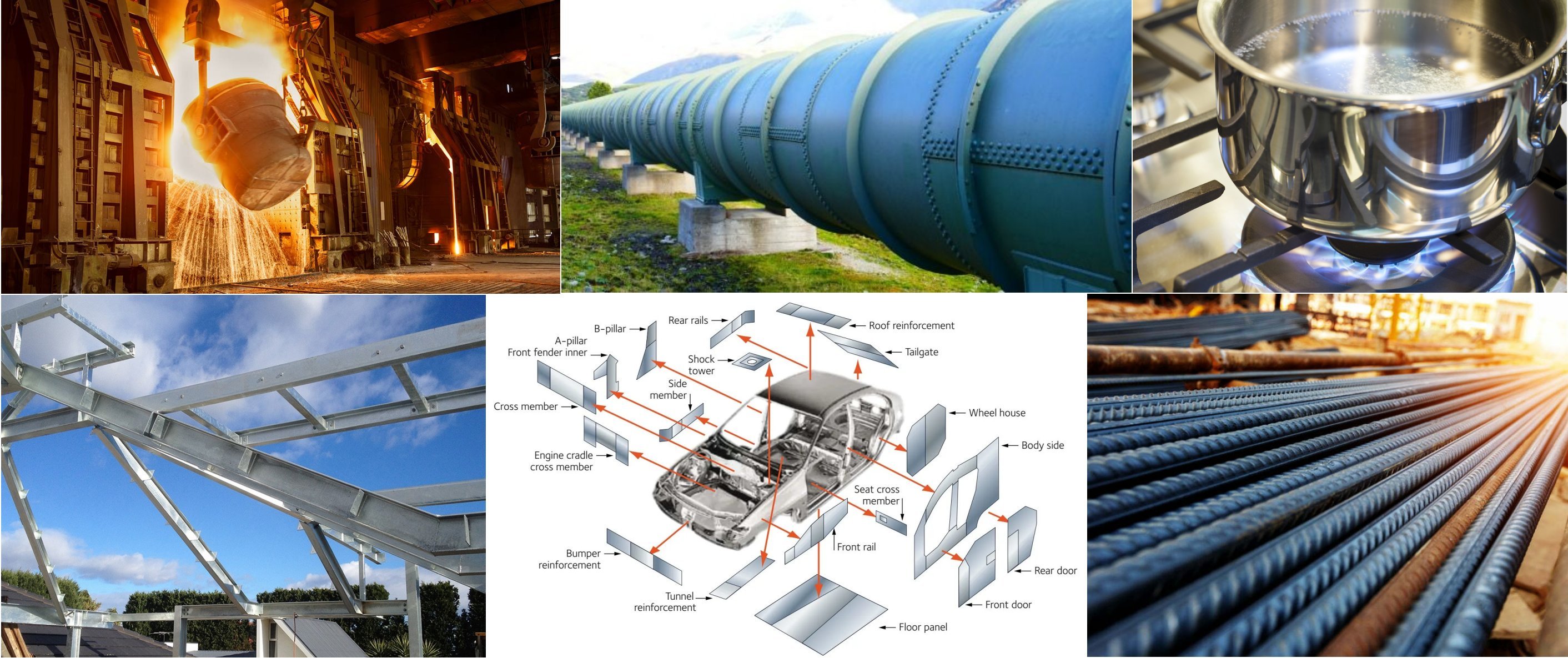
Steel's combination of strength, ductility, weldability, formability, and low cost makes it irreplaceable across virtually every industrial sector:
- Construction — structural sections (beams, columns), rebar, roofing, cladding, pipelines
- Automotive — body panels, chassis, crash structures, suspension (largest single end-use sector)
- Machinery & equipment — shafts, gears, pressure vessels, machine frames
- Energy — oil & gas pipelines (line pipe), wind turbine towers, power plant components
- Packaging — tinplate and tin-free steel for food and beverage cans
- Railways — rails, wheels, axles, rolling stock
- Shipbuilding — hull plates, structural members
- Appliances — white goods casings and internal components
Global Production & Trade
China dominates global steel production, accounting for approximately 54% of world output (~1.0 billion tonnes/yr), followed by India (~140 Mt), Japan (~90 Mt), the USA (~80 Mt), and Russia (~70 Mt). The global steel market is valued at over USD 900 billion annually. Steel is the world's most recycled material — globally, approximately 630 million tonnes of steel scrap are recycled each year, with a theoretical infinite recyclability without degradation of properties.
Relationship to Iron
Steel is produced from iron — either from pig iron (BF-BOF route) or direct reduced iron (EAF route). The transformation from iron to steel consists essentially of removing excess carbon and other impurities, and adding precise alloying elements to achieve target properties.
References
- Andre, National Material Company (Jun 15, 2020). Steel Breakdown: Types, Classifications, and Numbering Systems
- wordsteel (May 21, 2025). World Steel in Figures 2025
- Wikipedia. Steel (Page version Feb 20, 2026)
- Scott T., H&K Fabrication (Aug 7, 2023). Steel Grading: Understanding the Types of Steel Grades
- Grand View Research. Report GVR-4-68040-508-5: Alloy Steel Market (2025 - 2030)
- Zion Market Research. Report ZMR-7701: Alloy Steel Market Size, Share, Growth Analysis Report - Forecast 2034 (Sep 2005)
- wordsteel (Mar 2023). Fact sheet: Steel and raw materials





 CAS Number