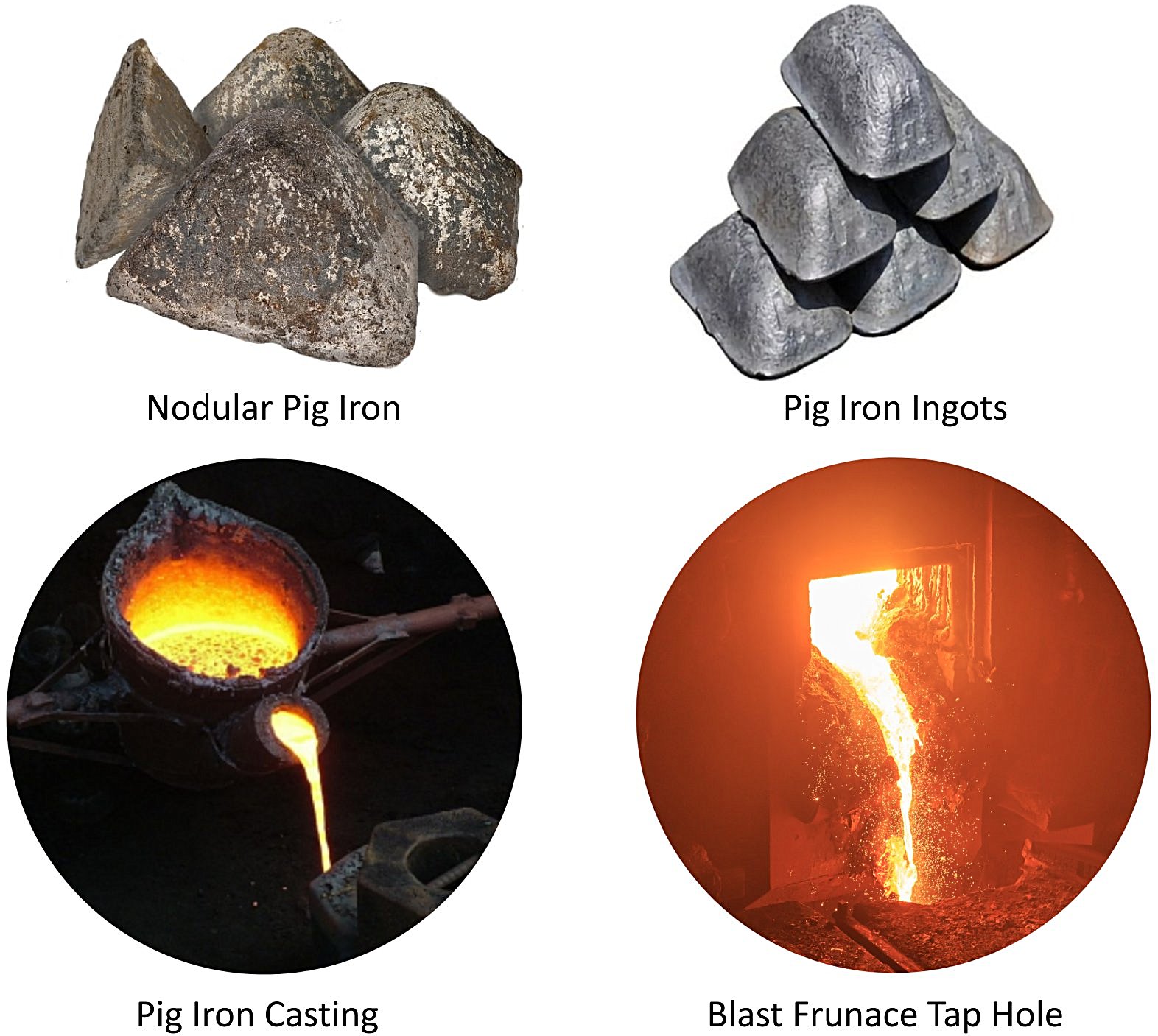

Pig iron is the primary metallic output of the blast furnace and the foundational intermediate of the iron and steel value chain. It is produced by the carbothermic reduction of iron ore using coke and limestone at temperatures exceeding 1,500°C, yielding a carbon-saturated molten iron that is tapped periodically from the furnace hearth. The name derives from the traditional sand-mould casting system in which molten iron flowed from a central runner into a series of small branching moulds — the arrangement resembled piglets feeding from a sow.
Chemical Identity & Composition
| Property |
Value |
| Primary Element |
Iron (Fe) — 93–95% |
| Carbon Content |
3.5–4.5% C (near eutectic saturation) |
| Silicon |
0.3–2.5% Si |
| Manganese |
0.1–1.5% Mn |
| Sulphur |
0.01–0.05% S |
| Phosphorus |
0.04–2.0% P (ore-dependent) |
| Physical State (tapped) |
Liquid at ~1,450–1,500°C |
| Density (solid) |
~7.1–7.2 g/cm³ |
The high carbon content (near the Fe-C eutectic at 4.3% C) and residual impurities make pig iron hard and brittle — it cannot be worked or fabricated directly and is not an end-use structural material.
Production Process
Pig iron is produced exclusively in the blast furnace (BF), a continuous counter-current reactor in which iron-bearing burden (ore sinter, pellets, or lump ore) descends against an ascending stream of hot reducing gases generated by the combustion of coke with preheated air blast. The key reactions are:
Indirect reduction (dominant, 800–1,000°C):
Fe2O3 + 3 CO → 2 Fe + 3 CO2
Direct reduction (at high temperature, >1,000°C):
FeO + C → Fe + CO
Carburisation (in the bosh/hearth zone, >1,200°C):
Fe + C → Fe(C) (dissolved carbon in iron)
Limestone flux decomposes and combines with gangue minerals to form a separate blast furnace slag phase, which floats on the liquid iron and is tapped separately.
Product Grades
| Grade |
Description |
Primary Use |
| Basic pig iron / hot metal |
Standard BF output;
C ~4%, Si ~0.3–0.8% |
BOF steelmaking
(direct hot metal charge) |
| Foundry pig iron |
Higher Si (1.5–2.5%);
lower P |
Cupola remelting
for grey cast iron castings |
Nodular (ductile) grade
pig iron |
Low S, low P;
high Mn |
Ductile iron casting;
nodular iron foundries |
High-purity / merchant
pig iron |
Low P, low S;
consistent composition |
Export trade;
EAF charge material |
Physical Forms & Trade
Pig iron is traded and transported in two principal forms:
- Hot metal — liquid pig iron transferred directly from blast furnace to BOF converter in torpedo cars or ladles within integrated steel plants; not traded commercially in this form
- Solid pig iron (merchant pig iron) — cast into ingots (~5–10 kg), T-bars, or granules at a casting machine; cooled, stockpiled, and traded as a commodity; used by foundries and EAF operators without captive blast furnace capacity
Major exporting countries for merchant pig iron include Brazil, Russia, Ukraine, and China, with significant trade flows to the United States and European foundry industries.
Industrial Significance & Downstream Use
Approximately 95% of global pig iron production is consumed internally within integrated BF-BOF steelworks as hot metal — it never enters merchant trade. Of the remainder:
- Foundry pig iron is remelted in cupola or electric induction furnaces to produce grey cast iron, ductile iron, and malleable iron castings for automotive, infrastructure, and machinery applications
- Merchant pig iron serves as a virgin iron source for EAF steelmakers seeking to dilute tramp element (copper, tin, nickel) contamination in scrap-based charges
Global Production
Global pig iron production is approximately 1.18–1.20 billion tonnes per year (2023–2024), with the following geographic distribution:
| Region/Country |
Share |
| China |
~60% |
| India |
~8% |
| Japan |
~5% |
| Russia |
~4% |
| Brazil |
~3% |
| Rest of World |
~20% |
Relationship to Cast Iron
Although pig iron and cast iron share overlapping carbon content ranges and cast iron is produced by remelting pig iron, they are distinct materials in different product categories. Cast iron is an engineered ferrous alloy produced with deliberate compositional control (silicon content, inoculation, heat treatment) to achieve specific microstructures (graphite flake, spheroidal graphite, white iron matrix) and mechanical properties. Pig iron is an unrefined intermediate; cast iron is a finished engineering material. Cast iron is classified under Ferrous Alloys.
References
- wordsteel (May 21, 2025). World Steel in Figures 2025
- Britannica. pig iron (Page version: Sep 7, 2022)
- Satyendra, Ispat Guru (Apr 1, 2013). Pig Iron
- International Iron Metallics Association (iima). About ore-based metallics (Accessed Mar 1, 2026)