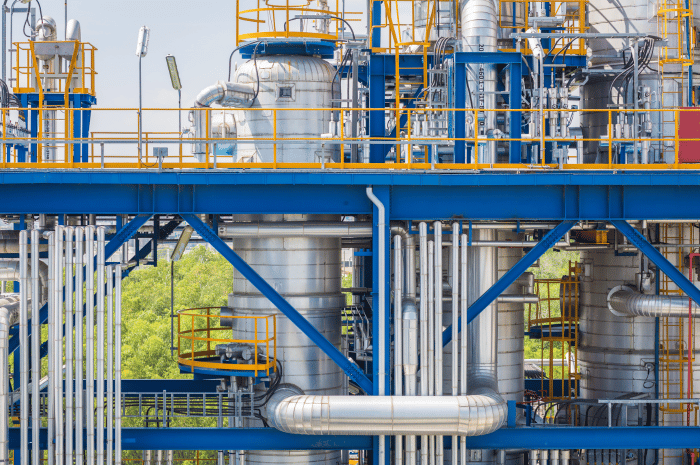
The Tehran Refinery, officially named the Shahid Tondgooyan Oil Refinery, is Iran's most centrally located crude oil refinery, situated in Rey City on the southern outskirts of Tehran. Established in 1965, it is one of the oldest refineries in Iran, comprising two separate refinery complexes built in two phases:
- Southern Refinery (Unit 1): commissioned in 1969
- Northern Refinery (Unit 2): commissioned in 1973
Together they form a single integrated operational complex managed by TORC.
Capacity
The Tehran Refinery is one of the largest refineries in Iran, primarily serving the fuel demand of the greater Tehran metropolitan area — the most densely populated region of Iran. As of early 2021, capacity details are as follows:
- Refining capacity: 250,000 b/d of crude oil
- Gasoline production: ~6.6 million litres/day (~41,500 b/d); upgrade target ~7.5 million litres/day
Feedstock
The refinery processes a blend of Iranian domestic crude oils:
- Ahvaz/Asmari crude (light Iranian crude from Khuzestan)
- Maroon/Shadegan crude (medium sour Iranian crude)
- Central Asian crude (imported blend, used when available)
Process Units
The refinery is a complex conversion refinery with the following main process units:
| Process Unit |
Details |
| Crude Distillation Units (CDU) |
Atmospheric distillation units (North and South refinery trains) |
| Vacuum Distillation Units (VDU) |
Producing vacuum gas oil (VGO) and vacuum residue for downstream conversion |
| Fluid Catalytic Cracking (FCC) |
Upgrades VGO to gasoline, LPG, and light cycle oil |
Catalytic Reforming
(CCR) |
Continuous Catalytic Reforming for high-octane gasoline and hydrogen production |
| Isomerization Unit |
18,000 b/d light naphtha isomerization; raises octane from 64 to 88 |
| Naphtha Hydrotreater |
Pre-treatment of naphtha for reformer feed |
| Kerosene / Gasoil Hydrotreaters |
Desulphurisation to meet product specs |
LPG Recovery /
Saturation Gas Plant |
Propane and butane recovery |
| Sulphur Recovery Unit (SRU) |
Claus process for sulphur recovery |
| Wastewater Treatment |
MBBR (Moving Bed Biofilm Reactor) system |
Products
The refinery produces a full range of petroleum products primarily for domestic supply to the Tehran region:
- LPG (propane, butane)
- Gasoline (regular and premium, Euro-4/5 spec after upgrade)
- Naphtha
- Jet A-1 / Kerosene
- Gasoil / Diesel
- Fuel oil
- Sulphur
Upgrade Projects
A major upgrade project was awarded to an Iranian contractor in February 2021 to raise gasoline production capacity from 6.6 to 7.5 million litres/day and upgrade quality to Euro-5 specifications. The project included an expanded naphtha hydrotreater and FCC naphtha desulphurisation unit.
Additionally, NIORDC's broader 2025 expansion programme includes development of RFCC (Residue Fluid Catalytic Cracking) capacity across its refinery network, with domestically-produced RFCC catalysts developed in collaboration between IKORC/Shazand engineers and Iranian technology startups — reportedly containing 16 specialized components with 800°F heat resistance.
Technology & Licensors
Given Iran's sanctions environment since 2012, TORC's original process units were licensed from Western technology providers prior to sanctions, and subsequent upgrades have been executed using domestically engineered solutions:
| Technology |
Licensor / Origin |
| FCC / RFCC |
Originally UOP / Stone & Webster (pre-sanctions); domestic catalyst development post-2012 |
| Catalytic Reforming (CCR) |
Originally UOP (pre-sanctions) |
| Isomerization |
Domestic Iranian engineering (post-sanctions) |
| Hydrotreatment |
Originally Axens / IFP / Haldor Topsøe (pre-sanctions); domestically maintained |
| SRU |
Claus process (original licensor not publicly confirmed) |