Technology Overview
The JPP Horizone™ Process—formerly known as the "Chisso Gas Phase PP Process"—is a sophisticated gas-phase polypropylene manufacturing technology that utilizes two horizontal reactors arranged vertically in stages for polymerization. The main distinguishing feature is the use of horizontal reactors with mild mechanical agitation, which contributes to operational stability, product quality improvements, and performance advantages.
Historical Development
Origins and Joint Development (1963-1995)
The Horizone™ technology originated from joint development between Chisso Corporation and Amoco Chemical Company. Chisso started its polypropylene business in 1963 as one of Japan's petrochemical pioneers. The initial process technology was developed by Amoco for homopolymer production in the mid-1970s. Chisso then expanded the technology into ethylene-propylene copolymer production in 1987.
The collaboration between Amoco and Chisso resulted in joint licensing arrangements starting in 1985, with the horizontally stirred reactor concept being a key innovation of this partnership. The Amoco-Chisso stirred-bed process utilized a horizontally stirred reactor with evaporative cooling, distinguishing it from other gas-phase technologies.
Figure 1 — JPP Horizone™ technology background and history
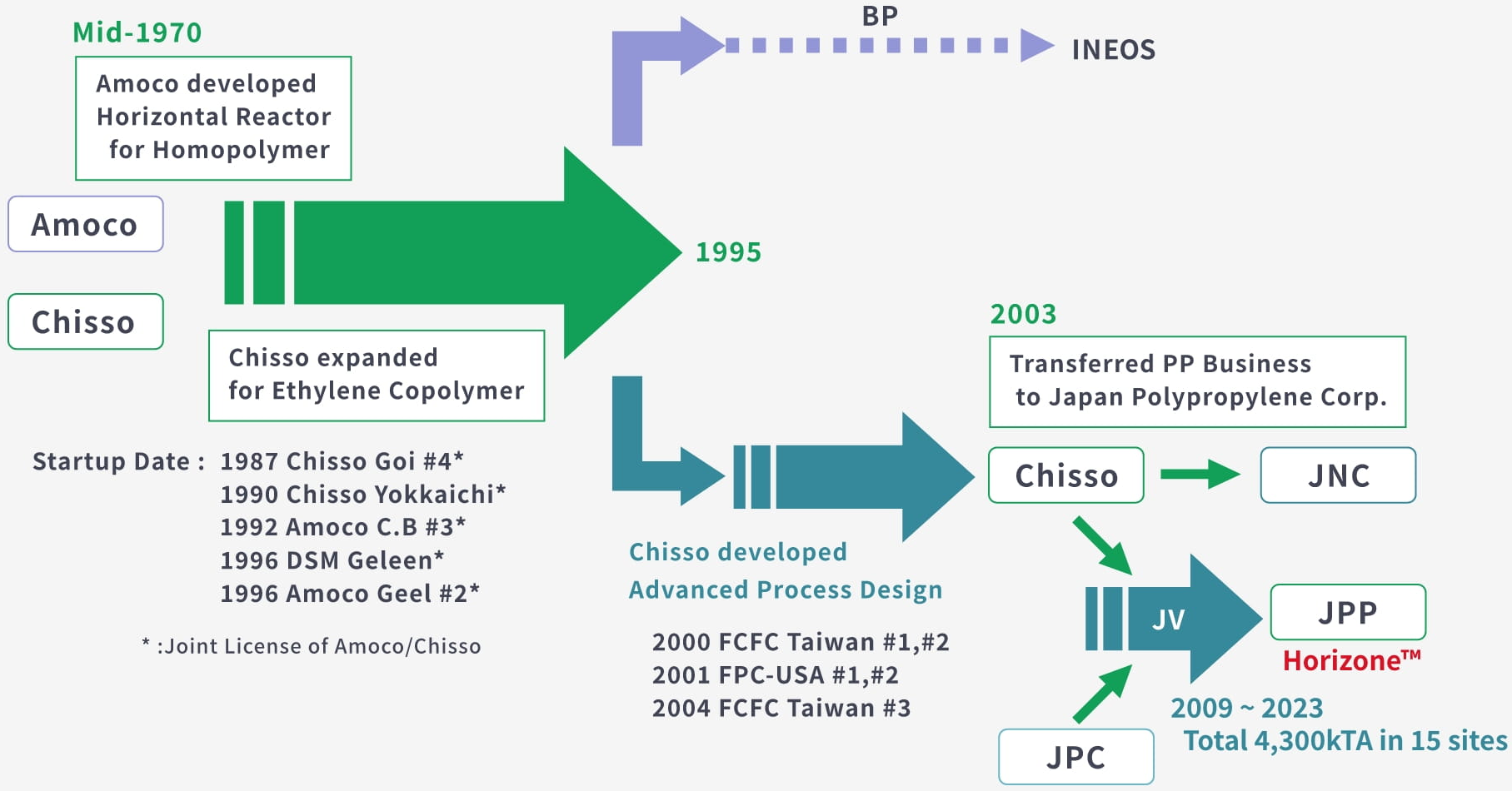
JPC: Japan Chemical Co.; JNC: JNC Corporation; JPP: Japan Polypropylene Corporation
Technology Split and Common Lineage with INEOS (1995)
In spring 1995, the cooperation between Chisso and Amoco ceased, after which each company independently carried out process development and licensing activities. This split created two distinct technology lineages from the original joint development:
- Chisso lineage: Continued as the Chisso Gas Phase PP Process, later becoming JPP Horizone™ after the formation of Japan Polypropylene Corporation in 2003
- Amoco lineage: Became the Innovene PP technology, which was later acquired by INEOS and marketed as INEOS Innovene PP
Both technologies share a common ancestor in the original Amoco-Chisso horizontal gas-phase polypropylene process developed during their partnership. After 1995, Amoco (which merged with BP in 1999) licensed its horizontal gas-phase polypropylene process technology separately, while Chisso continued developing its version independently. INEOS subsequently acquired the Amoco/BP polymer technologies and rebranded them as Innovene PP, though INEOS no longer actively licenses this technology.
Formation of JPP (2003-Present)
On October 1, 2003, Chisso and Japan Polychem Corporation (a subsidiary of Mitsubishi Chemical Corporation) established Japan Polypropylene Corporation (JPP) as a joint venture company. JPP became the leader of Japan's polypropylene business and has since provided state-of-the-art polypropylene manufacturing technology globally. The company continues to license the Horizone technology internationally, particularly targeting specialty polypropylene manufacturing for high-quality market segments, especially automotive applications.
Process Features
Reactor Configuration
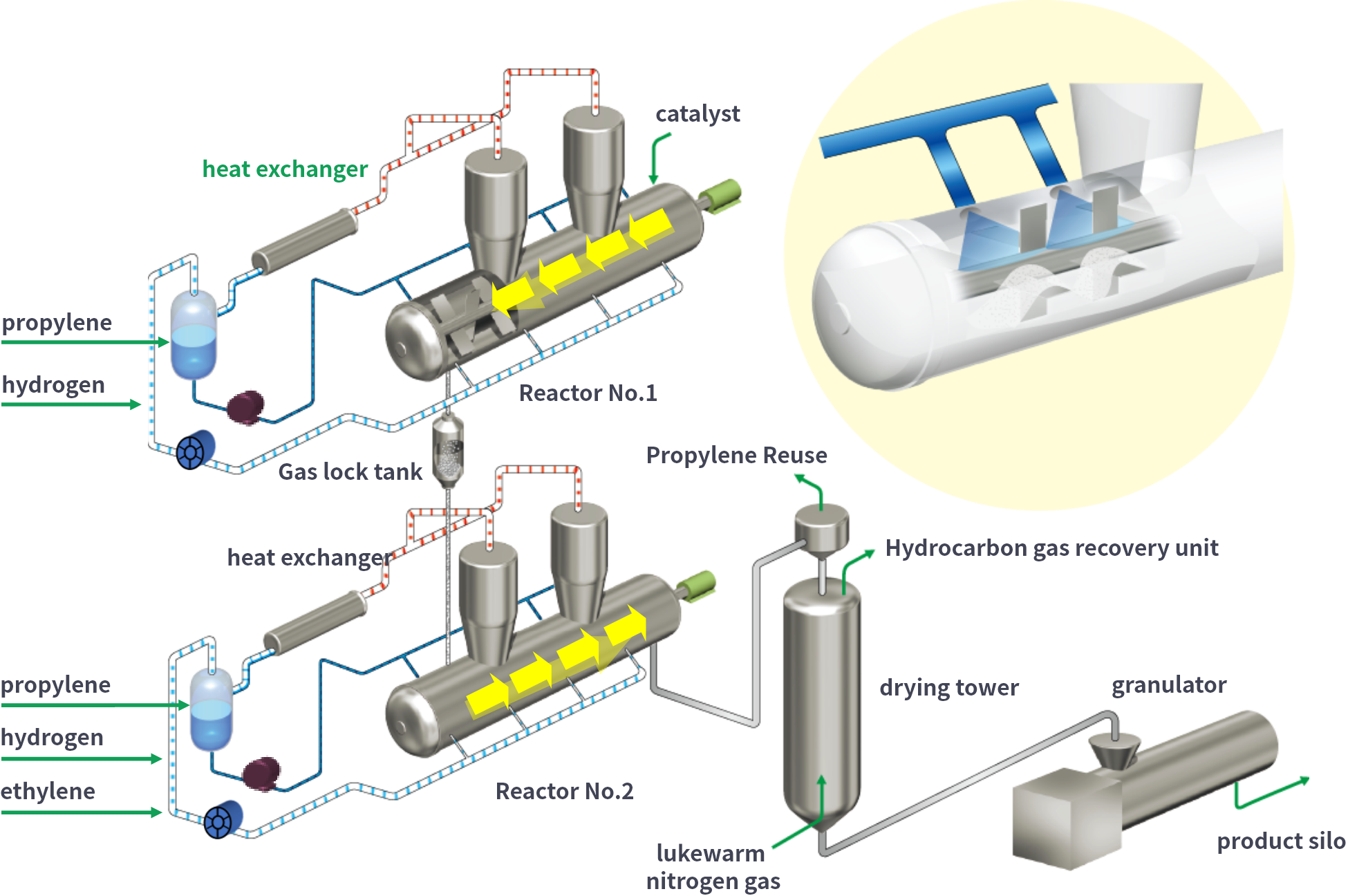
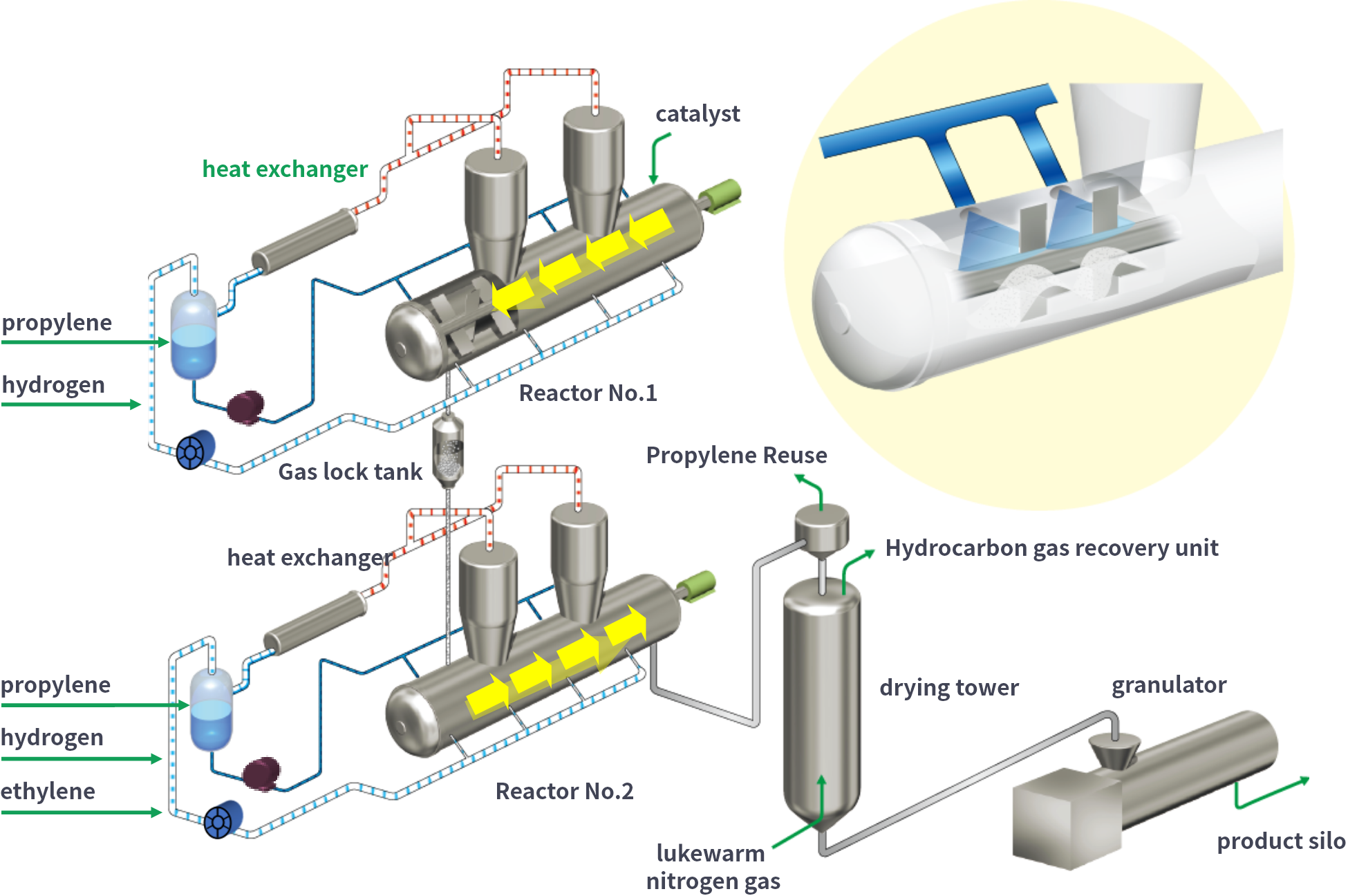
The Horizone™ process employs two horizontal reactors arranged vertically in stages. Each reactor operates with mild mechanical agitation at low speeds. This horizontal configuration achieves a "Plug Flow Powder Movement" that results in a narrow residence time distribution of powder in the reactors. The plug-flow profile is particularly suitable for impact copolymer production due to sharp residence time distribution.
Figure 2 — JPP Horizone™ simplified process diagram
Heat Removal System
The defining characteristic of the Horizone process is its unique heat removal mechanism. Reaction heat is removed through evaporative cooling accomplished by spraying liquid propylene from multiple nozzles into the reactors. The liquid propylene contacts the agitated powder bed and vaporizes by absorbing the heat of polymerization. Small liquid propylene particles contact the powder bed, and because vaporization has a limited rate, some liquid propylene is present within polymer particles. Each tonne of polymer produced requires approximately 6 tonnes of liquid propylene to be evaporated as coolant. This system provides accurate and stable control of polymerization reaction temperature.
Catalyst System
The process utilizes a proprietary tailor-made catalyst featuring high activity, high stereo-regularity, and excellent particle morphology. The catalyst is specifically designed to contain rich rubber content with minimal fines, ensuring optimum powder flow and enabling stable long-term operation. The catalyst's outstanding performance is attributable to synergistic effects originating from both catalyst and process design factors.
Process Advantages
The combination of the horizontal reactor design, liquid propylene cooling system, and proprietary catalyst provides several operational and economic benefits:
- Narrow powder residence time distribution achieved through plug-flow powder movement in horizontal reactors
- High polymer product throughput with minimum quantity of production transition materials
- Excellent stable reactor operation with superior product uniformity and quality control
- Efficient energy consumption and economical operating costs
- Low investment requirement and attractive operating costs compared to competing technologies
- Compact process package due to efficient heat removal system
Product Capabilities
The Horizone technology can produce a full range of polypropylene products across three main categories:
Homopolymer:
- Xylene insolubles: 94 to 99.5 wt%
- Reactor-made MFR range: 0.9 to 60 g/10 min (with controlled rheology grades extending to 300 g/10 min)
- Tensile strength: 33-39 MPa
- Flexural modulus: 1,350-2,000 MPa
Random Copolymer:
- Ethylene content: up to 6 wt%
- MFR range: 0.25 to 50 g/10 min
- Tensile strength: 23-31 MPa
- Flexural modulus: 700-1,300 MPa
Impact Copolymer:
- Reactor-made MFR: 0.65 to 65 g/10 min (fractional to 100 g/10 min for some grades)
- Reactor-made rubber content: up to 60 wt%
- Tensile strength: 22-28 MPa
- Flexural modulus: 830-1,500 MPa
- Charpy impact at 23°C: 5.3-62 MPa
Specialty Products: NEWCON™ R-TPO
The process enables the production of advanced in-reactor thermoplastic olefins (R-TPO) marketed under the NEWCON™ brand. NEWCON™ is a series of flexible R-TPO products containing high levels of a precisely designed rubber phase dispersed in crystalline-controlled matrices. These materials can contain rubber content up to 60 wt% and are highly suitable for automotive and industrial applications. NEWCON™ products demonstrate:
- MFR range: 0.5 to 45 g/10 min
- Tensile strength: 11-21 MPa
- Flexural modulus: 300-1,050 MPa
- Charpy impact at 23°C: 8 MPa to no break
- Charpy impact at -20°C: 2 MPa to no break
Global Licensing Portfolio
As of July 2023, JPP has licensed the Horizone technology to numerous world-scale facilities:
- Japan: JPP's own plants including Kashima (300 kTA), with earlier installations at Goi and Mizushima
- United States: Formosa Plastics USA in Texas with three plants totaling 790 kTA capacity, and Formosa Gulf Coast Louisiana with 600 kTA capacity
- China: Multiple SINOPEC facilities (Wuhan, Guangzhou, Hainan) totaling 600 kTA, plus additional projects
- Taiwan: Formosa Chemicals & Fibre Corp with 642 kTA across three plants
- Middle East: SABIC facilities in Saudi Arabia and joint ventures in China totaling over 1,000 kTA
- Europe: INEOS facilities inherited from the original Chisso/Amoco licensing period
- Thailand: IRPC with 100 kTA including in-line compounding
Figure 3 — JPP Horizone™ process licensees map (Sep 15, 2023)
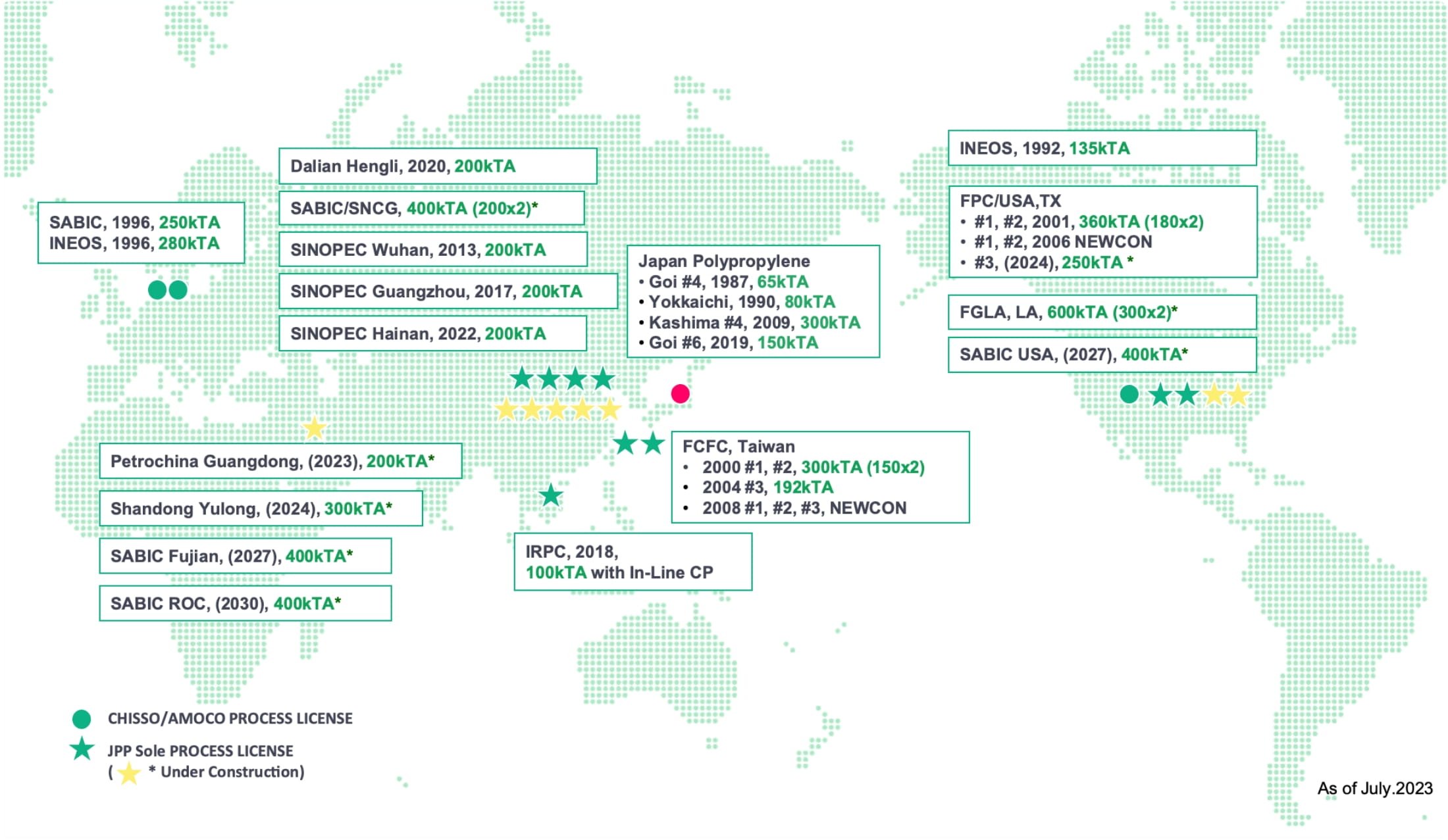
The customer regions are shifting from initial focus on the US, China, and Southeast Asia toward next stages including the Middle East and India.
References
- Japan Polypropylene Corporation. Technology & Licensing (retrieved via the Web Archve: Oct 15, 2023)
- Japan Polypropylene Corporation. Licenses (Sep 15, 2023)
- Japan Polypropylene Corporation. Licenses > History (Sep 15, 2023)
- Mitsubishi Chemical Group. Japan Polypropylene’s Polypropylene Manufacturing Technology (Document date: Aug 5, 2022)
- Heggs T.G.. Polypropylene. Ullmann'Encyclopedia of Industrial Chemistry (2012). DOI: 10.1002/14356007.021_004
- Arzoumanidis G.G.. Amoco CD commercial polypropylene catalyst tailor-made for the Amoco-Chisso gas phase process. Polyolefins Journal, Vol. 1 No. 2 (2014) 131-137
- Ineos. Polyolefin Catalysts & Technologies - History (Accessed: Jan 19, 2026)
- Ineos. Olefins & Polymers USA - History (Accessed: Jan 19, 2026)
- Kouzai I. and Fukuda K.. Modeling Study on Effects of Liquid Propylene in Horizontally Stirred Gas-Phase Reactors for Polypropylene. Macromol. Symp. 2009, 285, 23–27. DOI: 10.1002/masy.200951103