Koch's PET technology PolyVolve™ traces from DuPont's original continuous-polymerization research through the branded "NG3" pastille process to today's KTS/Chemtex single-stream continuous polymerization (CP) platform, now licensed globally with capacities up to 2,200 tonnes/day per line.
Process History
DuPont began developing continuous PET polymerization technology as early as 1952, eventually displacing batch processing as the industry standard by 1963. DuPont's proprietary continuous process evolved over subsequent decades into what was branded "NG3" — a technology that departed from conventional practice by producing a low-intrinsic-viscosity (IV) melt-phase intermediate formed into solid "pastilles," with the bulk of molecular weight buildup completed via solid-state polymerization (SSP) rather than in the melt phase. In 2004, DuPont divested the bulk of its fibers business — including this polymerization technology — to Koch Industries (now Koch, Inc.) through the Invista spin-off, while DuPont's separate European PET/intermediates business (DuPont-SA) was explicitly excluded from that transaction. The technology was subsequently marketed as "IPT (Invista Performance Technologies) NG3™" through the mid-2000s to 2010s.
INVISTA exited direct PET manufacturing operations in 2010–2011, selling its Spartanburg, South Carolina and Querétaro, Mexico PET polymer/resin plants to Indorama Ventures for $420 million — but Koch retained and continued developing the underlying process technology through its separate technology-licensing business. Today the technology is licensed through Koch Technology Solutions (KTS), the technology-licensing arm of Koch Engineered Solutions, in partnership with engineering firm Chemtex Global Corporation. KTS states it has spent "over 50 years enhancing this technology," and its current commercial offering is branded PolyVolve™ for virgin polymerization and PolyReVolve™ for chemical-recycling-integrated production. In September 2025, KTS/Chemtex, together with SSP technology partner Polymetrix, commissioned the world's largest single-stream continuous polymerization plant (2,200 TPD) for China's SFX (Sanfangxiang Group) — the 15th such project in the KTS/Chemtex/Polymetrix partnership.
Process Summary and Chemistry
The technology produces bottle- and fiber-grade PET from purified terephthalic acid (PTA) and ethylene glycol (EG) via the standard two-stage polyester polycondensation chemistry, distinguished by its historical NG3-era innovation of shifting most molecular-weight buildup to the solid state:
Esterification: PTA + EG → bis(2-hydroxyethyl) terephthalate (BHET)-dominated oligomer + water, at 240–260°C and 300–500 kPa.
Pre-polymerization: The esterification product (DP ~3–7) is advanced under vacuum (250–280°C, 2–3 kPa) to a low-IV melt oligomer.
Melt finishing/pastille formation (NG3-era distinguishing step): Rather than driving the melt all the way to bottle-grade IV, the low-molecular-weight polymer (degree of polymerization 20–30, IV 0.23–0.28) is formed into solid pastilles with a distinctive crystalline structure that facilitates subsequent handling and SSP processing.
Solid-state polymerization (SSP): Pastilles undergo crystallization, annealing, SSP, and cooling stages, raising IV from ~0.25 to the bottle-grade target of 0.72–0.85 dL/g while reducing acetaldehyde and carboxyl end-group content.
The current KTS/Chemtex single-stream CP platform retains this fundamental chemistry while integrating both virgin and recycled feedstock.
Step-by-Step Technology Description (Based on Process Flow)
KTS PolyVolve™ Technology
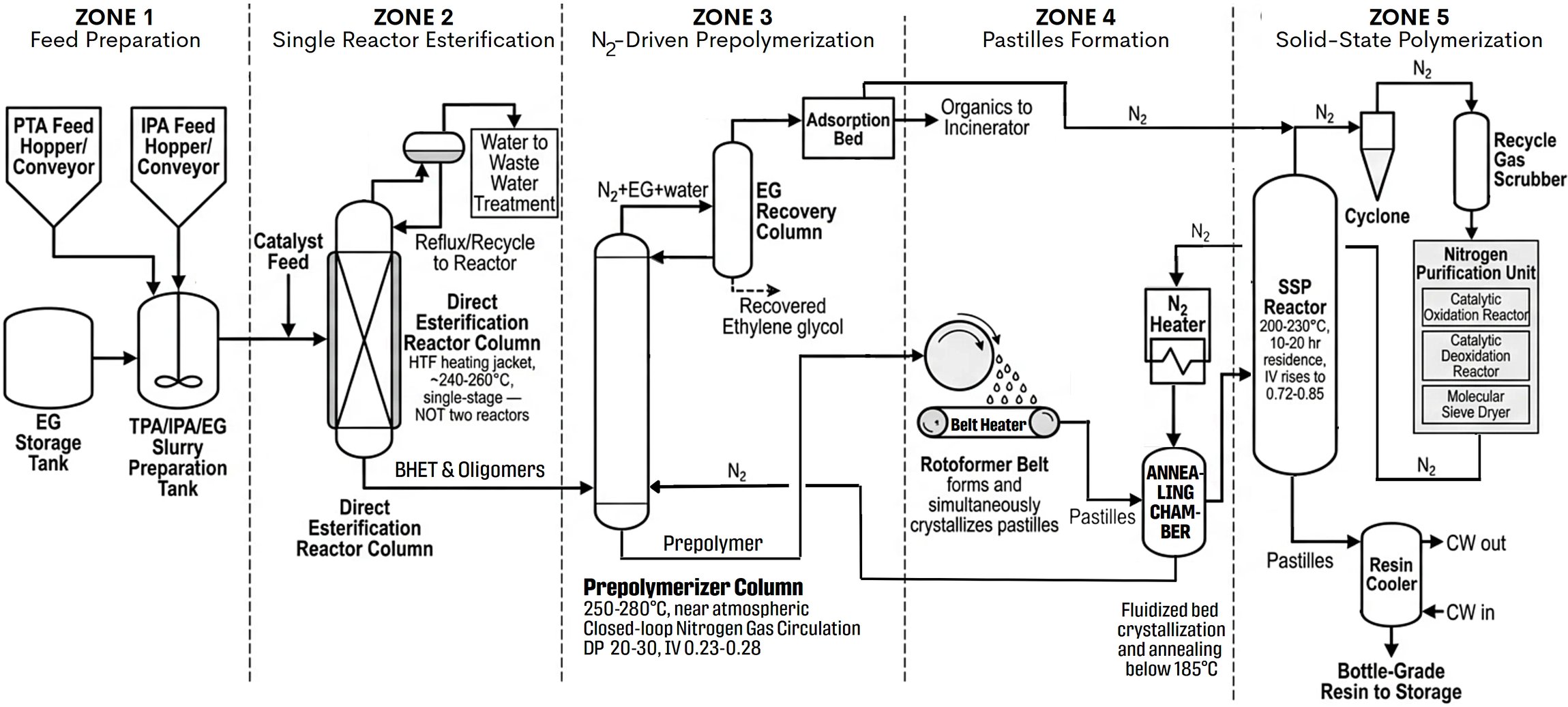
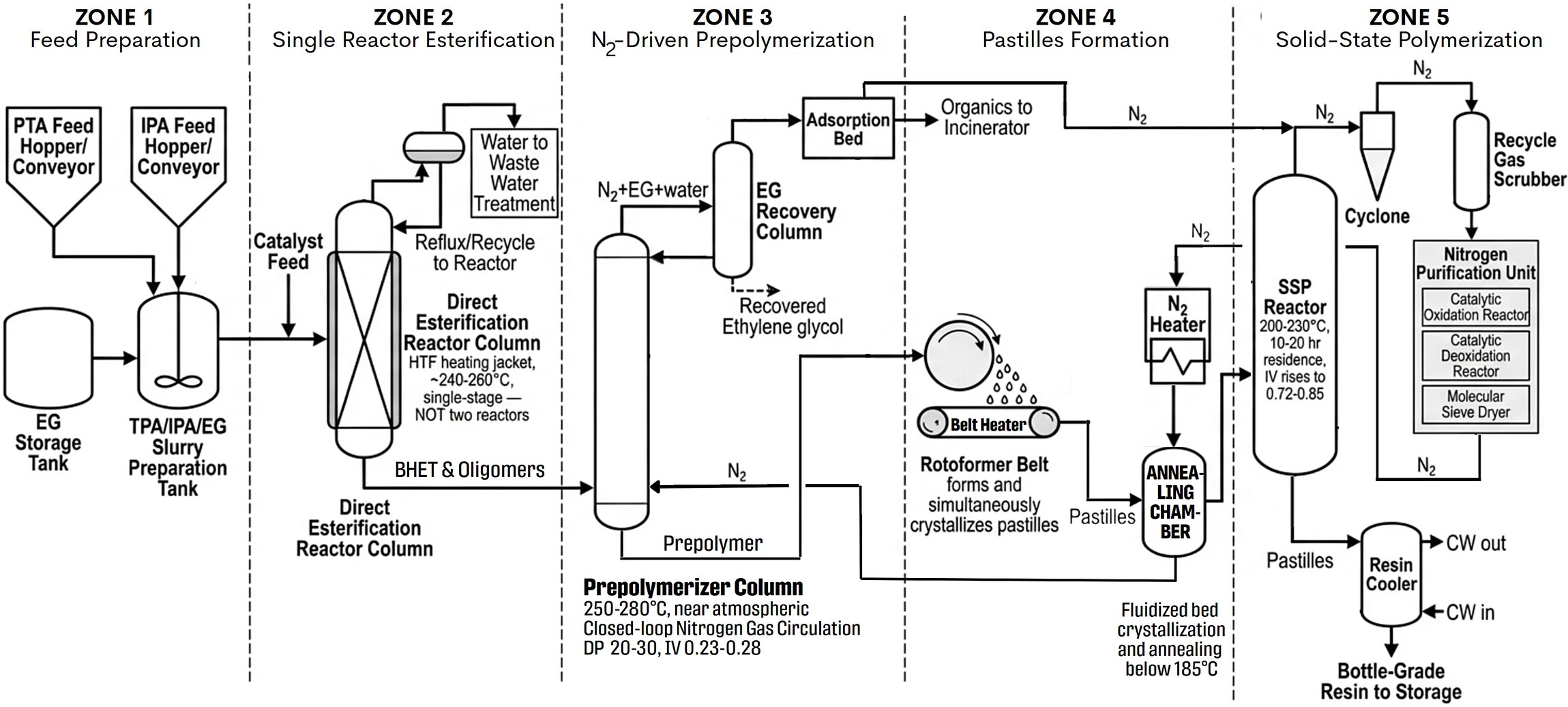
Best guess process flow diagram based upon available information details
-
Feedstock preparation — PTA and EG (virgin route) are metered into a paste-mixing system; for recycled content.
-
Esterification — PTA/EG paste reacts in a primary (and typically secondary) esterification reactor at 240–260°C, producing a BHET-dominated oligomer and water vapor, which is removed via a distillation/reflux system.
-
Pre-polymerization — The oligomer stream is advanced under increasing vacuum (250–280°C, ~2–3 kPa) to a low-IV prepolymer (DP ~20–30).
-
Pastille formation — The low-IV melt is formed into solid pastilles via a rotoformer-type system, producing the distinctive crystalline particle morphology characteristic of the NG3 lineage.
-
Crystallization and annealing — Pastilles/amorphous chip are heated in a fluidized bed under air or nitrogen below ~185°C to induce crystallinity while preventing thermal yellowing.
-
Solid-state polymerization (SSP) — Crystallized pastilles/chip undergo extended solid-phase reaction (typically 10–20 hours) at 200–230°C under inert gas flow, raising IV to the bottle-grade target; modern installations pair this stage with third-party SSP technology (e.g., Polymetrix).
-
Cooling and packaging — Finished resin is cooled and conveyed to storage/rail/bulk load-out.
Process Performance
-
Pastille intermediate: degree of polymerization 20–30, IV 0.23–0.28
-
Final bottle-grade product: IV 0.72–0.85 dL/g
-
Demonstrated single-line capacity: >1,150 TPD historically (NG3 era); current single-stream CP lines now scaled to 2,200 TPD per train at the SFX site
-
Melt residence time reduced 50–66% versus conventional (fully melt-phase) technology, since most molecular weight buildup occurs in solid state rather than the melt
Economic Performance
The original NG3 technology's principal economic claim, as benchmarked against conventional melt-phase-dominant PET technology, was a roughly 5 percent cost-of-production advantage (approximately 44.6 vs. 46.8 cents/lb including return on investment). This advantage derived from reduced melt-phase capital (shorter, lower-temperature melt residence) and vacuum system requirements, offset by continued reliance on SSP capital and processing time.
Commercial Experience and Deployments
| Deployment |
Year |
Capacity |
Notes |
| First PET plant licensed in 1972 |
From 1972 on |
Single lines with 30 TPD capacity |
KTS Reference List |
| 192 Individual production line |
1972 - 2024 |
Cumulated capacity of 78,700 TPD |
KTS Reference List |
| SFX (Sanfangxiang Group), China — single-stream CP plants |
2025 |
2,200 TPD each (two lines, one project on-going) |
World's largest single-stream CP plant; 15th SFX/KTS/Chemtex/Polymetrix collaborative project; SSP via Polymetrix technology |
| 6 ongoing projects |
August 2025 |
50, 900, 3 x 1,100, 2,200 (2nd SFX line) TPD |
KTS Reference List |
| Ioniqa Technologies partnership |
2024 (announced) |
Not disclosed |
KTS invested up to €30 million to commercialize Ioniqa's advanced PET chemical recycling technology alongside KTS's licensing platform |
| PolyReVolve™ commercial rollout |
2025–2026 |
Scalable, retrofit or greenfield |
Positioned for both greenfield PolyVolve™ polymerization plants and retrofits of existing polymerization assets |
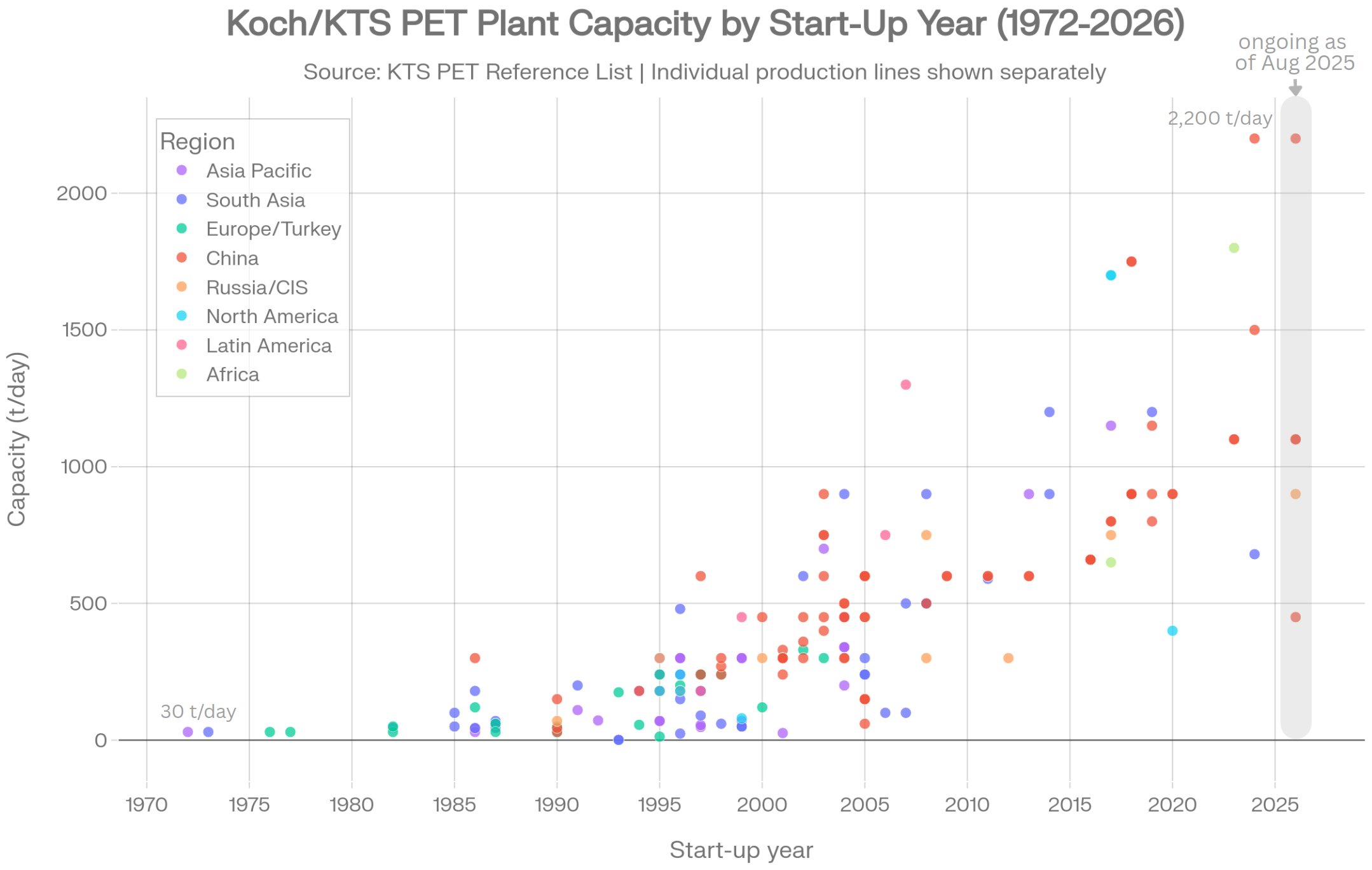
KTS's polyester business is described by its own leadership as having "over 50 years" of continuous technology enhancement, positioning the current single-stream CP and PolyReVolve™ offerings a direct commercial descendants of the original DuPont/NG3 technology lineage rather than a clean-sheet redesign.
References
- PolyVolve™ - The Next EVOLUTION in Polyester Technology
- KTS PET Reference List
- Chemtex PolyVolve™
- Koch Technology Solutions UK Ltd — Company Overview
- World First — SFX Delivers Largest Single Stream CP Plant at 2,000 TPD
- rPET — Chemtex Global Corporation
- PolyReVolve™: Beyond Mechanical — A Scalable Path to rPET
- Dutch chemical company Ioniqa and UK’s Koch Technology Solutions announce deal to make plastics sustainable
- Invista Will Sell Polyester Business To Indorama
- Indorama Ventures Purchases Invista Plants in South Carolina, Mexico
- PET Production Technical Report — Comprehensive Technology and Market Review