Setting up a Grassroots Complex Maximizing Advanced Petrochemicals in Eastern India Dhamra- Part II

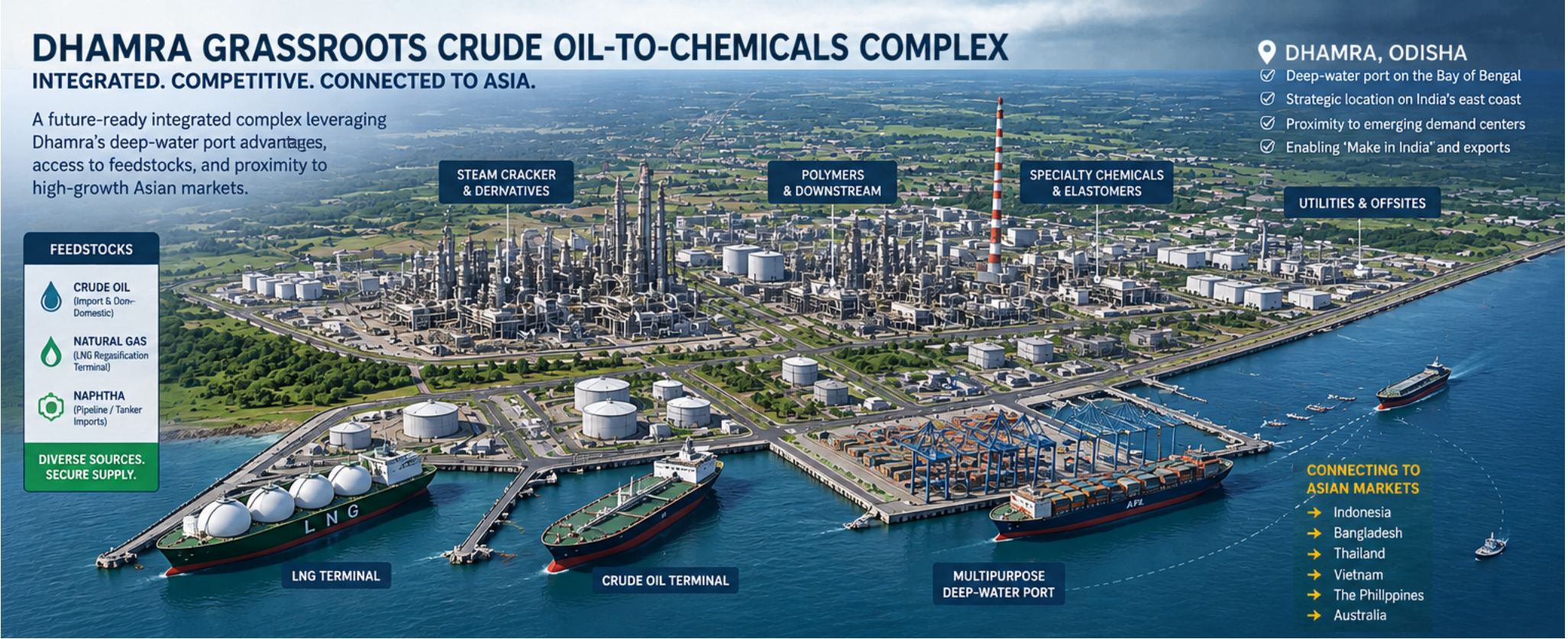
This article is divided in multiple parts. The first part covers the background and perspective of a location where a grassroots Integrated petrochemical complex can be set up in Eastern India to maximize production of advanced plastics and Elastomers. A brief insight on the processes and technologies associated with niche products is touched herein in part II. Part III will deal with the complex configuration and establish the viability of the complex, which would intend to minimize the Petrochemical import and also establish strategic export of niche products.
Styrene-Butadiene- Acrylonitrile and Synthetic Rubbers Loop
Building a massive Styrene Monomer (SM) plant at Dhamra is an anchor strategy, but its value is maximized if the monomer is captively consumed, though it serves well as a dual-role asset as well, as India runs a severe domestic deficit in Styrene, making a large unit highly viable for import substitution. However, merchant Styrene is avoidable, and it is better to pursue a strategy for conversion of the same into high value synthetic rubbers. Moving downstream into Synthetic Rubbers (SBR and PBR) acts as a critical hedge. Elastomers command a structural price premium over the base monomer ($2,200+ for rubber vs. base monomer prices). For a mega-COTC project, the plant therefore targets a multi-train layout configuration, which lets the asset consume intermediate Styrene and Butadiene entirely within the site boundary, shielding the complex from volatile merchant monomer pricing.
- Styrene Process Scheme - Captive Benzene from Aromatics block and Ethylene gas from the Mixed-Feed Steam Cracker are reacted to form Ethylbenzene. Modern plants utilize liquid-phase alkylation processes licensed by companies like Badger (ExxonMobil catalyst) or Lummus (UOP Q-Max process). Highly selective, non-corrosive zeolite catalysts are utilized in the process. The reaction runs under moderate pressure and temperatures (160°C - 200°C). A distinct engineering feature of this design is the Transalkylation Reactor where Benzene regularly hits side-chains to produce Polyethylbenzenes (PEB). The transalkylation loop takes these heavy PEB streams, reacts them with fresh benzene, and converts them back into pure Ethylbenzene, driving total raw material efficiency past 99.5%.
- Adiabatic Dehydrogenation of Ethylbenzene to Styrene - This is the core chemical conversion step. The Ethylbenzene molecule undergoes a strongly endothermic reaction to strip away hydrogen atoms, transforming it into Styrene Monomer. Because the reaction absorbs massive amounts of heat and is favored by low pressure, EB vapor is mixed with superheated steam (600°C - 650°C) under a deep vacuum. A pelletized Iron Oxide (Fe₂O₃) catalyst, promoted with Potassium Carbonate (K₂CO₃) and Cr/Ce stabilizers. The potassium acts as a continuous self-cleaning agent, reacting with the steam to gasify and remove coke deposits from the catalyst surface. Performed inside a multi-stage adiabatic reactor train operating under vacuum. Because the single-pass conversion is thermodynamically limited to roughly 65–70%, the effluent gas must be condensed, separating the water phase from the raw organic liquid phase before entering the purification loop.
- Fractional Distillation & Purification - The organic liquid exiting the dehydrogenation reactors is a complex mix of Styrene, unreacted Ethylbenzene, and minor structural byproducts (Benzene and Toluene). Separating them is one of the most demanding tasks. Styrene monomer polymerizes naturally into a solid plastic gel when exposed to heat. However, boiling it under normal conditions requires high temperatures that trigger this reaction, clogging the columns. To circumvent this, the entire fractionation train operates under a deep vacuum. This drastically lowers the boiling points of the chemicals, allowing them to separate at much safer, lower temperatures. A continuous stream of polymerization inhibitors is injected into the column feeds to keep the monomer stable during distillation.
- For a typical 1,000 kg Styrene Output, Captive Benzene Feed: ~760 kg and Captive Ethylene Feed ~260 kg, byproduct yields generated: ~30 kg of Toluene + ~25 kg of Pure Hydrogen Gas (H₂).The Hydrogen byproduct generated from Stage 2 is highly pure is captured, compressed, and routed directly into the downstream loops. This internal integration lowers the operating cost floor of the entire complex.
- Acrylonitrile & ABS Process Chains - Acrylonitrile is a hazardous liquid chemical manufactured primarily via the SOHIO Propylene Ammoxidation Process. Chemical reactors combine Propylene, Ammonia and Air over a highly specialized fluid-bed bismuth-molybdenum catalyst operating at 400°C–450°C and mild pressure. The reaction produces ACN along with valuable, marketable secondary streams like Hydrogen Cyanide (HCN)—which can be routed downstream into Methyl Methacrylate (MMA)—and Acetonitrile. Hydrogen Cyanide (HCN) by product should be immediately routed into an adjacent Methyl Methacrylate (MMA) / Polymethyl Methacrylate (PMMA) plant, adding a highly profitable plexiglass line to the asset base. Also the Acetonitrile by product is a highly valuable solvent processed for the global pharmaceutical manufacturing sectors.
- ABS Resin Process Loop - A COTC plant can use its light olefin streams to enter the Acrylonitrile-Butadiene-Styrene (ABS) value chain. ABS is an engineered thermoplastic copolymer created by combining three distinct monomers to balance strength and stiffness: Acrylonitrile (for heat and chemical resistance), Butadiene (for impact toughness), and Styrene (for structural rigidity and gloss). Graft Polymerization: Pure Butadiene is polymerized into a liquid polybutadiene synthetic rubber latex. Copolymer Infill: Styrene and Acrylonitrile monomers are introduced into the rubber emulsion or solution fluid block. They are chemically grafted onto the poly-butadiene rubber backbone. Compounding: The resulting ABS slurry is coagulated, washed, dried, and sent to final compounding extruders where UV stabilizers, colorants, and glass fibers are added to produce commercial-grade engineering plastic pellets.
- ABS (Engineering Thermoplastic): Extensively utilized for structural rigidity, impact resistance, and premium aesthetics. Applications: Housing for consumer electronics (laptops, routers), major home appliances (refrigerator inner liners, washing machine tubs), automotive interior panels and instrument clusters, and consumer goods (premium luggage). For the ABS and Acrylonitrile (ACN) loops, technology suites from providers like Sabic, INEOS Nitriles (SOHIO process), and Toyo/JSR offer the highest single-pass conversions and optimal safety containment setups for handling hazardous intermediate gases.
- NBR (Nitrile Butadiene Rubber - Elastomer): Valued primarily for its exceptional resistance to petroleum oils, fuels, and chemicals. Applications: Heavy industrial gaskets, fuel-transmission hoses, oil-field seals, O-rings, automotive belts, and medical/industrial protective nitrile gloves. Rather than selling raw Styrene monomer on the open market, the plant should route its output directly into SBR, PBR, and ABS lines. Synthetic rubbers and engineering plastics operate on a higher, more stable margin plane than the base monomer. By utilizing Styrene as an internal feed block, the Dhamra complex completely insulates its bottom line from open-market monomer price corrections.
- Integrating NBR and SBR inside the complex unlocks major economic efficiencies. Both plants sit side-by-side downstream from Butadiene Extraction Unit (BDU). Routing butadiene to SBR when tyre markets are booming, or to NBR when industrial glove and oil-field demand peaks. SBR consumes captive Styrene, while NBR consumes captive ACN, completely shielding both plants from open-market merchant monomer price spreads. The finishing, drying, dewatering, and automated baling/packaging machinery use nearly identical designs, allowing optimization of spare parts logistics and operational maintenance teams across a single elastomeric manufacturing hub.
- PMMA - Polymethyl Methacrylate (PMMA), commonly known as acrylic glass or plexiglass, is experiencing a strong structural growth phase driven by structural changes in the electronics, automotive, and clean energy sectors. Global PMMA demand sits at approximately 2.6 to 2.8 million metric tonnes per annum. Production is heavily concentrated in East Asia (Mainland China, Taiwan, South Korea, and Japan), controlled by key players like Mitsubishi Chemical (Methacrylates business), Röhm GmbH, Arkema, and Sumitomo Chemical. Demand is growing globally at a 4.5% to 5.2% CAGR. Key growth areas include Automotive Light-Weighting: PMMA is replacing heavy glass in vehicle light casings, rear lamps, interior touch panels, and EV battery housing enclosures. Electronics & Display Panels: Used for light guide plates (LGP) in LED screens, smartphones, and optical sensors. Renewable Energy Infrastructure: Pushing into specialized solar panel protective glazing and wind turbine component layers due to its exceptional UV resistance and weathering durability. The Regional Trade Balance (ASEAN & India): While mainland China produces immense volumes of general-purpose extrusion-grade PMMA, the ASEAN region (Vietnam, Thailand, Malaysia) runs a structural deficit in high-optical-clarity, impact-modified injection molding grades. India relies almost entirely on imports for its premium PMMA requirements. Setting up a integrated asset at allows to target these high-margin, specialized application gaps.
SBR Process Scheme (Emulsion Grade - eSBR)
- Feed Preparation & Emulsification: Fresh and recycled 1,3-Butadiene and Styrene monomers are mixed with demineralized water, an emulsifying agent (soap), a molecular weight regulator and an initiator system. Polymerization : The emulsion is pumped into a continuous chain of 4 to 12 stirred-tank reactors. To produce premium "Cold Rubber," the reactors are chilled and held precisely at 5°C. Short-Stopping: To prevent excessive branching and cross-linking, which makes the rubber brittle, a short-stop chemical is injected once the monomer-to-polymer conversion hits roughly 60%. Monomer Recovery (Stripping): The unreacted butadiene is flashed off under vacuum, while the unreacted styrene is removed down the line in a steam-stripping column. Both monomers are condensed and recycled back to the front end.Coagulation & Finishing: The stripped latex is treated with an acid-salt solution (like sulfuric acid and sodium chloride) to break the soap emulsion. The rubber precipitates out as porous crumbs, which are washed, dried in a hot-air conveyor, compressed into 35 kg bales, wrapped in polyethylene film, and crated.
- SBR (Styrene-Butadiene Rubber) Licensors - Goodyear Tire & Rubber Company (USA): emulsion SBR (e-SBR) and solution SBR (s-SBR) technology.Trinseo (Formerly Styron / Dow Chemical asset base): a high-performance Solution SBR (s-SBR) technology, critical for low-rolling-resistance green tires. Versalis (Eni S.p.A. - Italy)for both emulsion and solution-grade rubbers. Sinopec / PetroChina (China): emulsion SBR process.
- Emulsion SBR (eSBR) Plant: The absolute minimum economic size is 100,000 to 120,000 Tonnes Per Annum (TPA). Most modern configurations build a design footprint consisting of multiple parallel 50,000–60,000 TPA production trains to optimize monomer recovery.
PBR Process Scheme (Solution Process)
- Feed Purification & Drying: 1,3-Butadiene and a hydrocarbon solvent (typically hexane or benzene) pass through heavy alumina bed dryers to achieve absolute dryness (moisture levels below a few ppm). Solution Polymerization: The dry monomer-solvent mix enters the reactor series. A proprietary catalytic system—such as Neodymium (Nd), Cobalt (Co), or Titanium (Ti) compounds mixed with aluminum alkyls—is injected. The exothermic reaction runs at 50°C to 90°C, turning the feed into a thick, viscous polymer cement. Short-Stopping & Antioxidant Dosing: An alcohol or water stream is injected into the cement line to purposefully deactivate the catalyst. Stabilizers and staining/non-staining antioxidants are blended in to protect the rubber during downstream hot processing. Solvent Stripping: The polymer cement enters a flash vessel filled with hot water and steam. The hexane solvent flashes out overhead, leaving behind rubber crumbs suspended in water. The hexane vapor is condensed, separated from water, distilled, and recycled. Dewatering & Finishing: The PBR crumbs are screened out of the water slurry and sent to mechanical dewatering twin-screw extruders to squeeze out trapped moisture. The dried rubber is then hot-air dried, baled into blocks, and packed.
- Within an integrated petrochemical setup, the butadiene extraction unit (BDU) sits directly upstream from both blocks, splitting its output between the eSBR and PBR feed prep areas based on current tyre market demands.
- PBR (Polybutadiene Rubber) Licensors - JSR Corporation (Japan Synthetic Rubber): high-cis PBR technology using advanced Neodymium (Nd-BR) and Cobalt catalysts. Arlanxeo (Saudi Aramco subsidiary / formerly Lanxess): for Nd-PBR, which maximizes fuel-efficiency profiles in final tire applications. Michelin / Goodyear: strategic joint-venture partners globally.
- Epict / EPC Partners (The Process Integrators) - Lummus Technology / Toyo Engineering / Technip Energies: These firms do not own the elastomer patent themselves, but they act as the primary Engineering, Procurement, and Construction (EPC) integrators. They take the licensor's "recipe" and build out the continuous polymerization reactor trains and finishing lines within a larger COTC or cracker complex.
- While Polybutadiene Rubber (PBR) and Styrene-Butadiene Rubber (SBR) share similar finishing and packaging steps, their core polymerization chemistry dictates entirely different upfront process configurations. SBR typically uses an emulsion process in an aqueous (water-based) medium, whereas PBR relies on a highly sensitive solution process using hydrocarbon solvents and precise organometallic catalysts.
- Polybutadiene Rubber (PBR) Plant: Because solution polymerization involves hazardous hydrocarbon solvent loops and sensitive catalyst handling, the threshold is tighter. The baseline economic scale sits at 50,000 to 80,000 TPA to justify the continuous multi-stage solvent purification and drying utilities.
Butadiene
- Even when maximizing chemical intensity even in a 20 MMTPA refinery natively yields a Butadiene Extraction Unit (BDU) capacity of roughly 320 to 350 KTPA. This becomes a constraint in terms of leading the formulation of recipes of various elastomers. The entire 320 KTPA internal Butadiene pool cannot be dumped into a single rubber product. To build a world-class, resilient petrochemical complex a diversified higher-margin value chain is desirable. An 800 KTPA ABS mega-plant requires 120 KTPA of Butadiene to build its impact-resistant polybutadiene rubber core. ABS is a higher-value engineering plastic ($1,900+/MT) that cannot be sacrificed. PBR: To become a serious global tire giants (like Michelin, Goodyear, MRF, or Apollo), one must offer a complete tire-compounding slate. Passenger car treads require a blend of both SBR and High-Cis PBR (Polybutadiene Rubber). Sizing a companion PBR plant at 100 KTPA consumes another 100 KTPA of Butadiene. SBR Limit: This leaves 100 to 120 KTPA of captive Butadiene left over. This remaining volume through the emulsion polymerization reactor and bind it with 60 KTPA of Styrene, it yields 250 KTPA SBR asset. Operating a single-site SBR plant larger than 250 KTPA introduces severe downstream commercial risks: The Global Scale: A 250 KTPA eSBR installation is already one of the largest single-site synthetic rubber plants in the world.
- For maximisation of value Captive Butadiene Pool of 650 to 750 KTPA is required. A facility of Butadiene Dehydrogenation is therefore envisaged in the complex to ensure that sufficient butadiene is available to support the intended downstream portfolio. With the constraint on butadiene removed the portfolio could open.
- The complex could be configured to run two parallel trains of 800 KTPA, totaling a massive 1.6 MMTPA ABS Mega-Precinct. This will enable prioritization of captive downstream integration and limit raw monomer sales matching the design core of world-scale petrochemical hubs. By scaling the ABS capacity to 1,600 KTPA, the site would transform into one of the largest single-site engineering plastics capitals in the world, matching the massive production scales found in East Asia. Operating two 800 KTPA ABS trains requires a continuous monomer feed. A 1,600 KTPA ABS footprint consumes 960 KTPA of internal Styrene Monomer. The expanded ABS block consumes 400 KTPA of Acrylonitrile. Further the 150 KTPA NBR rubber plant takes its captive share of 53 KTPA, the raw merchant ACN export exposure drops further.
- An Emulsion-SBR plant requires a rigid monomer blend: ~76.5% Butadiene and ~23.5% Styrene. Butadiene is generated as a component of the Crude C4 stream coming off the Steam Cracker and PFCCU.
- While Styrene and ACN are abundant and ready to support the expansion, scaling ABS to 1,600 KTPA creates a highly critical constraint in the third raw material stream: 1,3-Butadiene. An expanded 1.6 MMTPA ABS block requires a 15% polybutadiene rubber core, which translates to a rigid requirement of 240 KTPA of pure Butadiene. ABS Consumes 240 KTPA (Up from 120 KTPA). NBR Consumes 65 KTPA. Remaining Butadiene for SBR/PBR: Drops down to just 295 KTPA.This would imply that the highly lucrative SBR and PBR rubber capacities would have to be cut by roughly 35% to 40% to keep the site's mass balance stable. This implies that BDH facility will have to be installed to augment butadiene production.
- In this Mega-Complex strategy we propose to shift from a traditional chemical-monomer mindset to a highly profitable, fully integrated Downstream End-Product Fortress. By setting a hard constraint to eliminate the export of raw Styrene and Acrylonitrile (ACN) we insulate the complex from open-market price drops and build a highly competitive cost structure.To achieve complete internal integration, it is important to address the Butadiene deficit by adjusting the front-end cracking units to absorb the entire remaining chemical monomer pool.
Eliminating Styrene Exports: The Polystyrene & Latex Shift
Two 800 KTPA ABS trains consume 960 KTPA of Styrene, and the expanded 320 KTPA SBR unit takes 75 KTPA, leaving a residual surplus of 265 KTPA of raw Styrene Monomer. To eliminate this final monomer stream, two high-margin consumer plastic lines should be added next to the Styrene unit:
Expand into Polystyrene (PS/EPS): 200 KTPA
Monomer Take-Down: Consumes 200 KTPA of captive Styrene. The Value Add: Pushes into Expandable Polystyrene (EPS) and High-Impact Polystyrene (HIPS), which are intensely demanded across Bihar, Bengal, and Odisha for cold-chain food packaging, protective appliance shipping blocks, and electronic casings. The balance styrene could be used to support the PBR and SBR units.
Zero-Monomer Export Master Site Balance
By implementing these upgrades, the final monomer zero balance could be achieved fully integrated mass flow as below:
- 1,3-Butadiene 750 KTPA balance
Unit Capacity KTPA Butadiene Consumption KTPA
- ABS 1600 240
- SBR 320 245
- PBR 160 160
- NBR 150 65
- SB latex 40 40
Styrene Monomer balance 1200 KTPA
Unit Capacity KTPA Styrene Consumption KTPA
- ABS 1600 960
- SBR 320 75
- Polystyrene 200 200
- SB latex 65 65
Acrylonitrile balance 500 KTPA
- ABS 1600 400
- NBR 150 55
Phenol and Acetone
Building a captive Cumene-to-Phenol/Acetone unit within the Dhamra site footprint is necessary for MMA via the Acetone Cyanohydrin (ACH) route. Captive production provides structural advantages. Feedstock Synergy: The raw materials required to make Phenol and Acetone are Benzene and Propylene which would be captively available. The Co-Product Dynamic: The traditional chemical route (the Cumene process) fixes the output ratio: for every 1 tonne of Acetone produced, 1.6 tonnes of Phenol is produced. West Bengal and Bihar host major manufacturing centers for decorative laminates, plywood adhesives, and phenolic molding powders, which consume immense volumes of phenol-formaldehyde resins. Odisha's heavy engineering sectors utilize Phenol for epoxy coatings and industrial wire enamels. From the above it may be inferred that the Mega-Complex will ship only premium, consumer-ready solid engineering plastics, synthetic rubbers, maximizing margins across the entire Indo-Pacific trade corridor.
EPDM
- Ethylene Propylene Diene Monomer is a premium, high-growth synthetic rubber elastomer that fits perfectly into high-intensity 20 MMTPA Dhamra COTC framework. Unlike standard tire rubbers (like SBR and PBR) that wear out when exposed to sunlight and outdoor conditions, EPDM features a saturated polymer backbone. This molecular structure gives it exceptional resistance to heat, ozone, UV radiation, and severe weather conditions. Integrating an EPDM plant into the layout is highly strategic.
- EPDM Process The plant uses a solution polymerization process in a hydrocarbon solvent loop, similar to High-Cis PBR unit, because the organo-metallic Ziegler-Natta or Metallocene catalysts used to make EPDM are sensitive to water and impurities. Polymer-grade Ethylene and Propylene are dried to parts-per-million moisture levels and dissolved in a purified hydrocarbon solvent, typically hexane. A small fraction (4% to 8% by weight) of a specialized third monomer—usually Ethylidene Norbornene (ENB)—is introduced. ENB introduces residual double bonds outside the main polymer chain, allowing the rubber to be vulcanized (cured) with sulfur just like natural rubber. The feed enters continuous stirred-tank reactors running at 30°C to 50°C under moderate pressure. Advanced Metallocene catalysts are injected, turning the olefins into a thick, viscous polymer cement. The cement is mixed with water and injected with high-pressure steam in flash vessels. The hexane solvent vaporizes instantly overhead to be condensed and recycled. The EPDM precipitates out as rubber crumbs suspended in hot water. The crumbs are screened, passed through mechanical squeezing extruders to remove water, hot-air dried, and compressed into commercial bales.
- Minimum Economic Scale: For a greenfield installation inside an integrated mega-refinery, the minimum economic size for a world-scale EPDM plant is 70,000 to 100,000 Tonnes Per Annum (TPA). Global leaders like Arlanxeo, Dow, and Mitsui Chemical operate production lines within this footprint. The typical Mass Balance Per 1,000 kg EPDM Output, Ethylene Feed is to the tune of ~550 to 600 kg to provide the structural foundation and Propylene Feed ~350 to 400 kg to provide flexibility and elasticity. The ENB Diene Feed is about ~50 to 80 kg which enables vulcanization profiles.
- EPDM does not compete with SBR or PBR in the tire tread market. Instead, it services premium automotive components and infrastructure sectors. The primary material used for car door seals, window tracks, windshield seals, and trunk gaskets to block wind and water. Used for automotive radiator hoses, heater hoses, and conveyor belts because it remains stable when exposed to hot engine fluids and steam. Roofing Membranes: Extensively applied as single-ply rubber roofing sheets (EPDM roofing) for commercial buildings and airports due to its ability to withstand decades of sun exposure without cracking. EPDM is often blended with Polypropylene (PP) to dramatically lift the impact strength of automotive bumpers and dashboards.
- A 100 KTPA EPDM asset fits neatly into the confiuration. It converts your highly active, internal Ethylene and Propylene streams directly into a premium, solid product ready for containerized export. This configuration helps maximize returns across the entire Indo-Pacific corridor.
Large-Scale PET Plant
A mega-scale PET resin plant is justified economically, provided it is vertically integrated within the refinery footprint. Feedstock Cost Floor: Thermodynamically, producing 1 metric ton of PET requires roughly 0.86 MT of PTA and 0.33 MT of MEG. If a plant must buy merchant PTA and MEG, the logistics cost and external margins destroy profitability. An integrated COTC plant rationalizes this by routing its own aromatics stream straight into a contiguous PX-PTA-PET reactor loop, capturing all intermediate margins on-site. PET is a high-volume, bulk-freight commodity. Setting the plant right at the deep-draft port allows for direct gravity-fed or conveyor loading onto bulk carrier vessels heading to high-import markets like Australia and the ASEAN region.The absolute justification for the capital investment of PET is complete vertical integration.If a plant exports merchant PX or sells merchant PTA, it gives away margin to middle-tier logistics providers and international traders. By building a continuous, zero-interruption pathway from PX - PTA - PET on a single site, the complex a) eliminates Intermediate crystallization and reheating costs b) Bulk shipping costs for hazardous chemical intermediates c) External broker margins. The integrated asset turns volatile upstream oil molecules directly into stable, solid polymer pellets ready for bulk export. This allows a facility to capture the cumulative margin of the entire chain, justifying a higher upfront investment.To maximize risk diversification the PET complex should feature large parallel continuous polymerization lines, configured into various market grades such as Bottle Grade (Chips) - targetting Soft drinks, mineral water, FMCG packaging (India & ASEAN), BOPET Film Grade - targeting Flexible food packaging, electronic insulations, solar backing sheets, Recycled-Integrated PET (rPET) - targeting Premium global beverage brands mandating 25–50% circular plastic content.
PVC/VCM 300 KTPA
- VCM/PVC project is highly strategic. India consumes over 4.1 million tonnes of PVC annually but imports roughly 60% of it. To produce 300 KTPA of Suspension-PVC, the facility must follow the balanced Ethylene feed stock route. Half of your captive ethylene is reacted directly with chlorine gas over a ferric chloride catalyst to yield Ethylene Dichloride (EDC). Oxychlorination: The other half of the ethylene is blended with oxygen and the Hydrochloric Acid (HCl) byproduct generated downstream. This step converts the HCl back into fresh EDC, ensuring zero chemical waste. The purified EDC is sent to gas-fired cracking furnaces operating at 480°C to 530°C under pressure. The heat cracks the EDC molecules into Vinyl Chloride Monomer (VCM) and gaseous HCl. The HCl is captured and routed back to the oxychlorination loop, while the pure VCM liquid is distilled and stabilized.The liquid VCM is pumped into high-pressure water autoclaves along with dispersing agents and organic peroxide initiators. The mixture is stirred continuously at 50°C to 60°C, causing the VCM droplets to polymerize into a suspension of solid PVC resins. The slurry is stripped of trace monomers under vacuum, centrifugally dewatered, dried in a rotary hot-air kiln, and silo-packed. Chlorine Gas Requirement is met by siting this unit at Dhamra requires building an adjacent Chlor-Alkali Plant, which will generate high-value Caustic Soda as a co-product to cater nearby domestic manufacturers.
- For the VCM/EDC Cracking Loop: Vinnolit (Westlake Chemical) or Technip Energies (Badger/OxyVinyls process) are important licensors. These platforms offer excellent thermal efficiency in their cracking furnaces and provide highly reliable oxychlorination catalyst yields. For the Suspension PVC (S-PVC) Loop: Shin-Etsu (Japan)—the world's largest PVC producer—or Kem One (Europe). Their large-scale reactor designs feature advanced automated internal cleaning systems, preventing polymer crust fouling and maximizing your plant's operational uptime.
- Siting the VCM/PVC plant at Dhamra places it right next to Bihar and West Bengal, which are major agricultural and infrastructure hubs. These regions require immense volumes of PVC pipes and fittings, allowing you to easily capture premium local margins protected by active domestic import policies.
- For a PVC/VCM complex, chlorine represents the largest chemical operating cost. Because the thermal cracking of Ethylene Dichloride (EDC) to generate Vinyl Chloride Monomer (VCM) naturally discards half of its chlorine content as anhydrous Hydrogen Chloride (HCl) gas, a modern plant cannot afford to waste this stream. To achieve a profitable cost structure and maintain a tight environmental footprint, the complex uses an integrated Chlorine Recovery and Recycle Loop. This loop captures the discarded HCl gas and loops it straight back into the system.
300 KTPA PVC/VCM Mass Balance
- Direct Chlorination - 175 KTPAof chorine from Chlor-Alkali Converts into 245 KTPA of liquid EDC feed. Oxychlorination Loop - 85 KTPA of chorine recovered as HCl gas Converts into 245 KTPA of recycled liquid EDC. EDC Cracker Combined Feed - cracks 490 KTPA of total purified liquid EDC into 303 KTPA VCM + 175 KTPA anhydrous HCl gas. Suspension Polymerization - Consumes all 303 KTPA of liquid VCM to produce 300 KTPA of final solid Suspension PVC resin. Due to handling hot, gaseous Hydrogen Chloride presents severe engineering hazards, the recovery precinct utilizes highly specialized materials of construction. Anti-Corrosion Metallurgy: When perfectly dry, anhydrous HCl is non-corrosive to carbon steel. However, if it contacts even a trace amount of moisture, it instantly turns into highly corrosive hydrochloric acid. To prevent catastrophic wall thinning and pipe ruptures, all reactor effluents, quench columns, and distillation overhead lines are constructed from premium Hastelloy C-276, Inconel 625, or solid Tantalum linings. Vent Gas Scraping Security: Emergency pressure-relief vents from the oxychlorination and cracking blocks are routed directly to an integrated Caustic Scrubbing Tower. In the event of a process upset, any escaping HCl gas is immediately neutralized with circulating sodium hydroxide, transforming it into harmless sodium chloride salt water and preventing hazardous environmental releases.
- The membrane cell process is used to produce chlorine and relies on the electrolytic decomposition of an aqueous sodium chloride brine solution inside an electrochemical reactor (an electrolyser). The defining engineering feature of this technology is a cation-exchange membrane (a highly advanced perfluorinated polymer film, typically developed by firms like Asahi Kasei or Chemours) that physically divides each individual electrolysis cell into two distinct compartments: an Anode chamber and a Cathode chamber. About 200 KTPA of caustic soda and 5 KTPA of Hydrogen would be produced as by products to produce 175 KTPA of chlorine from the Chlorination loop.
- Technology Licensors for chorine electrolysers - The manufacturing of membrane electrolysers is a highly consolidated field dominated by premium engineering firms that control the catalytic coatings and element frame designs. Asahi Kasei Corporation (Japan): The undisputed global market leader. thyssenkrupp Uhde Chlorine Engineers (tk UCE - Germany): Widely deployed across Europe and India. INEOS Electrochemical Technologies (UK): known for high safety margins and low maintenance overheads. Bluestar (China):
LDPE
Low-Density Polyethylene (LDPE) is a high-performance polymer used for flexible films, food-grade milk pouches, and high-voltage cable insulation. India runs a structural deficit in LDPE, and prices hover at a premium $1,500+/MT. Unlike lower-pressure polyolefins (HDPE and LLDPE) that utilize coordinate catalysts, LDPE is manufactured via a free-radical polymerization mechanism under extreme operating conditions. The process requires handling compressed ethylene at pressures ranging between 2,000 to 3,400 bar and temperatures of 150°C to 300°C. Polymer-grade ethylene from cracker enters a Primary Compressor to reach roughly 250 bar. It is then routed into a massive, heavy-duty Secondary (Hyper) Compressor driven by high-voltage electric motors. This step pushes the gas into a supercritical state at ~2,800 bar. The supercritical ethylene is injected into main Tubular Reactor - A long, jacketed pipe up to 2–3 kilometers long wrapped in a loop. Organic peroxides or trace oxygen are injected at multiple zones to initiate free radicals. Tubular designs achieve excellent heat transfer, low specific energy costs, and provide a single-line capacity of 300+ KTPA with a high conversion rate. As an alternate to tubular reactor Autoclave Reactor are also used. This is a thick stirred vessel. While it handles a slightly lower conversion rate per pass, autoclaves excel at producing specialized, ultra-clear packaging films, EVA copolymers, and coatings due to tight control over molecular weight distribution. Monomer Separation and Recycle: The mixture exiting the reactor drops in pressure through a series of separator drums. Unreacted ethylene flashes out overhead and is cooled, purified, and recycled straight back to the hyper-compressor. This internal loop ensures your final chemical yield exceeds 99%. Extrusion & Degassing: The molten polymer is extruded into clean water baths, sliced into pellets by underwater cutters, and sent to degassing silos to strip out trace trapped ethylene before final bulk packaging.
Because operating hyper-compressors and managing high-pressure thermal profiles involves steep safety and metallurgy barriers, the licensing landscape is highly consolidated. LyondellBasell (Netherlands) – Lupotech Process: The global gold standard. Their Lupotech T (Tubular) technology handles single-line capacities up to 450–500 KTPA with excellent plant reliability, effective heat integration, and minimal energy consumption. ExxonMobil Chemical (United States): A dominant high-pressure tubular technology licensor known for producing premium film grades with superior mechanical strength and optics. Technip Energies / SABIC (Exclusive Partnership): Technip acts as the global licensor for SABIC's highly regarded Clean Tubular Reactor (CTR®) technology. This design minimizes fouling inside the reactor tubes, lowering maintenance overheads.
The Strategic Advantage of Mega-Scale
An integrated complex with a varied product slate allows the Mega-Complex to reuse all intermediate waste heat, optimize hydrogen balances and eliminate regional freight costs. This design structure establishes a highly competitive cost floor, allowing the facility to confidently export downstream chemicals into any major global market. The completely integrated configuration eliminates intermediate transport packaging, marine logistics bottlenecks, and third-party margins, allowing the Dhamra Mega-Complex to capture the absolute maximum margin floor across the entire Indo-Pacific chemical trade corridor. Such a complex is a need of the hour for a country like India which continues to import significant quantities of petrochemicals of the niche variety!
This article will continue to part III