Petroline Restored: Saudi Arabia's Signal to Markets — and Its Limits

- Entity
- Saudi Arabian Oil Company

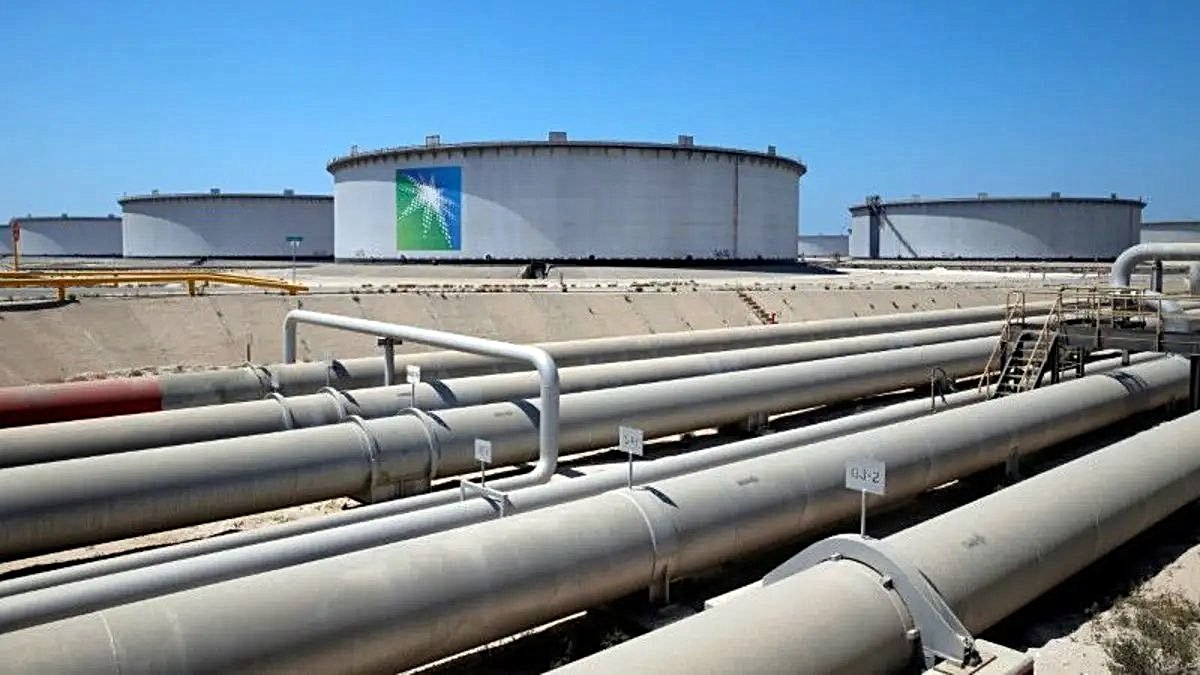
Saudi Arabia's Petroline Pipeline Reaches Full 7 Million Barrel Capacity, Securing Red Sea Export Route | Source: moenergy.gov.sa (April 12, 2026)
Saudi Arabia's Ministry of Energy announced on Sunday 12 April that full crude oil pumping capacity through the East–West Pipeline (Petroline) has been restored to approximately 7 million barrels per day — recovering the ~700,000 b/d lost in the Iranian drone strike on the pipeline's pumping infrastructure. Simultaneously, Manifa offshore field production of 300,000 b/d has been fully recovered. The announcement, issued directly via the Saudi Press Agency and attributed to the Ministry of Energy, is notable both for what it confirms and for what it carefully omits.
What Has Been Restored
The speed of recovery is genuine and operationally significant. The Petroline's pumping capacity was restored within days of the 9 April damage assessment — a timeline that reflects the pre-positioned engineering redundancy Saudi Aramco maintains on its most critical export artery. Manifa's recovery is similarly rapid given that it is an offshore facility exposed to the logistical complications of operating in a conflict-affected maritime environment.
The Ministry's framing — "high operational resilience and crisis management efficiency" — is not empty rhetoric for this particular infrastructure. The Petroline was designed from the outset with redundancy and rapid-repair doctrine in mind, a legacy of the post-1973 strategic planning that recognised Hormuz vulnerability decades before the current crisis.
What Remains Unresolved
The announcement is carefully structured to lead with recoveries and conclude with the outstanding problem. Khurais — 300,000 b/d of production capacity — remains offline, with no timeline given beyond "work is ongoing and will be announced upon completion". This is not a minor footnote. Khurais is Saudi Arabia's second-largest producing field at 1.45 million b/d total capacity, and the attacked units represent a meaningful share of its output.
Separately, the SATORP refinery at Jubail — the 460,000 b/d Aramco–TotalEnergies joint venture — remains partially shut following the attack of 7–8 April on one of its two processing trains. TotalEnergies has stated no restart timeline, and full damage assessment is still underway. This is a downstream loss that the Petroline restoration does not address: Saudi Arabia can move crude westward, but its refining capacity for products — diesel, jet fuel, naphtha — is still impaired.
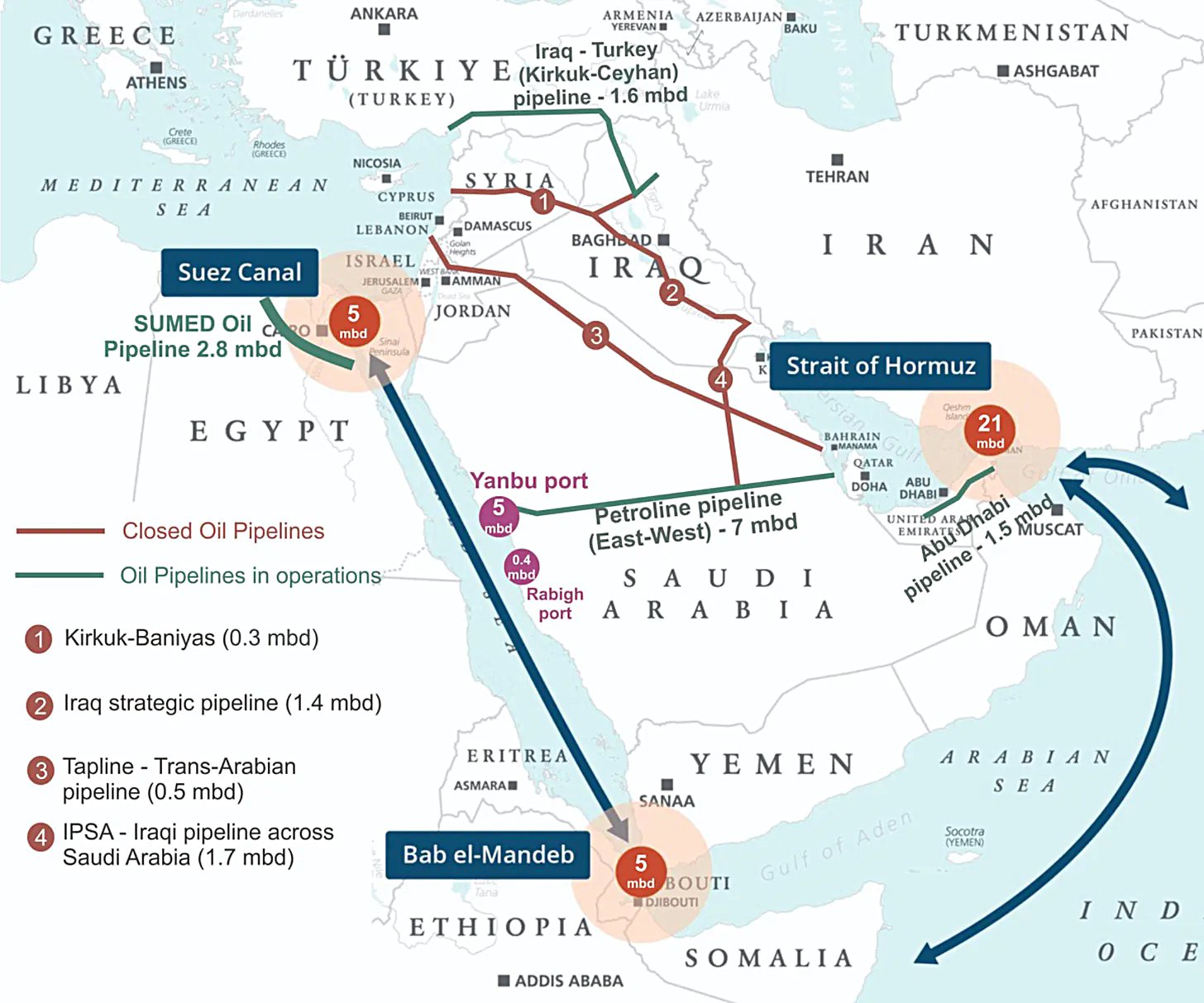
Middle East’s Tier 1 pipelines and maritime chokepoints (Bab el-Mandeb, Hormuz, and Suez)
Source: Mihail Stoyanov (April 3, 2026), The OldEconomy Substack
The Strategic Reading
Three observations for energy market participants:
1. The signal is deliberate and calibrated. Riyadh is doing precisely what a rational producer-state does during a conflict: restoring and publicising the recovery of its most visible, most strategically symbolic export route. The Petroline announcement functions as a market stabilisation signal as much as an operational update. It says: we are still a reliable exporter, and the bypass is working. This is consistent with Saudi Arabia's longstanding doctrine of supply reliability as a geopolitical instrument.
2. The restoration is necessary but not sufficient. The Petroline at 7 million b/d cannot fully compensate for Hormuz, through which Saudi Arabia would normally move significantly more crude to Asian markets. The Red Sea routing via Yanbu serves primarily European and Mediterranean destinations. As long as Hormuz remains effectively constrained, Saudi Arabia's Asian export logistics remain structurally impaired — regardless of Petroline capacity.
3. The ceasefire context is the most important variable. The Ministry's announcement arrives against the backdrop of what multiple sources describe as a fragile US–Iran ceasefire. A Petroline restored to full capacity under an unstable ceasefire is an asset that remains exposed. The 9 April strike demonstrated that Iran is willing and able to target the Petroline specifically — the infrastructure that was Saudi Arabia's last large-scale bypass option. A second, more damaging strike on Yanbu terminal infrastructure itself would be qualitatively different in consequence. The current restoration should not be read as a resolution of risk — it is a recovery within an ongoing exposure.
Net Assessment for ppPLUS Readers
| Facility | Status | Capacity Impact |
|---|---|---|
| Petroline (East–West Pipeline) | Fully restored | +700,000 b/d throughput recovered |
| Manifa offshore field | Fully restored | +300,000 b/d production recovered |
| Khurais field | Ongoing repair — no timeline | −300,000 b/d still offline |
| SATORP refinery (Jubail) | Partially offline — no timeline | ~230,000 b/d refining capacity lost (one train of two) |
| Ras Tanura refinery | Offline | −550,000 b/d refining capacity |
| Strait of Hormuz | Constrained / effectively closed | Systemic — affects all Gulf exporters |
Saudi Arabia has demonstrated, credibly and at speed, that its midstream infrastructure can absorb a significant strike and recover. That is a meaningful data point for long-term infrastructure resilience assessments. It does not, however, change the fundamental exposure profile of the global oil system as long as Hormuz remains closed, Khurais and Ras Tanura remain offline, and the ceasefire remains unverified.
ppPLUS monitors energy infrastructure and corporate developments across the global oil, gas, and petrochemical sector. Sources: Saudi Ministry of Energy official statement, Reuters, Al Jazeera, The National, The Saudi Times, World Oil, OilPrice.com.
#aramco #totalenergies #saudiaramco #satorp #petroline #rastanura #eastwestpipeline #yanbuexportterminal