Jet fuel (also called Aviation Turbine Fuel, ATF) is a highly refined, kerosene-based liquid fuel specifically formulated for use in gas-turbine engines powering commercial, private, and military aircraft. It appears clear to pale yellow in colour with a characteristic petroleum odour and is a middle distillate product boiling in the approximate range of 150–288 °C.
Chemical Composition
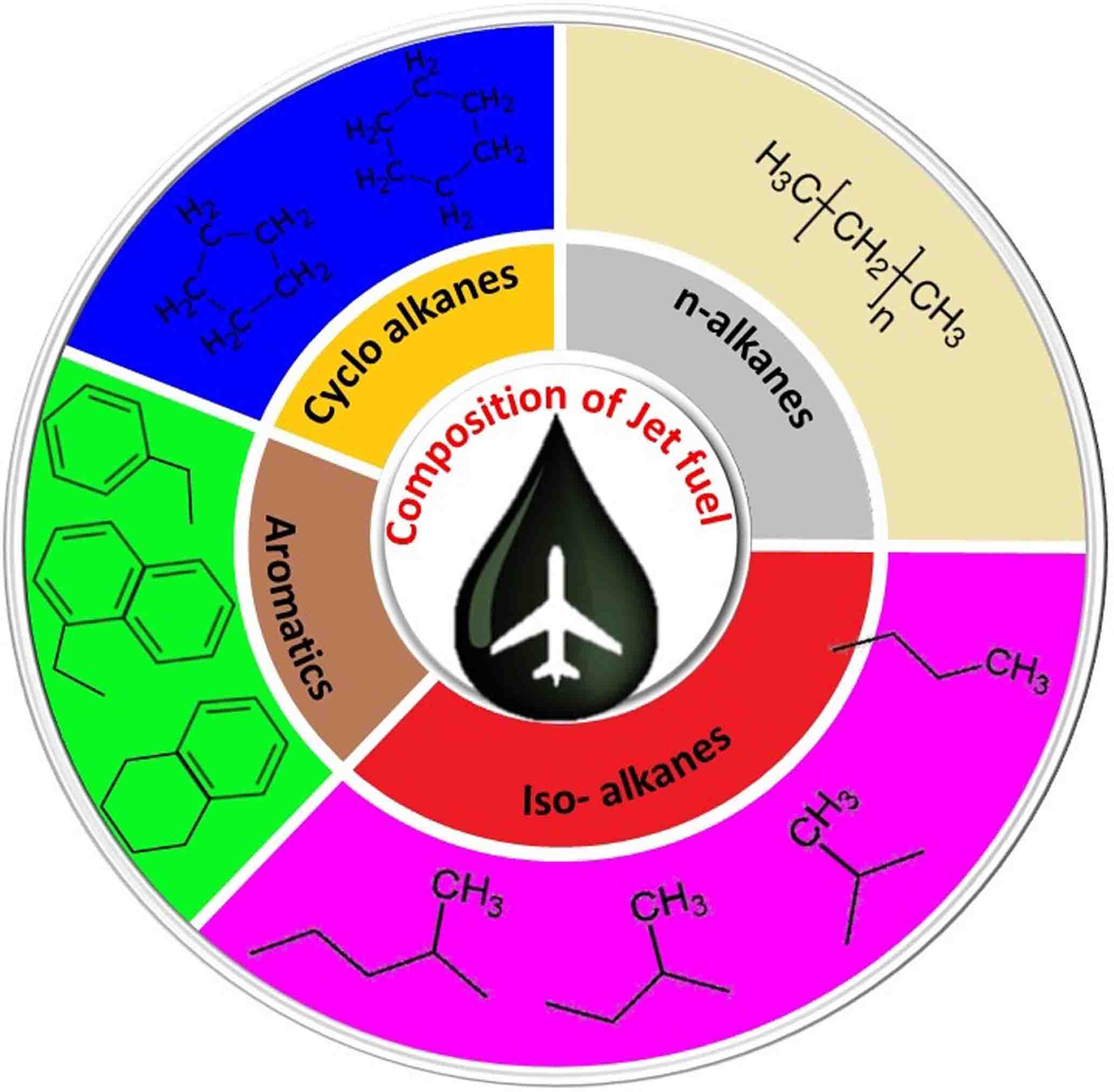
Jet fuel manufactured from crude petroleum oil consists of an extensive range of paraffinic hydrocarbons distributed across multiple carbon numbers. A typical Jet A composition comprises approximately 20% normal paraffins (n-alkanes), 40% isoparaffins (isoalkanes), 20% naphthenes (cycloalkanes), and 20% aromatics, with carbon number 10 carrying the highest weight-% of n-alkanes and isoalkanes, and carbon number 11 the highest weight-% of cycloalkanes and aromatics.
The overall aromatic concentration in Jet A is limited to a maximum of 25% by volume under ASTM D1655, as higher aromatic content reduces the hydrogen-to-carbon ratio and lowers the net heat content per unit mass compared to a paraffinic fuel of the same carbon number. However, aromatic content cannot be reduced to zero: a minimum level is required to swell elastomeric seals in aircraft fuel systems — if aromatics are too low, seals shrink and the fuel system leaks. This dual constraint — maximum for energy density and combustion cleanliness, minimum for seal compatibility — defines the aromatic window unique to jet fuel specification.
Physical and Operational Properties
Jet fuel is distinguished from other petroleum distillates by a tightly controlled combination of properties required for safe, reliable operation across the extreme conditions of high-altitude flight:
-
Flash point: Minimum 38 °C (Jet A/A-1), ensuring safe ground handling
-
Freeze point: ≤ −40 °C (Jet A) or ≤ −47 °C (Jet A-1), preventing wax crystal formation at cruise altitudes where ambient temperatures fall below −50 °C
-
Net calorific value: ~43.2 MJ/kg, providing the high specific energy required for turbine combustion efficiency
-
Thermal stability: Resistance to decomposition and deposit formation in hot fuel system components (JFTOT test, ASTM D3241)
-
Lubricity: Sufficient to protect fuel system pumps and control valves
-
Smoke point: Minimum 25 mm, ensuring clean combustion and limiting soot and particulate formation
Production
Jet fuel is produced from straight-run kerosene drawn from the atmospheric distillation tower and subsequently upgraded by hydrotreating — removing sulphur, nitrogen, and unstable olefins — or from the kerosene fraction recovered from a hydrocracker operating on heavier gas oil feedstocks. Both routes yield a product meeting ASTM D1655 or DEF STAN 91-091 specification. A mandatory additive package is blended into the finished fuel, comprising antioxidants, static dissipator, corrosion inhibitor, and thermal stability improver.
Grades
The principal commercial and military grades are:
| Grade |
Specification |
Freeze point |
Primary use |
| Jet A |
ASTM D1655 |
≤ −40 °C |
US domestic civil aviation |
| Jet A-1 |
ASTM D1655 /
DEF STAN 91-091 |
≤ −47 °C |
International civil aviation |
| Jet B |
CAN/CGSB 3.23 |
≤ −60 °C |
Cold-climate operations;
wide-cut kerosene/
naphtha blend |
| JP-8 / F-34 |
MIL-DTL-83133 |
≤ −47 °C |
NATO military aviation |
| JP-5 / F-44 |
MIL-DTL-5624 |
≤ −46 °C |
Naval carrier aviation
(minimum flash point ≥ 60 °C) |
Jet A-1 is the dominant global commercial grade, used at virtually all international airports outside the United States and referenced in all major fuel price indices (IATA, Platts, Argus). Jet B is the only other jet fuel in regular civilian use, employed specifically for its cold-weather performance advantage in Arctic and sub-Arctic operations.
References
- Ijaz Hussain, Saheed A Ganiyu, Hassan Alasiri, Khalid Alhooshani, A state-of-the-art review on waste plastics-derived aviation fuel: Unveiling the heterogeneous catalytic systems and techno-economy feasibility of catalytic pyrolysis, Energy Conversion and Management, Volume 274, 2022, 116433, ISSN 0196-8904
- ASTM International, ASTM D1655: Standard Specification for Aviation Turbine Fuels, American Society for Testing and Materials, West Conshohocken, PA, 2022
- UK Ministry of Defence, DEF STAN 91-091: Turbine Fuel, Aviation Kerosene Type, Jet A-1, NATO Code F-35, Defence Standardization, Issue 9, 2016
- SKYbrary Aviation Safety, Jet Fuel, European Organisation for the Safety of Air Navigation (EUROCONTROL), 2022
- Shell Aviation, Civil Jet Fuel Grades and Specifications, Shell Global, 2026
- Shell Aviation, Military Jet Fuel Grades and Specifications, Shell Global, 2026
- US National Center for Biotechnology Information (NCBI), Physical and Chemical Properties of Military Fuels — JP-5, JP-8, National Academies Press, 1995
- Topsoe, Kerosene Hydrotreating — Dearomatisation for Jet A and Jet A-1 upgrade, Haldor Topsoe A/S
- US Energy Information Administration (EIA), Hydrocracking is an important source of diesel and jet fuel, EIA Today in Energy, 2013
- Petroleum HPV Testing Group, Kerosene / Jet Fuel — Substance Category Description, American Petroleum Institute, 2012