ConocoPhillips, Largest Independent E&P Globally: Financial Assessment & Strategic Review

- Entity
- ConocoPhillips

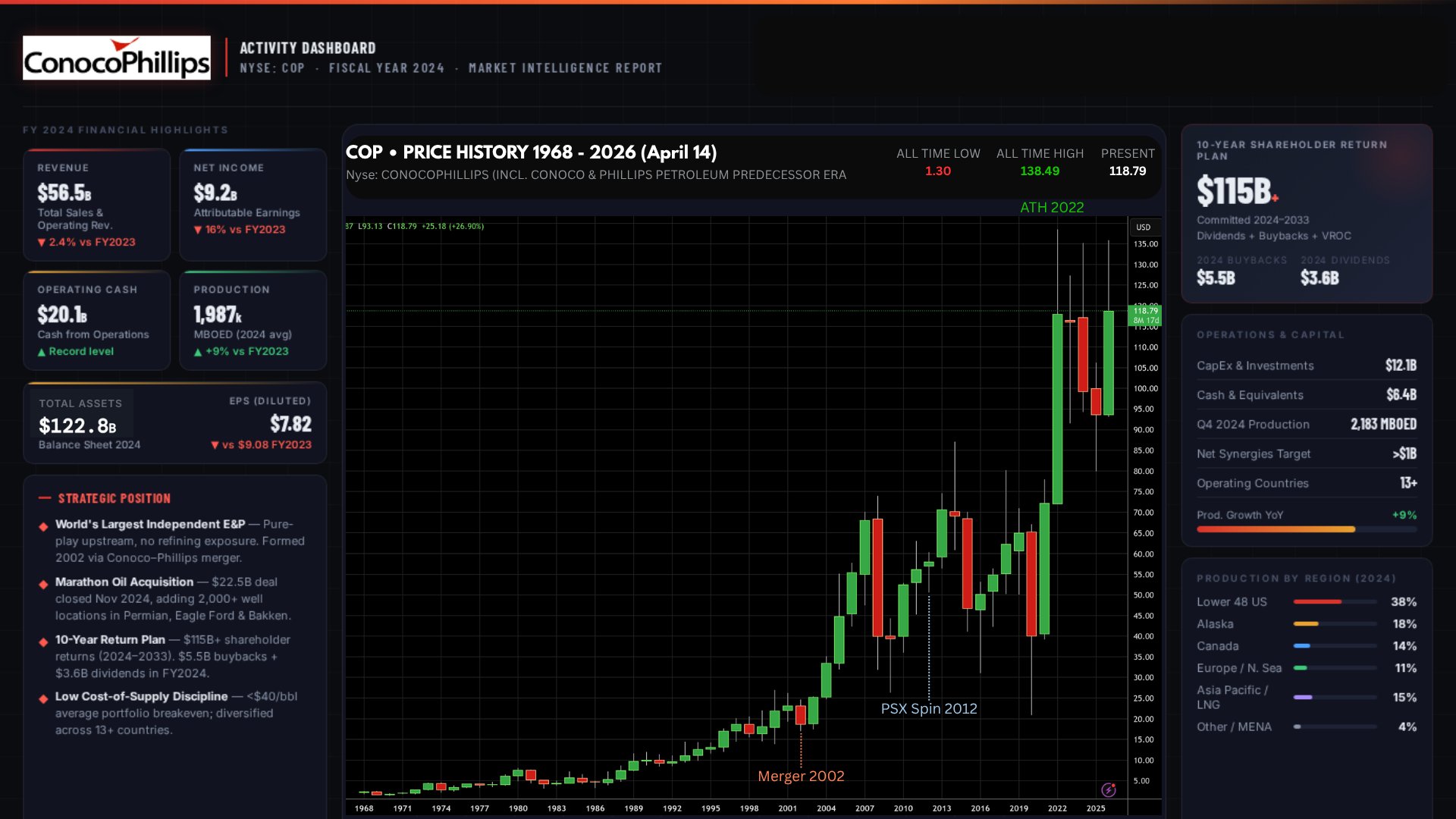
Current Market Position
ConocoPhillips trades on the NYSE under ticker COP with a current market capitalization of approximately $111.5 billion. The stock is currently trading near $118–134 per share (April 2026), within a 52-week range of $86–$136. The stock has delivered a 30% gain over the past six months and YTD return is 27%, though the 1-year return is -10%, reflecting pressure from declining crude oil prices in late 2025.
Financial Performance
Income Statement Trend (2021–2024)
| Metric | 2021 | 2022 | 2023 | 2024 |
|---|---|---|---|---|
| Sales & Other Operating Revenues | $46.1B | $78.6B | $56.1B | $56.5B |
| Gross Profit | $14.7B | $29.6B | $18.2B | $16.0B |
| EBITDA | $21.1B | $37.1B | $25.8B | $24.4B |
| Net Income | $8.1B | $18.6B | $11.0B | $9.2B |
| EPS (diluted) | $6.10 | $14.62 | $9.06 | $7.81 |
Source: ConocoPhillips SEC Form 10-K (FY 2024) and Q4 2024 Earnings Press Release
Revenue peaked in 2022 at $78.6 billion on the back of post-Ukraine conflict oil price spikes, declining since as crude prices normalised. The 2024 revenue of $56.5 billion reflects the first full partial-year contribution of Marathon Oil assets following the November 2024 acquisition close. EBITDA margin held at approximately 43% of revenues, while net income of $9.2 billion and EPS of $7.81 reflect integration costs from the $22.5 billion Marathon Oil transaction.
Key Financial Metrics (2025 / Current)
| Metric | Value |
|---|---|
| Market capitalisation | ~$111.5 billion |
| Trailing P/E | 12.75x |
| Forward P/E | 14.53x |
| Cash from operations (2024) | $20.1 billion |
| Total proved reserves | 7.8 billion BOE |
| Reserve replacement ratio | 244% |
| Full-year 2024 production | 1,987 MBOED |
| Q4 2025 EPS (reported) | $1.17 (adjusted: $1.02) |
| Shareholder distributions (2024) | $9.1 billion |
Source: ConocoPhillips Q4 2025 & Full-Year 2025 Earnings Release; ConocoPhillips 2024 Annual Report; Yahoo Finance; TIKR
2026 Financial Guidance & Strategic Targets
| Metric | Value |
|---|---|
| Production guidance | 2,330–2,360 MBOED |
| Capital expenditure budget | ~$12.9B |
| Cost reduction target | $1.0B (capex + opex combined) |
| Targeted incremental FCF by 2029 | $7.0B |
| Shareholder return commitment | ≥45% of cash from operations |
| Consensus analyst price target | $125.00 |
| 52-week trading range | $85.60 – $133.80 |
| Market capitalisation (Apr 15, 2026) | ~$111.5B |
| Forward P/E | 14.53x |
| Trailing P/E | 12.75x |
Source: ConocoPhillips 2026 Capital Budget Press Release (Dec 2025); Q4 2025 & Full-Year 2025 Earnings Release (Feb 4, 2026)
The 2026 production guidance of 2,330–2,360 MBOED represents an approximately 18% increase over the 1,987 MBOED delivered in FY 2024, driven by the full-year contribution of Marathon Oil assets and continued Permian Basin and Eagle Ford development. The $1.0 billion combined cost reduction programme — encompassing a 20–25% workforce restructuring and capital efficiency measures — is expected to underpin free cash flow generation sufficient to sustain the company's commitment to returning at least 45% of cash from operations to shareholders through its progressive ordinary dividend, variable return of cash (VROC), and share buyback programmes.
Strategic Review
STRENGTHS
Lowest cost of supply in the sector
ConocoPhillips' portfolio is anchored on assets with a break-even cost of supply below $40/barrel WTI, providing resilience across commodity price cycles — including the price spikes and demand destruction episodes that typically accompany geopolitical disruptions to global trade routes.
Scale and diversification
Post-Marathon Oil, ConocoPhillips is the largest independent E&P globally, with a multi-basin, multi-country footprint across the Lower 48 (Permian, Eagle Ford, Bakken), Alaska (North Slope), Canadian Oil Sands, Europe, Middle East, and Asia Pacific. Critically, over 70% of 2026E production of 2,330–2,360 MBOED originates from basins entirely independent of the Strait of Hormuz or other Gulf chokepoints, providing structural insulation against regional trade route disruptions.
Marathon Oil synergies
Over $1 billion in run-rate synergies were captured in 2025, ahead of original targets. The acquisition added approximately 394 MBOED of low-cost U.S. onshore production — all Hormuz-independent — and meaningfully expanded COP's U.S. Gulf Coast export optionality, creating a natural hedge against Arabian Gulf disruption scenarios through Atlantic Basin re-routing.
Capital discipline
A sustained track record of returning capital to shareholders — $9.1 billion in 2024 alone — underpinned by a progressive ordinary dividend supplemented by Variable Return of Cash (VROC) and buybacks, with a commitment to return at least 45% of cash from operations. The company maintains a $7B+ liquidity buffer providing further resilience against commodity cycle or geopolitical shock.
Reserve depth
A 244% reserve replacement ratio and 7.8 billion BOE of proved reserves provide over 10 years of production runway at current rates, with the Qatar North Field LNG expansion (9.03% participating interest) adding long-duration, contracted volume growth beyond the current decade.
LNG contract structure
Qatar LNG volumes are sold primarily under long-term take-or-pay contracts with destination flexibility clauses, meaning a temporary Hormuz routing disruption triggers contractual force majeure provisions rather than immediate revenue loss — limiting downside in all but the most prolonged closure scenarios.
CHALLENGES & RISKS
Crude price sensitivity
Q4 2025 profit missed consensus estimates due to weaker crude prices, highlighting the fundamental commodity price exposure inherent to any pure-play E&P. This sensitivity is partially mitigated by the sub-$40/bbl cost floor but cannot be fully eliminated.
Debt from Marathon acquisition
The $22.5 billion Marathon Oil deal — including assumption of $5.4 billion in debt — elevated leverage ratios. Debt-to-equity and valuation multiples are flagged as below-average scores in financial screening models, and deleveraging pace remains dependent on sustained oil price levels above the mid-$60s/bbl range.
Workforce restructuring risk
A 20–25% workforce reduction targeting $1 billion in combined capex and opex savings carries execution and operational continuity risk during a period of simultaneous integration, production growth ramp-up, and the Qatar LNG expansion buildout.
Hormuz Strait & critical trade route exposure
ConocoPhillips maintains equity production and LNG offtake exposure in the Arabian Gulf through its Qatar North Field LNG position and legacy EMENA assets. A sustained Hormuz closure — through which approximately 20–21% of global oil trade and ~25% of global LNG volumes transit — would disrupt Asia Pacific and European LNG delivery commitments. The principal residual risk is a prolonged closure exceeding 60–90 days, which would generate sufficient global price volatility to simultaneously compress margins on non-Gulf barrels through demand destruction while locking in losses on Qatar LNG liftings. This tail risk is partially mitigated by the company's financial hedging programme, force majeure contract provisions, and its $7B+ liquidity buffer.
Geopolitical exposure
Beyond Hormuz, operations in Qatar, Norway, Malaysia, and other international jurisdictions add layered geopolitical, fiscal regime, and regulatory risk. The company's EMENA segment — while relatively small — is exposed to European energy policy volatility and potential windfall taxation mechanisms.
Energy transition
As a pure-play fossil fuel E&P, ConocoPhillips faces long-term structural demand risk from the global energy transition. Its low-cost portfolio and break-even discipline mitigate near- to medium-term impact, positioning it as among the last-barrel survivors in a demand-declining scenario — but this does not eliminate the long-duration capital allocation risk that institutional ESG-mandated investors increasingly price into the equity multiple.
Stock Price Forecasts (Analyst Consensus)
| Source | Target / Forecast | Basis |
|---|---|---|
| Wall Street consensus (36 analysts) | $125 median (range $98–$154) | Fundamental analysis |
| Piper Sandler (Ryan Todd) — most bullish | $154 (+19.4% upside) | |
| JP Morgan (Arun Jayaram) — most conservative | $98 (-24% downside) | |
| Benzinga consensus | ~$117 average target | |
| TIKR valuation model | $155 (~41% upside from ~$110) | DCF model |
| CoinCodex algorithmic model | $141.77 by end-2026 (+19.3%) | Quantitative |
| StockScan algorithmic model | $135.24 average 2026 (+13.9%) | Quantitative |
The overall analyst rating is Strong Buy (8.4/10) based on 20 Buy, 7 Hold, and 1 Sell ratings from 36 Wall Street analysts. Upside is primarily tied to the $1 billion cost reduction delivery, steady production growth to 2.33–2.36 MMBOED, and sustained 45% CFO shareholder return commitment rather than aggressive oil price assumptions.
Disclaimer: This assessment draws on ConocoPhillips' official SEC filings (Form 10-K for FY 2024 and Form 10-Q for Q3 2024), the company's full-year 2024 and 2025 earnings press releases published on the ConocoPhillips Investor Relations website, and the ConocoPhillips 2024 Annual Report. Financial metrics and analyst consensus data were sourced from Yahoo Finance, Nasdaq press release wires, Energy-Pedia, and TIKR. Stock price targets and rating summaries draw on Tickernerd, StockScan, Benzinga, and CoinCodex analyst aggregation platforms. Strategic and operational context was informed by reporting from Reuters, Forbes, OE Digital, and OilGasLeads. The Marathon Oil acquisition details were verified against ConocoPhillips' official acquisition completion announcement and Fox Business reporting. Production and reserve data reflect figures stated in ConocoPhillips' Q4 2025 and full-year 2025 results announcement. The 2026 capital budget and guidance figures are sourced from the company's December 2025 capital budget press release and the February 2026 earnings guidance update. All stock price forecasts are forward-looking estimates sourced from third-party analysts and do not constitute investment advice. Actual results may differ materially based on oil price movements, execution of strategic initiatives, and macroeconomic conditions.