Commercial PTA specifications enforce extremely tight 4-CBA limits on the order of a few ppm
- Product
- 4-Carboxybenzaldehyde
- Message Category
-

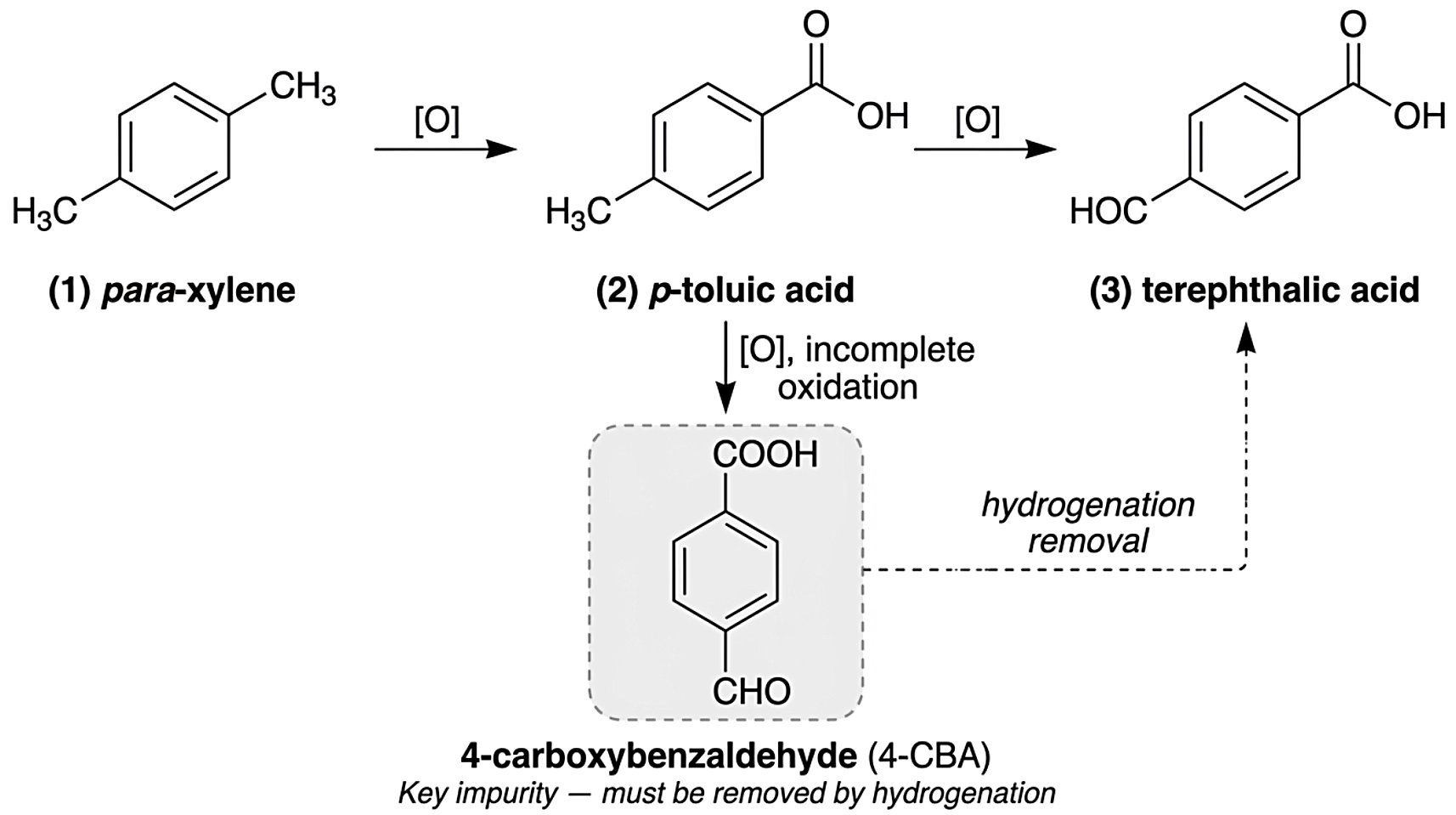
Within terephthalic acid manufacturing, 4-CBA is widely regarded as the single most important impurity to control
4-Carboxybenzaldehyde, commonly abbreviated 4-CBA, is a bifunctional aromatic compound bearing both an aldehyde group and a carboxylic acid group positioned on opposite corners (para positions) of a single benzene ring. Structurally, it sits chemically halfway between p-tolualdehyde and terephthalic acid, since one ring position has been fully oxidized to a carboxylic acid while the other remains only partially oxidized as an aldehyde.
When residual 4-CBA is carried through into polyethylene terephthalate (PET) polymerization, it interferes with the growing polymer chain, acting as a chain-terminating defect that reduces achievable molecular weight and degrades the color and clarity of the final resin. Because of this sensitivity, commercial purified terephthalic acid specifications enforce extremely tight 4-CBA limits, often on the order of a few parts per million.
Read the full profile here.
#cba #carboxybenzaldehyde #tpa #terephthalicacid #paraxylene #oxidation