
Product
4-Carboxybenzaldehyde
Abbreviation
4-CBA
Names
4-Formylbenzoic acid; p-Carboxybenzaldehyde; Benzaldehyde-4-carboxylic acid; Terephthaldehydic acid; p-Formylbenzoic acid; 4-Formylbenzenecarboxylic acid
Insight Articles
#PS817
Main Product
Aromatic Aldehydes (solid)
Segment
Chemicals
Main-Family
Functional Organic Products
Sub-Family
Aldehydes
Physical State

Solid

Description

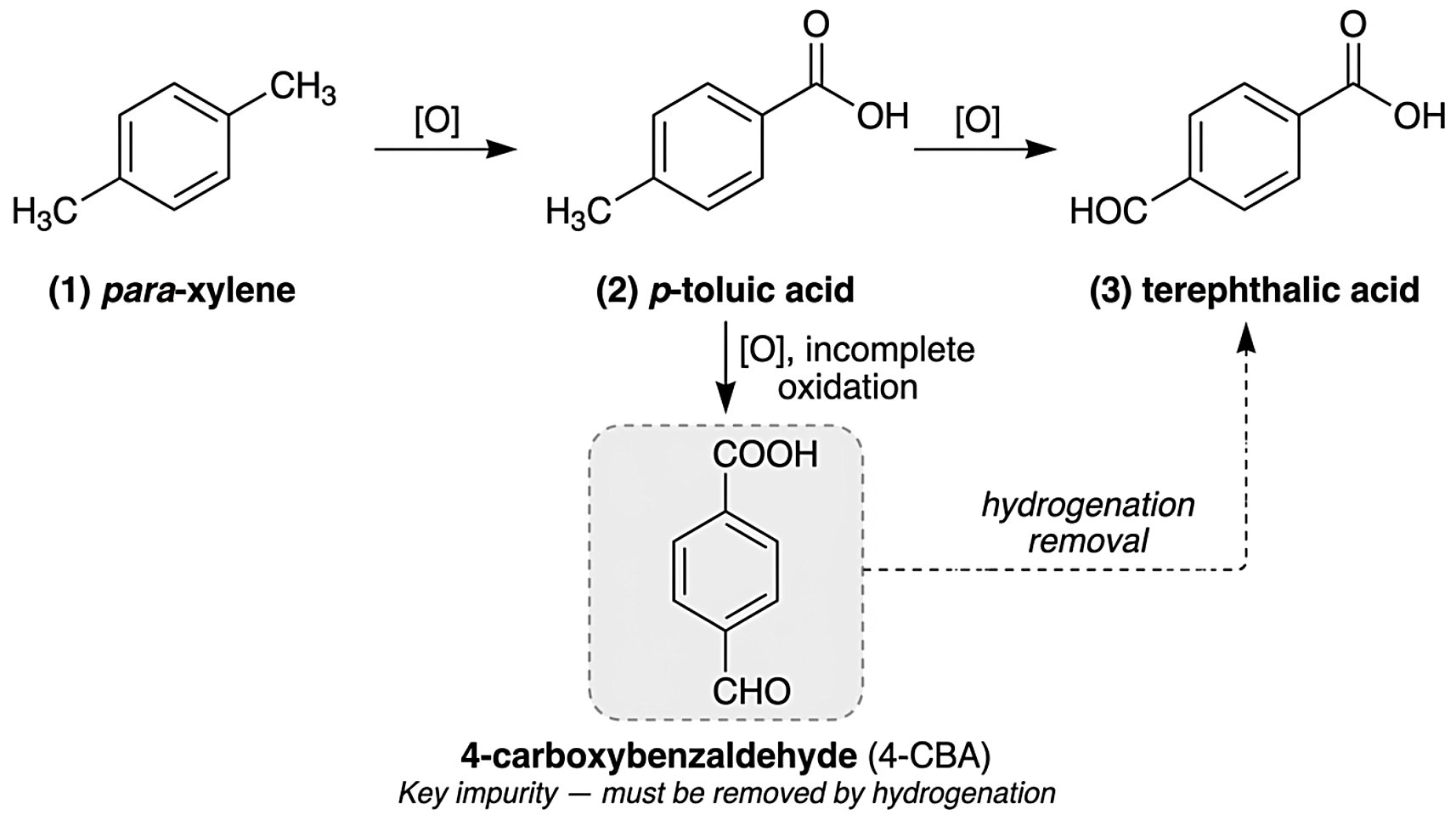
4-Carboxybenzaldehyde, commonly abbreviated 4-CBA, is a bifunctional aromatic compound bearing both an aldehyde group and a carboxylic acid group positioned on opposite corners (para positions) of a single benzene ring. Structurally, it sits chemically halfway between p-tolualdehyde and terephthalic acid, since one ring position has been fully oxidized to a carboxylic acid while the other remains only partially oxidized as an aldehyde.


Structural Identity and Formation

4-CBA can be understood as an incompletely oxidized version of terephthalic acid: whereas terephthalic acid carries two carboxylic acid groups, 4-CBA retains one carboxylic acid and one aldehyde group on the ring. It forms specifically during the industrial liquid-phase oxidation of para-xylene, arising when one of the two methyl groups on the starting material is fully oxidized to a carboxylic acid while the second methyl group only reaches the intermediate aldehyde stage rather than completing its oxidation. Under typical industrial conditions, 4-CBA is generated in a yield of roughly 0.5%, which, given that global terephthalic acid production runs into the tens of millions of tonnes annually, still makes it a relatively large-scale byproduct in absolute terms despite its small percentage.


Physical Appearance and Character

At room temperature, 4-CBA exists as a crystalline powder with a pale yellow color, distinctly different from the pure white crystalline appearance of finished terephthalic acid. It has a melting point in the vicinity of 247°C, considerably higher than lighter aromatic aldehydes like p-tolualdehyde, reflecting the added polarity and hydrogen-bonding capability introduced by its carboxylic acid group. It is notably air-sensitive and is typically recommended for storage below 30°C to preserve stability, and it exhibits a moderately acidic character with a pKa around 3.77, consistent with other substituted benzoic acid derivatives.


Solubility and Handling

4-CBA is soluble in water as well as a range of common organic solvents including methanol, DMSO, diethyl ether, and chloroform, a broader solubility profile than many purely nonpolar aromatic compounds, owing to the polar character contributed by both its functional groups. This solubility profile has practical significance in industrial purification, since it influences how the compound partitions between aqueous and organic streams during separation and washing steps. It is also classified as an irritant, meaning standard precautions for skin, eye, and respiratory protection are warranted when handling it in concentrated or powdered form.


Role as a Process Impurity

Within terephthalic acid manufacturing, 4-CBA is widely regarded as the single most important impurity to control, because it directly and negatively affects the properties of the polymer made downstream. When residual 4-CBA is carried through into polyethylene terephthalate (PET) polymerization, it interferes with the growing polymer chain, acting as a chain-terminating defect that reduces achievable molecular weight and degrades the color and clarity of the final resin. Because of this sensitivity, commercial purified terephthalic acid specifications enforce extremely tight 4-CBA limits, often on the order of a few parts per million, in contrast to the much higher levels tolerated in the unpurified crude terephthalic acid (CTA) intermediate discussed earlier.


Purification Strategy

The standard industrial method for removing 4-CBA is catalytic hydrogenation, in which the crude terephthalic acid solution is passed over a supported noble-metal catalyst, typically palladium on carbon, under elevated temperature and hydrogen pressure. This step selectively reduces the aldehyde group in 4-CBA back to a methyl group, converting it into p-toluic acid, which is far more soluble in the aqueous mother liquor and is therefore easily separated from the crystallizing terephthalic acid product during subsequent purification stages.


Commercial and Synthetic Uses

Outside its role as a process impurity, 4-CBA also has recognized value as a synthetic building block in its own right, serving as an intermediate in the preparation of certain pharmaceutical compounds, pesticide formulations, and fluorescent whitening agents. It has also been used in specialized organic chemistry applications, such as in esterification reactions to produce functionalized piperidine-oxide derivatives used in radical chemistry research.


Insight Articles
Your insights will be shown here

Within terephthalic acid manufacturing, 4-CBA is widely regarded as the single most important impurity to control
Identifiers

logo CAS Number
619-66-9
logo EC Number
210-607-4
logo ECHA InfoCard
100.009.645
logo IUPAC Name
4-Formylbenzoic acid
logo PubChem ID
12088
Chemical Data

Chemical Formula

C8H6O3

Molecular Weight (g/mol)
150.133
Melting Point (°C)
246
Sulfur Content (wt%)
0
Specific Gravity
1.26
Crude Data

API Gravity
-19.6
Country
Product Settings

Default
Status
A
Content provided by
Transaction Name Date
Modified by UserPic   Kokel, Nicolas 7/30/2026 3:39 PM
Added by UserPic   Kokel, Nicolas 7/29/2026 3:06 PM