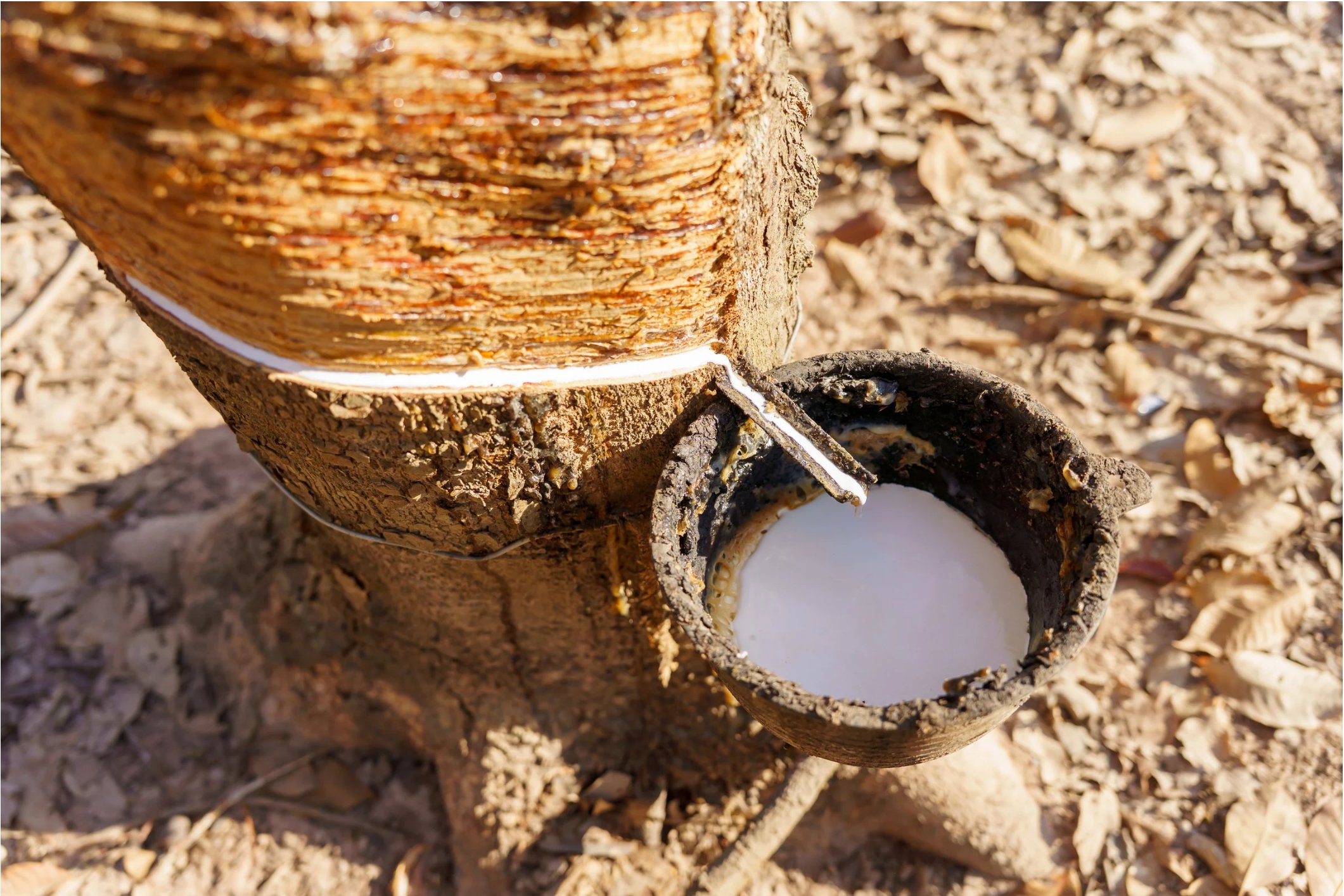
Hevea latex is the milky-white colloidal fluid naturally produced and stored in the laticifer cells of Hevea brasiliensis (the Pará rubber tree), representing the world's sole commercial-scale biological source of natural rubber. It is tapped by making incisions in the tree's bark, causing the pressurized latex to flow into collection cups, typically yielding 30–40 mL per tapping session per tree.
Structure
At the microscale, Hevea latex is a complex colloidal dispersion of three distinct particulate phases suspended in an aqueous cytoplasmic serum (C-serum):
- Rubber particles — spherical particles (0.1–3 µm) consisting of a cis-1,4-polyisoprene core surrounded by a stabilizing monolayer of phospholipids and proteins; the dominant fraction at 50–70% w/w of fresh latex
- Lutoids — membrane-bound vacuoles containing a serum rich in enzymes and destabilizing proteins (including hevein); act as natural promotors of latex coagulation
- Frey-Wyssling particles — carotenoid-containing organelles responsible for the characteristic yellow tint of some latex fractions
Chemical Composition
Fresh, unpreserved Hevea latex has the following approximate composition:
| Component |
Content (% fresh weight) |
| Water |
~60% |
| Rubber hydrocarbon (cis-1,4-polyisoprene) |
~35% |
| Proteins |
~1–2% |
| Lipids & fatty acids |
~1–2% |
| Carbohydrates |
~1% |
| Inorganic minerals & ash |
~0.5% |
The rubber hydrocarbon accounts for approximately 87% of the dry weight of latex. Critically, the minor non-isoprene components — proteins, lipids, and carbohydrates — are believed to be responsible for the superior mechanical properties of natural rubber over its purely synthetic counterpart, but also for the variability in rubber quality between tree clones and growing conditions.
Key Physical Properties
- Appearance: Milky-white to pale cream viscous liquid
- pH: Slightly acidic to near-neutral (6.5–7.0 in fresh state)
- Dry matter content: 25–50% depending on clone and tapping system
- Colloidal stability: Maintained by negative surface charges on rubber particles and lutoids; disrupted by pH reduction, bacterial action, or mechanical agitation, leading to spontaneous coagulation within hours of tapping
Preservation & Stabilization
Without intervention, fresh latex undergoes spontaneous coagulation within hours due to bacterial enzymatic activity that acidifies the serum below the critical pH threshold. Standard preservation methods used in commercial plantations include:
- Ammonia (NH₃) — most common; added at 0.6–0.7% to raise pH and inhibit bacterial growth
- Sodium sulphite or formalin — used in combination with ammonia for long-distance transport
- TMTD (tetramethylthiuram disulphide) + ZnO — low-ammonia preservation systems for sensitive applications
Commercial Significance
Hevea latex is processed along two main industrial pathways: either concentrated by centrifugation to ~60% DRC for direct use in latex-state manufacturing (surgical gloves, condoms, foam, adhesives), or coagulated and dried into solid rubber grades (TSR, RSS, crepe) for use in tire manufacturing and industrial rubber goods. The non-isoprene protein content — specifically the Hev b allergen family — is the primary cause of Type I latex hypersensitivity, driving regulatory scrutiny in medical device applications and interest in protein-reduced or deproteinized natural rubber (DPNR) grades.
References
- Bottier C. (2020). Biochemical composition of Hevea brasiliensis latex: A focus on the protein, lipid, carbohydrate and mineral contents. In : Nawrot Robert (ed.). Latex, laticifers and their molecular components: From functions to possible applications. Londres : Academic Press, p. 201-237. (Advances in Botanical Research, 93). DOI: 10.1016/bs.abr.2019.11.003
- Kent Elastomer (Oct 7, 2017). The Difference Between Rubber Latex and Natural Rubber Latex
- Elchemy (Oct 24, 2025). Natural Rubber vs Latex: Differences, Advantages, and Limitations Explained