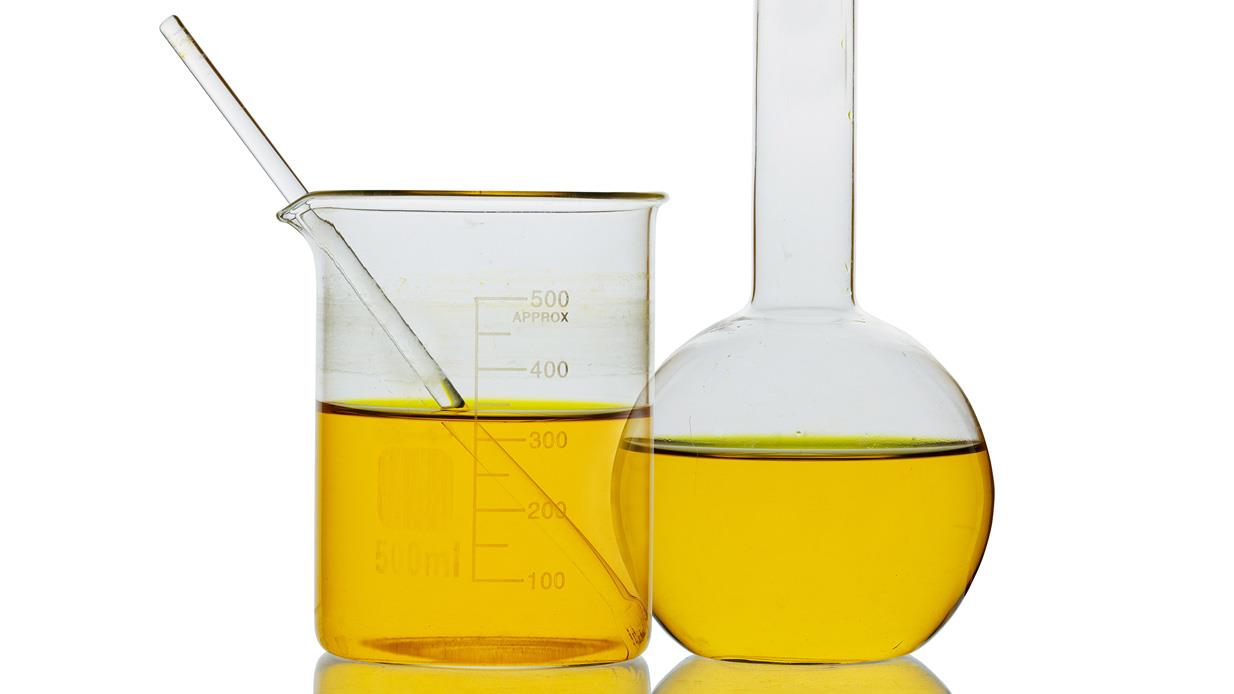
Bright Stock (BS) is a very high-viscosity Group I lubricant base oil, typically with a viscosity of approximately 28-35 cSt at 100°C (often designated as BS 150 based on its viscosity at 40°C). It represents the heaviest commercial grade of base oil produced from petroleum refining.
The term "Bright Stock" originates from early refining practices where dark-colored cylinder stock was blended with naphtha and winterized to extract wax, then distilled to remove the naphtha solvent, producing a bright-colored (clear) oil—in contrast to the dark residual oils that were common before hydrofinishing.
Production
Bright stock is produced from the heaviest fraction of vacuum distillation—the deasphalted vacuum residue. The manufacturing process involves:
- Atmospheric and vacuum distillation of crude oil
- Solvent deasphalting to remove asphaltenes from vacuum residue
- Solvent extraction (furfural or phenol) to remove aromatics
- Solvent dewaxing to reduce pour point
- Hydrofinishing - a mild hydrotreating step at elevated temperature and hydrogen pressure to improve color, oxidation stability, and remove reactive compounds
Figure 1 - How is bright stock produced
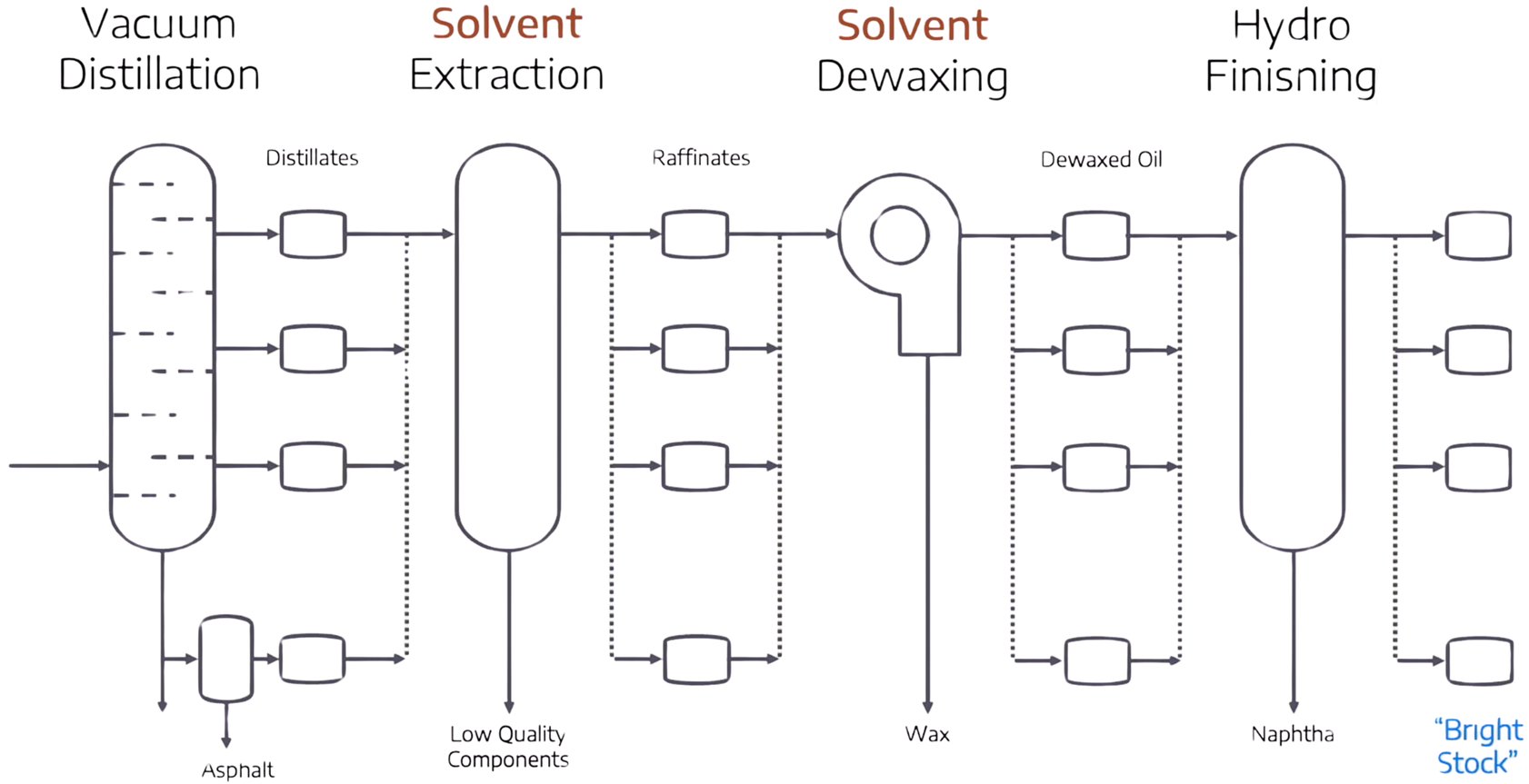
The hydrofinishing step is what distinguishes bright stock from solvent neutral (SN) base oils—it produces the characteristic "bright" (clear, light) color that gives the product its name.
Key Properties
- Viscosity: ~28-35 cSt at 100°C (extremely high compared to typical base oils)
- Viscosity Index: Typically 90-100 for Group I bright stock
- Density: ~0.900-0.920 kg/L at 15°C
- Sulfur content: >0.03% (Group I specification)
- Color: Light/bright (hence the name)
- Aromatic content: Moderate, which enhances solvency
Table 1 - Typical Specifications of Different Types of Bright Stocks | Source: Kline & Co. [3]
| Parameter |
Conventional Group I |
Group V-a |
Alternate-b |
Alternate-c |
| Viscosity Index |
92-100 |
20-30 |
102 |
83 |
| Viscosity, SUS @ 100 degree F |
2,200-2,800 |
2,133 |
~2,100 |
NA |
| Viscosity, cSt @ 100 degree C |
30-33 |
19.8 |
24 |
32.2 |
| Gravity, API |
22-27 |
21.7 |
NA |
NA |
Pour Point,
degree C |
(6.0) |
(16.0) |
(30.0) |
(12.5) |
| ASTM color |
L 2.0 - 8.0 |
L 2.0 |
L 0.5 |
NA |
| Sulfur, % |
0.2 - 5.0 |
0.08 |
<0.0003 |
<0.0010 |
| Saturates, % |
50-90 |
NA |
95 |
92.8 |
Notes: a-These properties are specific to the product (HyGold L2000) produced via a naphthenic crude source by Ergon. b-These properties are specific to the Product 120BS produced by SK at its Group II plant in South Korea. c-These properties are specific to Group I bright stocks produced by PetroChina at Karamay, China. NA-Not available.
Applications
Bright stock is primarily used as a viscosity booster or blending component rather than as a standalone lubricant. Key applications include:
- Marine cylinder oils for slow-speed diesel engines
- Heavy-duty gear oils and transmission fluids
- Industrial greases (calcium, lithium, and complex soap greases)
- Open gear lubricants for mining and cement equipment
- Blending component to increase viscosity in multigrade formulations
Its exceptional load-carrying capacity, film-forming properties, and high viscosity make it ideal for severe operating conditions requiring thick lubrication films.
Market Context
Bright stock remains an important Group I base stock despite the industry shift toward Group II/III base oils, particularly for marine and heavy-duty industrial applications where its unique combination of high viscosity and solvency is valued.
References
- ExxonMobil. Basestocks FAQ.
- Orizzonté. Base Oil Group-I, Bright Stock 150.
- Kumar A., Kline & Co. (June 2018). The evolving global bright stock market. Society of Tribologists and Lubrication Engineers.
- Nuroil. About "Bright Stock".
- Noria Corporation (October 4, 2017). The Truth About Bright Stock Oils. Machine Lubrication.
- Keyton Energy. Bright Stock.
- Chevron Marine Products (2020). Marine lubricants information bulletin 13, bright stock.
- Lubrication Explained (October 25, 2021). Bright Stocks (BS) and Solvent Neutral (SN) base oils explained. Youtube Video.