Iron is a chemical element and the most abundant heavy metal on Earth, forming the foundation of the modern metals industry. With the symbol Fe (from Latin ferrum) and atomic number 26, it is a lustrous, silvery-grey transition metal belonging to Group 8 of the periodic table. Iron is the primary raw material for steel production and, through its alloys, underpins virtually all of industrial civilisation — from construction and transportation to machinery, energy infrastructure, and advanced manufacturing.
Chemical Identity
| Property |
Value |
| Symbol |
Fe |
| Atomic Number |
26 |
| Atomic Mass |
55.845 g/mol |
| Electron Configuration |
[Ar] 3d⁶ 4s² |
| Oxidation States |
0, +2, +3 (also +4, +6 in rare compounds) |
| Crystal Structure |
BCC (α-iron, ambient); FCC (γ-iron, 912–1,394°C) |
| Colour |
Silvery-grey metallic |
| Density |
7.874 g/cm³ |
| Melting Point |
1,538 °C |
| Boiling Point |
2,861 °C |
| Hardness (Mohs) |
4.0 |
| Magnetic Property |
Ferromagnetic below 770°C (Curie point) |
Allotropic Forms
Iron is allotropic — it exists in distinct crystal structures depending on temperature:
- α-iron (ferrite) — stable below 912°C; body-centred cubic (BCC); ferromagnetic below 770°C (Curie temperature)
- γ-iron (austenite) — stable 912–1,394°C; face-centred cubic (FCC); non-magnetic; dissolves carbon readily — the basis of steel heat treatment and hardening
- δ-iron (delta ferrite) — stable 1,394–1,538°C; BCC again; exists immediately below the melting point
- ε-iron — hexagonal close-packed (HCP); exists only at very high pressures (above ~13 GPa)
The α↔γ transformation at 912°C is the metallurgical basis for heat treatment and hardening of steel.
Natural Occurrence
Iron is the fourth most abundant element in Earth's crust (~5% by mass) and the most abundant element in the Earth as a whole (~32%), where it constitutes most of the core. It does not occur in native metallic form at the Earth's surface under normal conditions, being found almost exclusively as iron oxides, carbonates, and silicates. Its principal iron-bearing ore minerals are hematite, magnetite, goethite, and siderite. Metallic iron occurs naturally in meteorites (as kamacite and taenite, iron-nickel alloys) and in rare terrestrial occurrences associated with highly reducing geological conditions.
Production — From Ore to Metal
Iron is produced commercially by the reduction of iron ore (hematite or magnetite) in one of two principal process routes:
Blast Furnace — Basic Oxygen Furnace (BF-BOF) — dominant route, ~70% of global production:
- Iron ore, coke, and limestone are charged into the blast furnace
- Hot air blast (enriched with oxygen) combusts coke to generate CO and heat
- CO reduces iron oxides stepwise: Fe₂O₃ → Fe₃O₄ → FeO → Fe
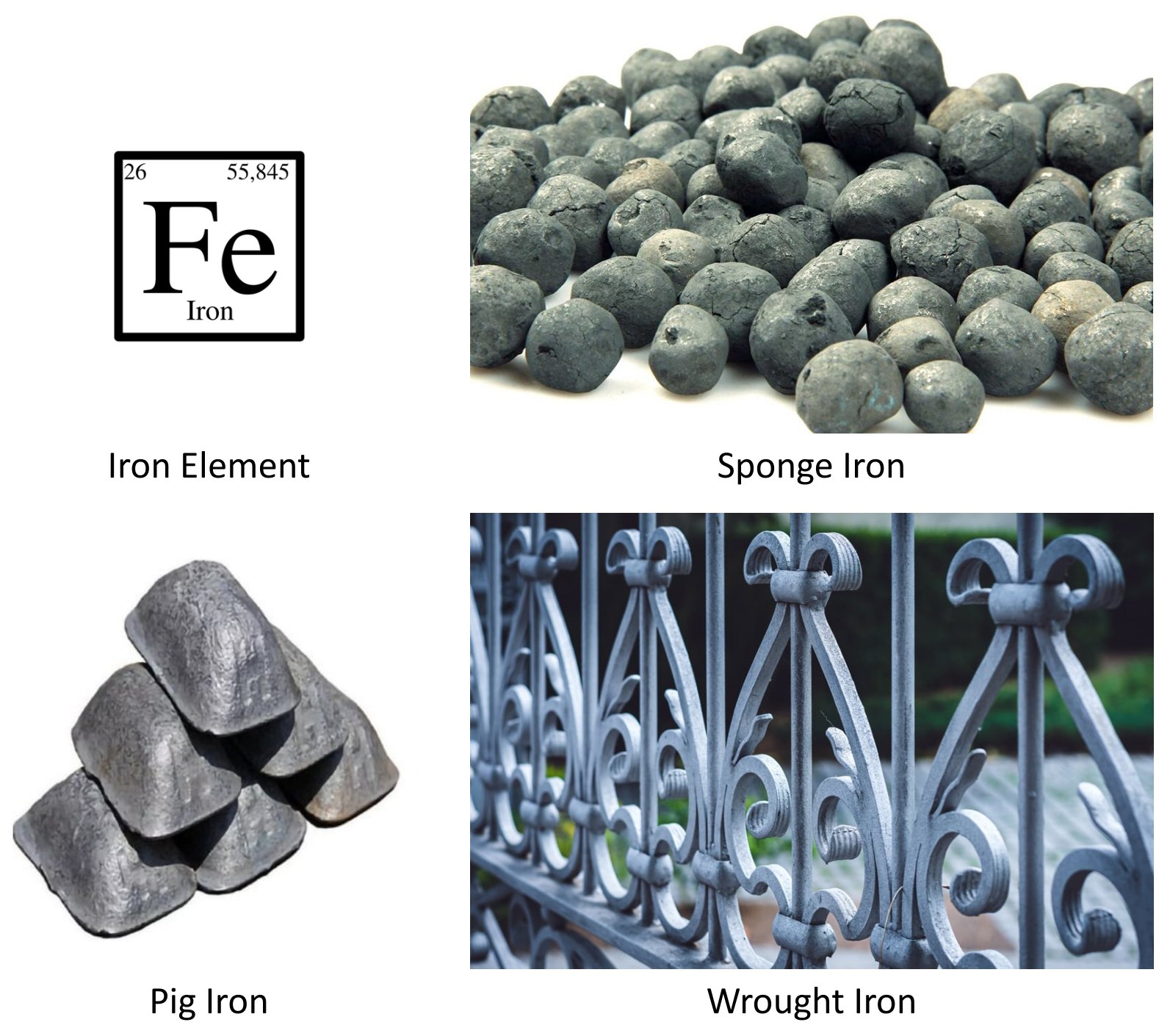
- Pig iron (hot metal) tapped from the furnace contains ~3.5–4.5% C, plus Si, Mn, P, and S
- Pig iron is converted to steel in the BOF converter by oxygen blowing
Direct Reduction — Electric Arc Furnace (DRI-EAF) — growing alternative, ~30% of production:
- Iron ore pellets are reduced at solid state by reformed natural gas (syngas: H₂ + CO) or hydrogen at 800–950°C
- Product is direct reduced iron (DRI) / sponge iron (~90–94% Fe, <0.5% C)
- DRI is melted and refined in an electric arc furnace
Commercial Iron Products
Commercial iron products span a range of carbon contents, purity levels, and production routes. Each is profiled individually at the product sub-level.
| Product |
Carbon Content |
Production Route |
Primary Use |
| Pig Iron |
3.5–4.5% C |
Blast furnace (BF) |
BOF steelmaking; foundry feedstock |
| Direct Reduced Iron (DRI) |
<0.5% C |
Gas/H₂ solid-state reduction |
EAF steelmaking feedstock |
| Hot Briquetted Iron (HBI) |
<0.5% C |
DRI + hot briquetting |
Seaborne DRI trade; EAF feedstock |
| Wrought Iron |
<0.08% C |
Puddling / forge welding |
Heritage ironwork; restoration |
| Iron Powder |
Variable |
Electrolytic / carbonyl / atomised |
PM parts; chemicals; food fortification |
Note on Cast Iron: Cast iron (2.0–4.0% C) is produced from pig iron but is classified as a ferrous alloy rather than an iron product. Its composition is deliberately engineered with silicon, manganese, and other additions to produce distinct grades (grey, ductile, white, malleable) with controlled microstructures. It is covered under the Ferrous Alloys category.
Global Production & Trade
Iron ore production exceeds 2.5 billion tonnes per year, with Australia and Brazil dominating seaborne exports. Global pig iron production is approximately 1.2 billion tonnes per year, with China accounting for over 60% of output. DRI/HBI production has grown steadily to over 120 million tonnes per year, driven by decarbonisation pressures on the traditional blast furnace route and the global expansion of EAF steelmaking capacity. Iron and steel together represent the world's most produced metal group, with total crude steel output exceeding 1.9 billion tonnes per year.
Relationship to Steel
Iron in its commercially produced forms is the exclusive feedstock for steel — iron alloyed with 0.02–2.0% carbon and various other elements — which multiplies its strength, hardness, and engineering versatility many fold. Iron's industrial dominance derives almost entirely from this conversion: virtually all pig iron and DRI produced globally is consumed by the steelmaking industry within the same integrated value chain.
References
- National Library of Medicine, PubChem. Iron (Page version Feb 28, 2026)
- ChemWhat. Iron CAS#: 7439-89-6; ChemWhat Code: 17600 (Accessed Mar 1, 2026)
- International Iron Metallics Association (iima). DRI production (Accessed Mar 1, 2026)
- wordsteel (Mar 2023). Fact sheet: Steel and raw materials
- wordsteel (May 21, 2025). World Steel in Figures 2025
- Fortune Business Insights . Report FBI108698: Iron Ore Market Size, Share & Industry Analysis (Feb 9 2026)