
Product
Crude Terephthalic Acid
Abbreviation
CTA
Names
Terephthalic Acid; Benzene-1,4-dicarboxylic Acid
Insight Articles
#PS815
Main Product
Benzenedicarboxylic Acid
Segment
Chemicals
Main-Family
Functional Organic Products
Sub-Family
Carboxylic Acids
Physical State

Solid

Description

Crude Terephthalic Acid (CTA) is the intermediate solid product formed by the liquid-phase catalytic oxidation of para-xylene, serving as the direct precursor to Purified Terephthalic Acid (PTA) — it is never sold as a final commercial product, but rather processed on-site (or in an integrated plant) through hydrogenation purification.


Chemical Identity

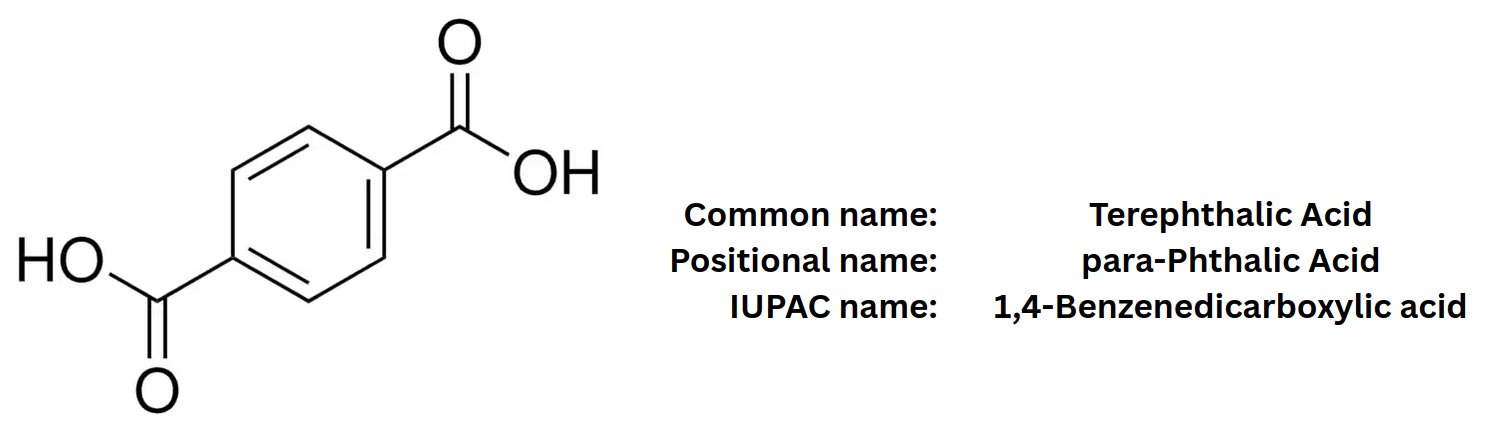
CTA is chemically identical in its base backbone to terephthalic acid (benzene-1,4-dicarboxylic acid) — the difference from PTA lies entirely in impurity content, not molecular structure. It appears as an off-white to yellowish/tan crystalline solid or powder, in contrast to the pure white powder appearance of finished PTA


Formation and Chemistry

CTA is produced via liquid-phase air oxidation of para-xylene in an acetic acid solvent medium, catalyzed by a homogeneous cobalt/manganese/bromine (Co/Mn/Br) catalyst system, typically at 150–220°C and 15–30 atm (1500–3000 kPa) in an agitated bubble-column or stirred-tank reactor. The oxidation proceeds via the intermediate p-toluic acid, and the reaction inevitably produces measurable levels of impurities carried through into the solid CTA crystal — most significantly 4-carboxybenzaldehyde (4-CBA), along with unreacted p-toluic acid, p-tolualdehyde, and trace colored oxidation byproducts.


Key Distinguishing Impurity Profile (CTA vs. PTA)

Parameter CTA (typical) PTA (finished,
per ORLEN spec)
4-CBA content Significantly higher (~thousands of ppm) Max 15 ppm
p-Toluic acid content Higher Max 150 ppm
Color/appearance Off-white/tan, less pure White powder,
Pt-Co color max 10
Metal catalyst residue (Co, Mn, Fe, Ni, Cr) Present at higher levels Max 0.5 ppm
Alkaline transparency (T400) Lower Min 97%


CTA is unsuitable for direct use in polyester (PET) production because residual 4-CBA acts as a chain-terminating impurity, degrading polymer molecular weight and imparting undesirable color to the finished resin — this is precisely why the purification/hydrogenation step exists.


Process Role: CTA Recovery and Handling

Following oxidation, the CTA-in-acetic-acid slurry undergoes staged flash crystallization (pressure/temperature letdown), then solid-liquid separation (historically centrifuge or belt filter; in current-generation KTS P8++ technology, a rotary pressure filter performing solvent interchange), where acetic acid mother liquor is exchanged for an aqueous wash medium. In some plant configurations, CTA is dried and stored/transported as an intermediate solid prior to purification; in fully integrated modern plants, the CTA slurry is transferred directly (without drying) into the purification section as an aqueous suspension, per the "aliphatic carboxylic acid mother liquor" filtration approach.


Purification Pathway (CTA → PTA)

  1. CTA is reslurried/dissolved in an aqueous medium at 250–350°C

  2. The resulting aqueous CTA solution is catalytically hydrogenated (typically over a palladium-on-carbon fixed-bed or trickle-bed catalyst at 250–350°C, ~20 atm) to convert 4-CBA into the more soluble and separable p-toluic acid

  3. The purified solution is crystallized (cooling/depressurization) to precipitate PTA crystals

  4. Crystals are separated, washed, and dried to yield finished PTA, typically specified at ≥99.98% purity for polyester-grade applications


Economic and Industrial Note

Historically, some producers operated separate, standalone CTA production units feeding downstream, sometimes third-party, PTA purification facilities — a business model that existed in the industry's earlier development, though most modern world-scale plants integrate oxidation and purification into a single continuous flowsheet, eliminating the need to dry, store, or transport CTA as an independent commodity.


Insight Articles
Your insights will be shown here

Terephthalic acid molecular structure and names
  Product Communicator
Title Date
Identifiers

logo CAS Number
100-21-0
logo EC Number
202-830-0
logo ECHA InfoCard
100.002.573
logo IUPAC Name
Benzene-1,4-dicarboxylic acid
logo PubChem ID
7489
Chemical Data

Chemical Formula

C8H6O4

Molecular Weight (g/mol)
166.132
Melting Point (°C)
427
Sulfur Content (wt%)
0
Specific Gravity
1.00
Crude Data

API Gravity
10
Country
Product Settings

Default
Status
A
Content provided by
Transaction Name Date
Modified by UserPic   Kokel, Nicolas 7/30/2026 3:38 PM
Added by UserPic   Kokel, Nicolas 7/29/2026 11:39 AM