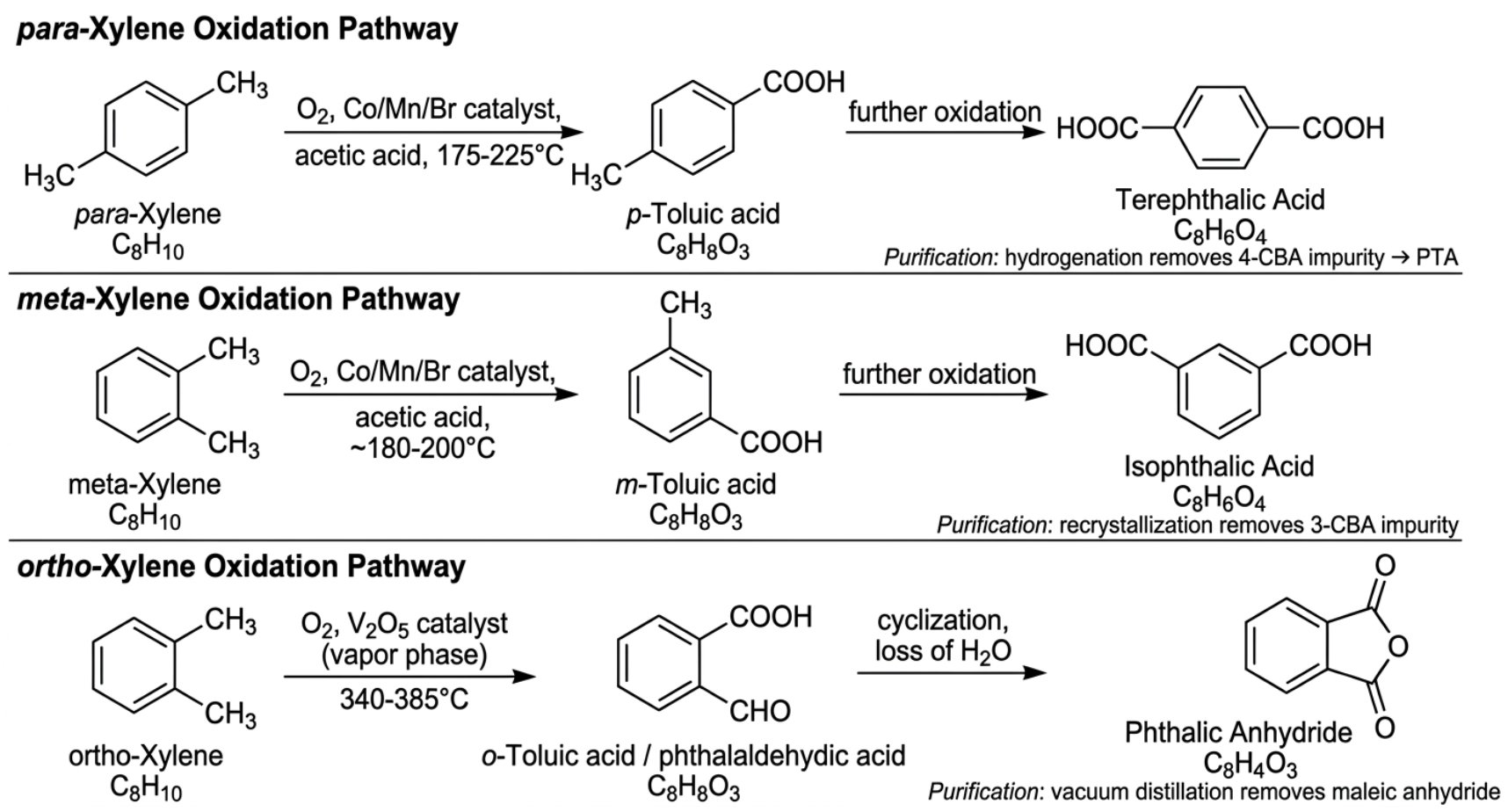
Xylene oxidation is the commercial route by which all three C8 aromatic isomers are converted into their corresponding aromatic dicarboxylic acids: terephthalic acid (from para-xylene), phthalic anhydride (from ortho-xylene), and isophthalic acid (from meta-xylene).
Process History
Mid-Century Corporation (later Amoco) commercialized the first liquid-phase catalytic oxidation of para-xylene using a Co/Mn/Br catalyst in acetic acid in the 1950s, a route now known as the Amoco/Mid-Century process. Phthalic anhydride production began in 1917 via naphthalene oxidation, later shifting to ortho-xylene once the feedstock became abundant from catalytic reforming. Isophthalic acid production developed as a direct extension of the same Co-Mn-Br homogeneous catalytic chemistry applied to meta-xylene, becoming commercially significant from the 1960s–70s onward as demand grew for modified PET resins with improved barrier and impact properties.
Process Summary and Chemistry
All three routes rely on catalytic partial oxidation with air, but differ in phase and catalyst detail:
-
PTA (from para-xylene): Liquid-phase oxidation in acetic acid with homogeneous Co/Mn/Br catalyst; each methyl group is oxidized stepwise through p-toluic acid to terephthalic acid
-
Phthalic anhydride (from ortho-xylene): Vapor-phase oxidation over fixed-bed V2O5 catalyst; the ortho geometry allows intramolecular ring closure with loss of water, forming the cyclic anhydride directly
-
Isophthalic acid (from meta-xylene): Liquid-phase oxidation, almost identical in principle to the PTA route, using the same homogeneous Co-Mn-Br catalyst system in acetic acid solvent; because the meta substitution pattern cannot cyclize, the product remains a diacid rather than an anhydride
Generic Step-by-Step Technology Description
-
Feed preparation: Air is filtered, compressed, and preheated; xylene isomer is fed as liquid with acetic acid solvent (PTA, IPA routes) or vaporized (phthalic anhydride route)
-
Reaction: Feed and air enter a bubble-column/stirred oxidizer (liquid-phase PTA/IPA) or a multitubular fixed-bed reactor (vapor-phase phthalic anhydride)
-
Heat removal: Cooling coils with solvent evaporation (liquid-phase) or circulating molten salt (vapor-phase) remove exothermic reaction heat, often generating medium/high-pressure steam
-
Product recovery: Crude terephthalic/isophthalic acid crystallizes from the reaction liquor and is filtered; phthalic anhydride desublimes as a solid in switch condensers
-
Purification: Hydrogenation (PTA, to remove 4-CBA) or recrystallization/further oxidation steps (IPA, to remove residual m-toluic acid and 3-CBA) yield commercial-grade product
-
Off-gas treatment: Vent gases scrubbed and/or incinerated before atmospheric release
Typical Process Parameters
| Parameter |
PTA
(p-xylene) |
Isophthalic Acid
(m-xylene) |
Phthalic Anhydride (o-xylene) |
| Catalyst |
Co/Mn/Br (homogeneous) |
Co/Mn/Br (homogeneous) |
V2O5 (heterogeneous, fixed-bed) |
| Temperature |
175–225°C |
~180–200°C |
340–385°C |
| Pressure |
~15–30 bar |
~15–20 bar
(liquid phase maintained) |
Near-atmospheric |
| Solvent |
Glacial acetic acid |
Glacial acetic acid |
None |
| Reactor type |
Bubble-column/
stirred oxidizer |
Bubble-column/
stirred oxidizer
ith cooling coil |
Multitubular
fixed-bed |
Specific Production Steps by Process
PTA-Specific Production Steps
-
Para-xylene, acetic acid solvent, and Co/Mn/Br catalyst are fed with compressed air into the oxidation reactor at 175–225°C
-
Crude terephthalic acid (CTA) crystallizes on cooling and is separated by centrifugation/filtration
-
CTA is dissolved in water and catalytically hydrogenated (Pd catalyst) to reduce 4-CBA to soluble derivatives
-
The purified solution is cooled to crystallize PTA, filtered, washed, and dried to PET-grade specification (4-CBA <25 ppm)
Isophthalic Acid-Specific Production Steps
-
Meta-xylene, acetic acid solvent, and Co/Mn/Br catalyst are fed with compressed air into a stirred/bubble-column oxidizer, with a cooling coil managing reaction heat via coordinated solvent evaporation
-
Crude isophthalic acid crystallizes as the reaction mixture cools and is separated by filtration
-
The crude product undergoes further oxidation or recrystallization treatment to reduce residual m-toluic acid and 3-carboxybenzaldehyde impurities to trace levels
-
Purified isophthalic acid is dried and packaged as a white crystalline powder for use as a PET comonomer or resin feedstock
Phthalic Anhydride-Specific Production Steps
-
Vaporized ortho-xylene and preheated compressed air are fed into a multitubular fixed-bed reactor with V2O5 catalyst at 340–385°C
-
Circulating molten salt removes reaction heat, generating high-pressure steam via a waste-heat boiler
-
Product gas passes through switch condensers where phthalic anhydride desublimes on cooled fins
-
Periodic hot-oil heating melts the collected solid, which undergoes continuous vacuum distillation to remove maleic anhydride and heavy impurities
-
Tail gas from switch condensers is scrubbed before atmospheric discharge
Process Performance
- The Amoco Co/Mn/Br PTA process typically achieves terephthalic acid selectivity of 90–95%, with p-toluic acid and 4-CBA as principal byproducts.
- The isophthalic acid process using the same catalyst chemistry achieves comparable high conversion of m-xylene, though managing 3-carboxybenzaldehyde and m-toluic acid impurities is analogous to the PTA purification challenge.
- Phthalic anhydride yields typically reach 105–112 kg per 100 kg o-xylene, with maleic anhydride as the main byproduct from over-oxidation.
Economics
All three routes are dominated by feedstock costs tracking xylene isomer and naphtha reformate pricing, with acetic acid solvent recovery and catalyst/bromide corrosion management (requiring titanium/Hastelloy metallurgy) being major capex/opex drivers for the liquid-phase PTA and IPA routes. The vapor-phase phthalic anhydride route has comparatively lower capital intensity due to simpler fixed-bed metallurgy.
Global Technology Licensors
| Technology |
Licensor / Provider |
Estimated Global Market Share (licensed capacity) |
Notes |
| PTA (p-xylene oxidation) |
INEOS / INVISTA |
Historically dominant; combined ~majority of licensed PTA capacity worldwide |
Originators of the Amoco/Mid-Century Co-Mn-Br process |
Phthalic anhydride
(o-xylene oxidation) |
BASF / Lonza |
Two of the principal historical licensors of vapor-phase V2O5 fixed-bed technology |
— |
Isophthalic acid
(m-xylene oxidation) |
Derivative of Amoco/BP Co-Mn-Br chemistry; increasingly licensed / operated by Asian producers via proprietary process patents |
Fragmented; no single dominant global licensor |
— |
Note: Precise licensed-capacity market share figures are not publicly disclosed by most licensors; the shares above are qualitative rankings based on installed complex counts and industry positioning, not audited percentages.
Market Size and Growth by Product
| Product |
Estimated Global Volume (2026) |
Projected Volume |
Volume CAGR |
Key Driver |
| Purified Terephthalic Acid (PTA) |
~98.5 million tons |
~128.4 million tons by 2031 |
~5.4% |
PET packaging and polyester fiber demand, led by Asia-Pacific |
| Phthalic Anhydride |
~4.79 million tons |
~5.41 million tons by 2031 |
~2.5% |
PVC plasticizers, alkyd resins; Asia-Pacific holds ~53.5% share |
| High-Purity Isophthalic Acid (PIA) |
~USD 621.8 million (2025, revenue basis) |
~USD 892.4 million by 2032 |
~5.3% |
Modified PET resins for bottles/films needing improved clarity and barrier properties |
A note on data reliability: This table intentionally leads with tonnage (physical volume) rather than dollar value wherever possible, because volume figures are far more consistent across independent research providers. Dollar-value estimates for these markets vary enormously between providers — for PTA alone, published figures range from roughly USD 12 billion to over USD 340 billion — because different firms use inconsistent scope (e.g., including or excluding PTA salts, crude terephthalic acid, or downstream PET conversion value) and different pricing/demand assumptions. Isophthalic acid is shown in dollar terms only because no comparably reliable tonnage figure was available across sources; that specific dollar estimate should therefore be treated as directional rather than precise. In general, growth rate (CAGR) and volume trends are the more trustworthy takeaways from this kind of market data, while any single headline dollar figure should be verified against the original report's stated scope before being used in a business decision.
References
- Long X. & Wang Z. — Oxidation of Metaxylene to Isophthalic Acid and Its Application (Mar 10, 2023)
- Wiley — BP-Amoco Mid-Century Process for Terephthalic Acid Production, Case Study (2023)
- PMC/NIH — Gong W.H. et al., p-Xylene Oxidation to Terephthalic Acid: New Trends (Feb 16, 2023)
- ScienceDirect — Production of isophthalic acid from m-xylene oxidation under H3PW12O40/carbon and cobalt catalytic system (Jan 24, 2014)
- Google Patents — CN114181075B: Method for producing isophthalic acid by oxidizing meta-xylene (Sep 13, 2020)
- Google Patents — CN106349048A: Method and apparatus for producing isophthalic acid by m-xylene oxidization (Aug 25, 2016)
- Google Patents — US5132450A: Process for producing high purity isophthalic acid (Jun 24, 2011)
- European Patent Office — EP0818434B1: Process for the production of high-purity isophthalic acid (Sep 26, 2001)
- ACS Publications — Experimental Study and Modeling of Homogenous Catalytic Oxidation of m-Xylene (Mar 30, 2015)
- Intratec — Purified Isophthalic Acid Production Report
- Douwin Chem — The Production Process of Phthalic Anhydride (Jun 6, 2023)
- NPTEL/IIT — Lecture 24.3: Phthalic Anhydride, Process Technology
- University of Liège, Chemical Engineering Dept. — Phthalic Anhydride Study of a Production Process from o-Xylene Oxidation (Jun 2022)
- Scribd — Review 2: Phthalic Anhydride Production Methods (Nov 9, 2025)
- Sci-Hub/Wiley — Xylene to Terephthalic Acid Using Co-Mn-Br Catalyst, Ch. 4
- Sulzer — Licensing (GTC Technology)
- Honeywell UOP — Hengyi Industries Selects Honeywell Technology for Brunei Petrochemical Complex (Feb 24, 2021)
- Honeywell UOP — Aromatics Technology Overview
- ExxonMobil Chemical — Xylenes Production, Catalysts and Technology Licensing
- Mordor Intelligence — Purified Terephthalic Acid Market Size & Share Analysis (Jan 19, 2026)
- Research and Markets — Purified Terephthalic Acid Market Report 2026
- Mordor Intelligence — Phthalic Anhydride Market Size & Share Analysis (Feb 12, 2026)
- Fortune Business Insights — Phthalic Anhydride Market Size, Share Forecast Report
- Chemical Research Insight — High Purity Isophthalic Acid Market: Market Leaders Powering Global Demand (Jul 22, 2026)