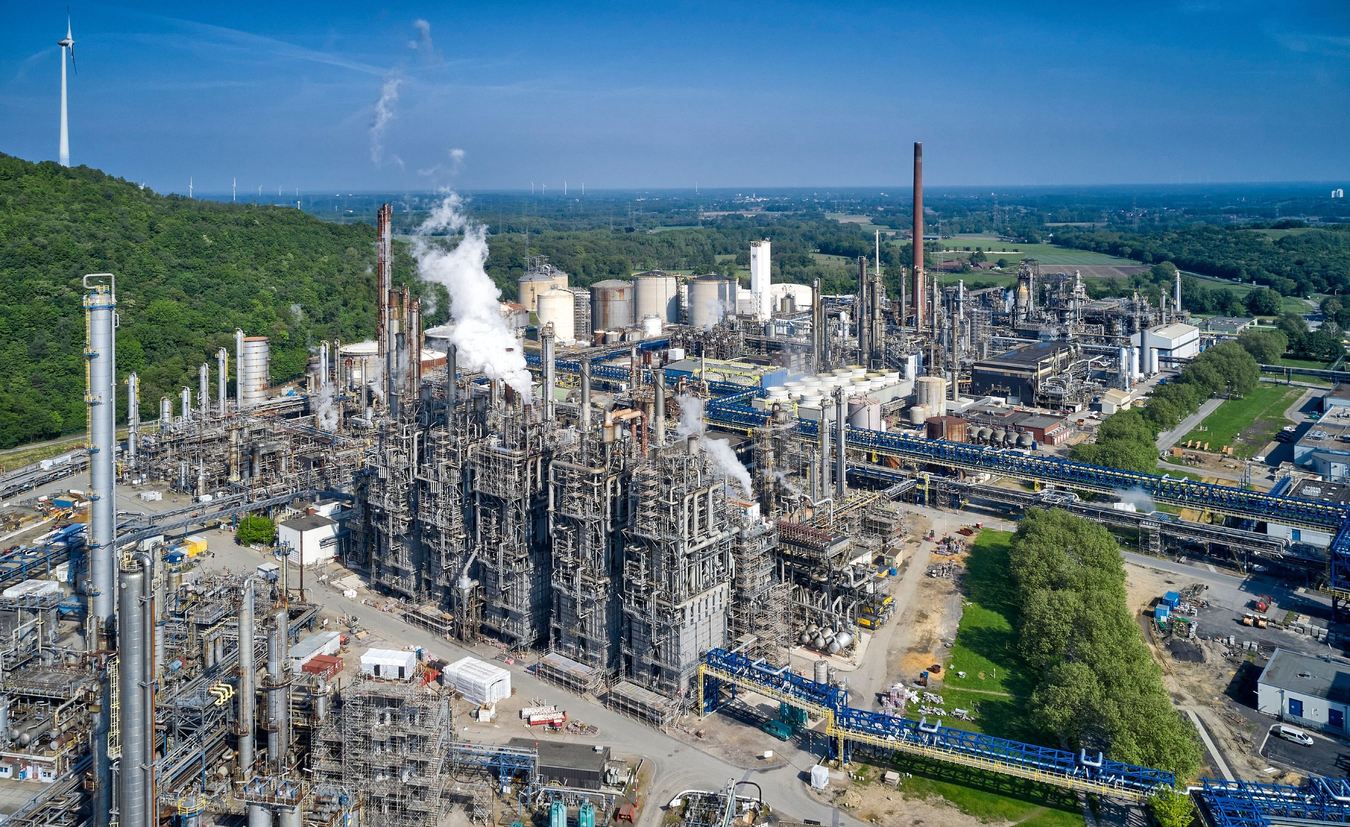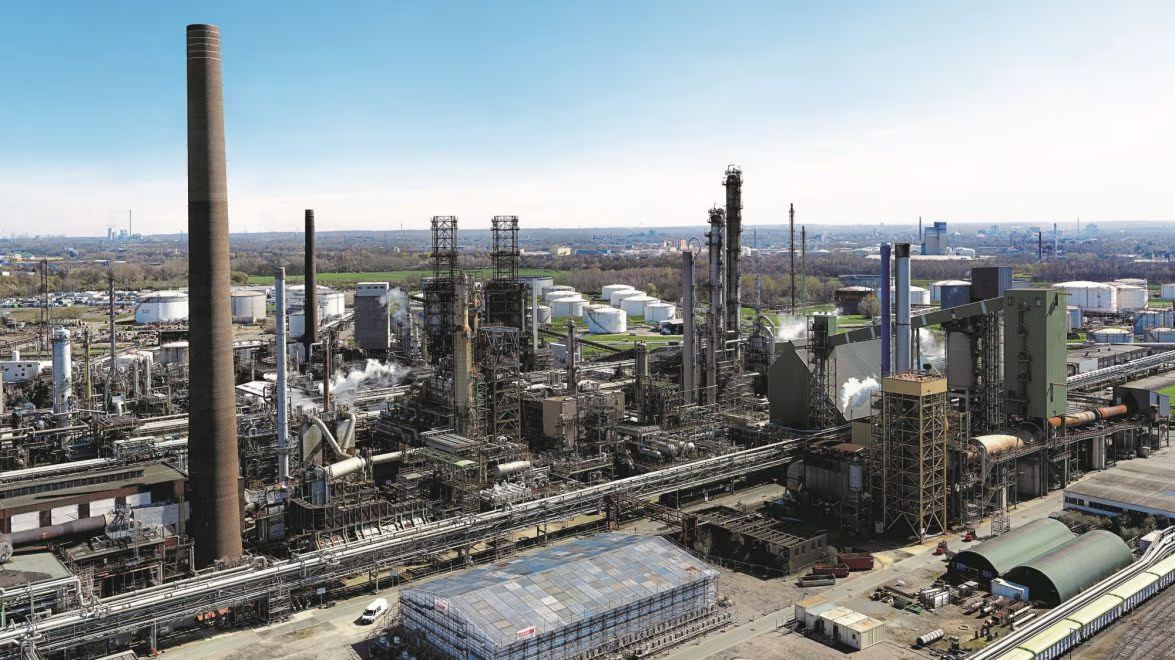
Horst Refinery | Source: BP (Jul 18, 2023)
The Horst refinery is a crude processing and heavy conversion hub of the integrated Ruhr Oel GmbH–BP Gelsenkirchen complex. With a crude distillation capacity of 5.5 million tonnes per year, it is the smaller of the two Gelsenkirchen sites, covering 160 hectares with approximately 600 employees. While Scholven specialises in petrochemicals and olefin production, Horst focuses on crude distillation and downstream conversion into fuel products via its FCC and Coker — the two defining units of the site.
Historical Summary
The Horst refinery traces its origins to the Gelsenberg Benzin AG, a synthetic fuel and mineral oil company established in Gelsenkirchen-Horst in the late 1920s — the wider Gelsenkirchen refining complex dates back to 1929. Like the neighbouring Scholven site, Horst was an important industrial target during World War II.
After the war, the site transitioned to conventional crude oil refining, with formal refinery operations recorded from 1935 onward. It developed as a primary crude processing hub, housing the initial distillation steps — the CDU and VDU — that feed the more complex conversion units at Scholven. In 1979, the Horst and Scholven sites were fully integrated into a single operational complex.
In 1983, both sites were incorporated into the Ruhr Oel GmbH joint venture between Veba Oel and Venezuela's PDVSA. The subsequent ownership history mirrors that of Scholven: BP acquired Veba Oel in 2002, Rosneft took the PDVSA stake in 2010, and BP became sole owner in 2017 following the dissolution of the BP–Rosneft joint venture.
Today, the Horst site serves as the front-end crude processing hub of the integrated Gelsenkirchen complex.
Process Units & Capacities
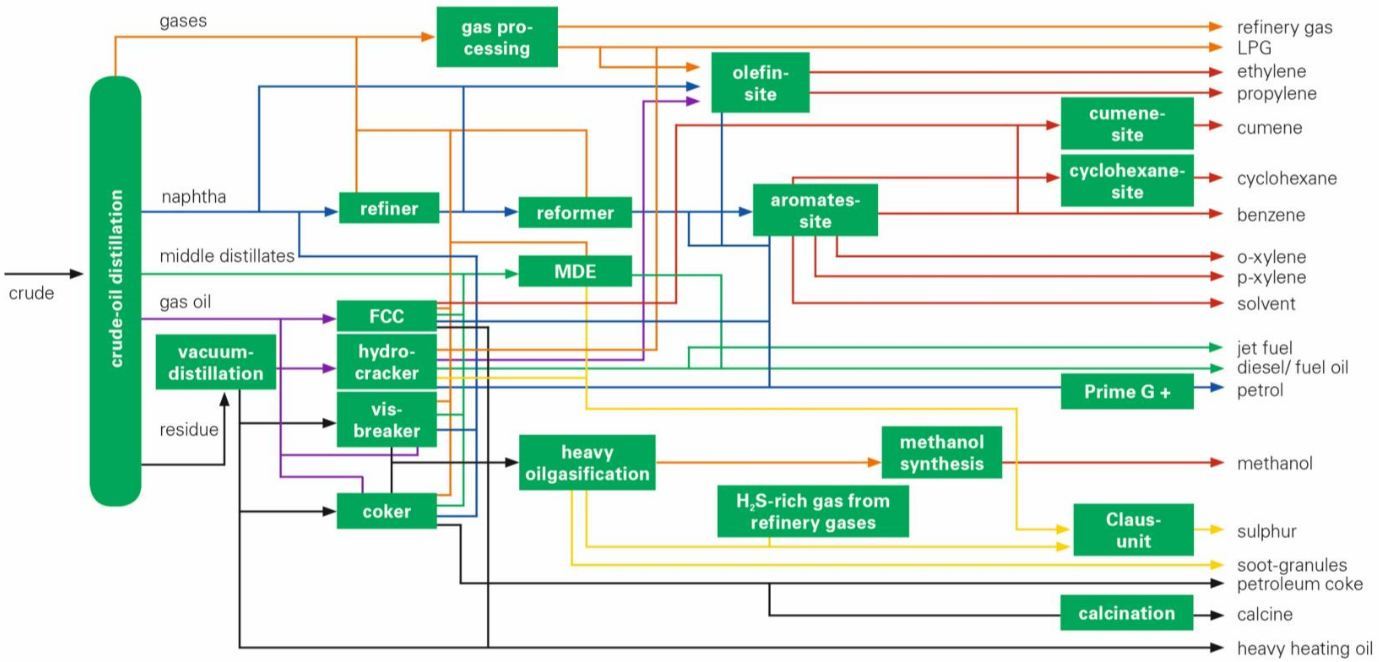
Gelsenkirchen refinery (combined Horst and Scholven refineries) PFD | Source: 2019 Ruhr Oel GmbH – BP Gelsenkirchen presentation
The total integrated ADU capacity across Horst + Scholven is 12.5 mt/yr (265,000 bpd).
| Process Unit |
Capacity |
Notes |
| Atmospheric Distillation |
120,000 bpd CDUs |
265,000 bpd CDUs across Horst and Scholven |
| Vacuum Distillation |
Part of the combined 5.3 mt/yr VDU capacity |
- |
| Fluid Catalytic Cracking |
Part of combined HCU+FCC 4.5 mt/yr |
FCC confirmed at Horst; FCC plant commissioned 2007 |
| Coker |
Part of combined Coker+Visbreaker 2.7 mt/yr |
Coker confirmed at Horst ; advanced process control implemented 2005 |
Feedstock Import
(Tank Storage) |
— |
Crude oil receipt and intermediate feedstock storage |
Process Configuration
Horst follows the classic crude-to-conversion flow:
Crude oil → ADU → VDU → FCC (vacuum gasoil) + Coker (vacuum residue) → fuel products
The FCC processes vacuum gasoil into gasoline, LPG, and cycle oils, while the Coker handles the heaviest vacuum residue, producing petroleum coke, coker naphtha, and coker gasoil. Both conversion products feed downstream hydrotreating units (located across the integrated complex) before blending into finished fuels.
References
- Ruhr Oel GmbH – BP Gelsenkirchen — 2019 Company Presentation (2019)
- Bezirksregierung Münster — Genehmigungsbescheide für die Stadt Gelsenkirchen
- Industrial Info Resources — BP German Refinery Sales Continue Downward European Refining Trend (Feb 13, 2025)
- EOG Asia — BP to Downsize Capacity at German Refinery (Mar 12, 2024)
- STAG — Refinery Gelsenkirchen — FCC Catalyst Dust Conveying System (2007 / Web archive capture Aug 21, 2019)
- PetroControl / Coker ERTC 2005 — Coker Advanced Control and Inferential Modeling at BP Gelsenkirchen (2005)
- Reuters — BP Plans to Reduce German Oil Refinery's Oil Processing Capacity (Mar 20, 2024)
- ChemEurope — Industrieparks BP Gelsenkirchen Scholven und Horst (Accessed June 11, 2026)