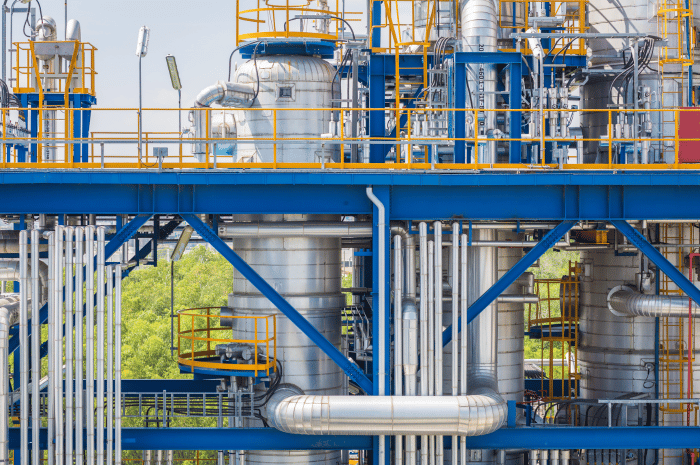
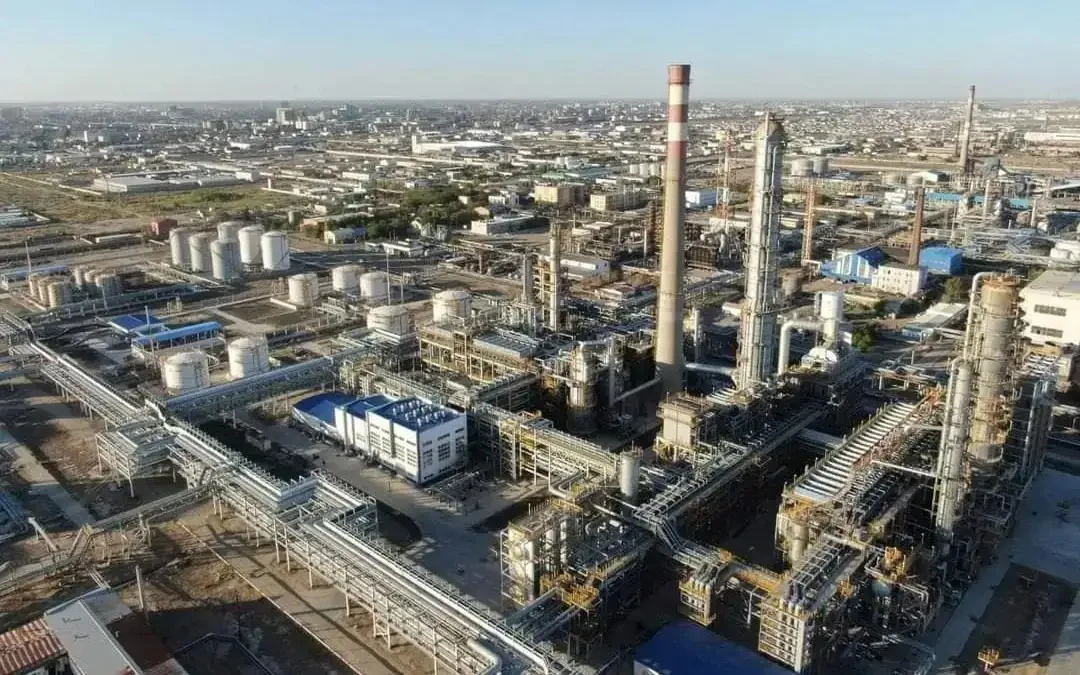
The Pavlodar Oil Chemistry Refinery was commissioned in 1978 as a Soviet-era fuel-profile refinery and is situated on a 460-hectare industrial site within the city of Pavlodar, Pavlodar Oblast, northeastern Kazakhstan. The refinery's original design capacity on commissioning was 6.0 million tonnes per year (MMtpy), with its primary crude processing backbone based on the LK-6u integrated distillation complex — a standard Soviet-era combined unit encompassing crude desalting/distillation, naphtha hydrotreating, catalytic reforming, diesel and kerosene hydrotreating, and gas fractionation in a single process train.
The refinery processes West Siberian crude oil delivered by pipeline from Russia, a feedstock orientation that reflects its original Soviet-era design and its geographic position in northeastern Kazakhstan rather than proximity to the Caspian oil fields that feed the Atyrau refinery.
Post-Modernisation Capacity (2017)
Following completion of the $1.2 billion modernisation programme in December 2017, POCR's effective balanced throughput capacity was increased to 7.5 MMtpy (approximately 150,000 bbl/d). The modernisation programme constructed 12 new process units and reconstructed 18 existing general facilities, raising the refinery's conversion depth to above 90% and enabling production of Euro-4 (K4) standard petroleum products across all output streams.
Key capacity parameters post-2017 modernisation:
| Unit / Stream |
Capacity / Output |
| Crude throughput (balanced) |
7.5 MMt/y (~150,000 bbl/d) |
| VGO hydrotreating |
1.9 MMt/y (up from 1.2 MMt/y) |
| Delayed coking unit (DCU) |
925,000 Mt/y (up from 600,000 Mt/y) |
| Gasoline (high-octane) |
~297,000 t/y |
| Diesel production |
~5,630 t/day |
| Fuel quality standard achieved |
K4 / Euro-4 |
| Refining depth |
>90% |
Process Unit Configuration
POCR operates in a fuel-profile configuration with no integrated petrochemical train. The full process unit slate as per POCR's corporate production description is:
Primary Processing:
-
Electrodehydration and desalting (C-100, part of LK-6u)
-
Atmospheric crude distillation (C-100, LK-6u)
-
Gas fractionation unit (C-400, LK-6u)
Secondary / Conversion Processing:
-
Naphtha hydrotreating (C-200/1, LK-6u)
-
Catalytic reforming (C-200/2, LK-6u)
-
Diesel fuel hydrotreating (C-300/1, LK-6u)
-
Kerosene hydrotreating (C-300/2, LK-6u)
-
Naphtha splitter unit (new, post-2017)
-
Light naphtha isomerisation unit (new, post-2017)
Residue Processing (KT-1 Complex):
-
Vacuum distillation of oil residue (C-001, KT-1)
-
Vacuum gasoil hydrotreating (C-100, KT-1)
-
Fluid Catalytic Cracking — FCC (C-200, KT-1)
-
Absorption and gas fractionation (C-300, KT-1)
-
Flue gas waste-heat recovery (C-400, KT-1)
The KT-1 residue deep-processing complex is a particularly notable feature — it was one of the first residue conversion complexes of its type commissioned in the former CIS countries, integrating vacuum distillation, VGO hydrotreating, and catalytic cracking in a single train.
Bottom-of-Barrel / Specialty:
-
Delayed coking unit (DCU) — for petroleum coke production; includes rectification, reactor, and steam generation blocks
-
Bitumen production unit — vacuum distillation of fuel oil and oxidising column block
-
Combined sulfur recovery unit (new, post-2017) — MDEA regeneration and Claus sulfur recovery
Utilities Supporting Euro-5 Upgrade:
Technologies and Licensors
POCR's modernisation programme (2012–2017) engaged a roster of internationally recognised process technology licensors:
| Technology / Unit |
Licensor |
| Delayed Coking Unit (DCU) — ThruPlus® Coking technology |
Bechtel Hydrocarbon Technology Solutions (BHTS) — technology originally developed by ConocoPhillips, acquired by Bechtel in 2011 |
| FCC / Catalytic Cracking, Isomerisation, Naphtha Splitter, Hydrotreating (Euro-5 upgrade) |
Honeywell UOP (UOP LLC, part of Honeywell Group) |
| Naphtha hydrotreating, reforming and residue processing technologies |
Axens (IFP Group, France) |
| Sulfur recovery / Claus process technologies |
Siirtec Nigi (Italy) |
| Hydrotreating catalysts and hydrogen-related technologies |
Haldor Topsøe (now Topsoe A/S, Denmark) |
| FEED and EPC engineering |
Rominserv (Romania, subsidiary of KMG International/Rompetrol) |
The involvement of Rominserv as both FEED and EPC contractor is significant: it reflects the KMG Group's ownership of KMG International (Rompetrol), a Romanian-Romanian downstream business, which provided engineering capacity to the Kazakhstani modernisation programme from within the same corporate group.
Current Phase: Euro-5 and Hydrogen
As of 2023–2026, POCR is engaged in a second-generation upgrade targeting Euro-5 (K5+) fuel quality across its gasoline and diesel output streams, with Honeywell UOP selected in March 2023 as the primary technology provider for this phase. A major associated project currently under construction is a hydrogen production unit (Stage 2) — a steam methane reforming (SMR) facility with a capacity of 8,878 tonnes/year of 99.9% purity hydrogen — being developed by Air Liquide Munay Tech Gases LLP (ALMTG), a joint venture between Air Liquide S.A. (75%) and NC KazMunayGas (25%), at a capital cost of approximately €60 million. Construction commenced March 2025 with completion expected September 2026. This hydrogen unit will supply the hydrotreatment units required to produce winter-grade Euro-5 diesel, with an output of approximately 160,000 tonnes/year of winter diesel fuel.
Product Slate
POCR's current output encompasses:
-
Motor gasoline (Regular, Premium; Euro-4 / K4, advancing to K5+)
-
Diesel fuel (summer and winter grades; Euro-4 / K4, advancing to K5+)
-
Jet kerosene (TS-1 domestic grade; Jet A international grade)
-
Liquefied petroleum gas (LPG — propane-butane mix)
-
Fuel oil (mazut)
-
Vacuum gas oil (VGO) — for further processing / export
-
Petroleum bitumen (road, construction, roofing grades)
-
Petroleum coke (for aluminium industry and energy use)
-
Commercial sulfur
Approximately 60% of total light product output is supplied to Kazakhstan's domestic market, with the balance available for export — primarily to regional markets in Central Asia and Russia.