
ppPLUS use cookies essential for this site to function well.
Learn about our use of cookies, and collaboration with selected social media and trusted analytics partners here.
Technologies are key to understanding the global Refining- and Chemicals operations.
ppPLUS has made a point from the design of its data-structure to model processes and operations,
based on their technolgies.
From Feedstock processing to recycling, ppPLUS is mapping out the whole process and value chain looking
at Technology specifics, the technology providers and the global deployment.
Join us to add, evaluate and complement the global picture of technology application in the industry.
Solution-Reference: #T399
ppPLUS Solutions - Expert Services
Enquire with us for information on the technology, processes and where it is deployed.
ppPLUS Experts cover a range of expertise providing insights for your enquiries
Explore ppPLUS Solutions for expert services
or monetize your own expertise
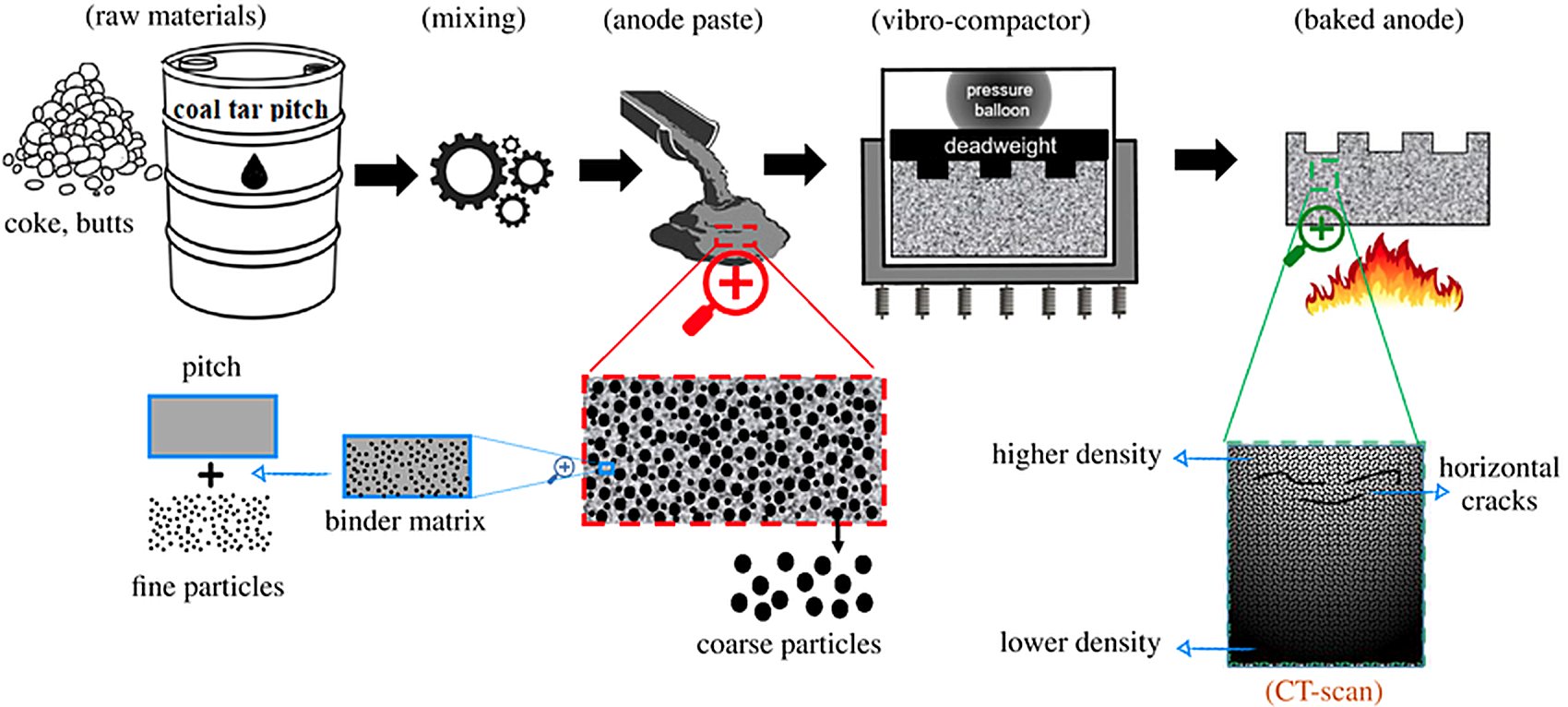
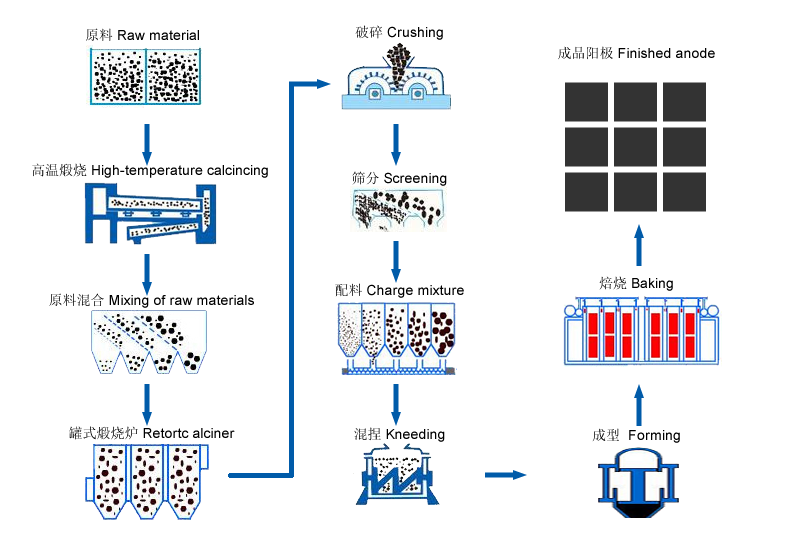
Figure 1 — Prebaked Carbon Anode production process schematics [4]
Step 1 — Raw Material Reception & Storage
CPC received as purchased feedstock by rail, truck, or ship and stored in enclosed silos or covered stockpiles
Coal tar pitch received as liquid (heated storage tanks at ~80°C) or as solid blocks for remelting
Anode butt returns from the smelter potroom received, sorted, and inspected for contamination
Conditions: CPC stored dry; liquid pitch tanks maintained at 70–90°C to prevent solidification
Step 2 — Crushing, Screening & Milling
CPC and crushed anode butts processed through jaw crushers and roll crushers, then classified on multi-deck vibrating screens
Fractions produced: coarse (4–14 mm), medium (1–4 mm), fine (0.2–1 mm), and flour (<0.2 mm)
Flour produced by ball mill or impact mill to d50 ~50–80 µm
Conditions: Ambient temperature; dust extraction on all transfer and screening points
Step 3 — Dry Aggregate Proportioning & Preheating
CPC fractions and anode butt aggregate weighed gravimetrically per the anode recipe using automated batch weighers
Butt content: typically 15–20 wt% of dry aggregate
Blended dry aggregate preheated to 150–170°C in a screw preheater or fluidised bed preheater
Conditions: Recipe controlled for optimum particle size distribution targeting maximum packing density and minimum void volume
Step 4 — Paste Mixing (Kneading)
Preheated dry aggregate transferred to twin-shaft batch kneader or continuous Intensive Mixing Cascade (IMC, Fives ECL technology)
Liquid coal tar pitch injected at 160–180°C; pitch content: 14–16 wt% of total paste mass
Batch mixing time: 10–20 minutes; paste temperature maintained at 155–170°C throughout
Rhodax® 4D inter-particle compression technology (Fives) enables homogeneous paste at lower pitch content, improving baked density
Conditions: Closed mixer with fume extraction; paste temperature monitored continuously
Step 5 — Green Anode Forming (Vibro-Compaction)
Hot paste discharged at 145–165°C into steel mould on vibro-compaction press
High-frequency vibration at 40–60 Hz at controlled amplitude consolidates paste into block form
Green anode typical dimensions: 700–900 mm (L) × 500–700 mm (W) × 550–650 mm (H)
Target green apparent density: 1.60–1.68 g/cm³
Dynpac® advanced compaction control (Fives) monitors and adjusts vibration parameters in real time
Conditions: Mould temperature controlled; forming cycle 2–4 minutes per anode
Step 6 — Green Anode Cooling
Green anodes transferred by conveyor to water spray cooling station or water pool conveyor
Target exit temperature: <60°C before storage or baking furnace loading
Cooling time: 30–90 minutes depending on anode size and cooling system design
Conditions: Controlled cooling rate to avoid thermal cracking or pitch migration
Step 7 — Baking
Green anodes loaded into pits of open-top ring furnace (dominant technology) with packing coke (filler) surrounding each anode block to prevent oxidation and support shape
Furnace fire travels section-to-section; incoming sections preheated by hot flue gas from active baking sections (heat recovery)
Pitch volatiles (BTX, PAH) combusted in flue duct system and treated in Fume Treatment Centre (FTC)
Conditions: Inert/reducing atmosphere within anode pits; furnace section pressure and temperature monitored continuously; packing coke recovered and recycled
Step 8 — Rodding Assembly
Baked anodes cleaned by shot-blasting; quality inspected (apparent density, electrical resistivity, crack detection by ultrasonic testing)
Stub holes pre-cleaned; steel stub/yoke assembly positioned and cast-in using liquid cast iron at ~1,300°C
Completed rodded anode assemblies dispatched to smelter potroom
Conditions: Cast iron temperature and pour volume controlled for joint integrity; cooling time before dispatch ~30 minutes