Prebaked Carbon Anode (PCA) manufacturing is the dominant process technology for producing consumable carbon electrodes for primary aluminium smelting via the Hall-Héroult electrolysis process. Anodes are formed and fully baked in dedicated carbon plants before installation in the reduction cell — in contrast to Söderberg technology where baking occurs in situ. Prebake technology is used in over 90% of global aluminium smelting capacity, driving a market valued at ~USD 4.8 billion in 2023 and projected to reach USD 7.9 billion by 2032.
Chemistry
The core thermochemical transformation is pitch carbonisation during anode baking at 1,050−1,200°C under inert atmosphere:
Pitch coke formed in situ binds the CPC aggregate particles into a dense, electrically conductive carbon matrix.
Process Steps
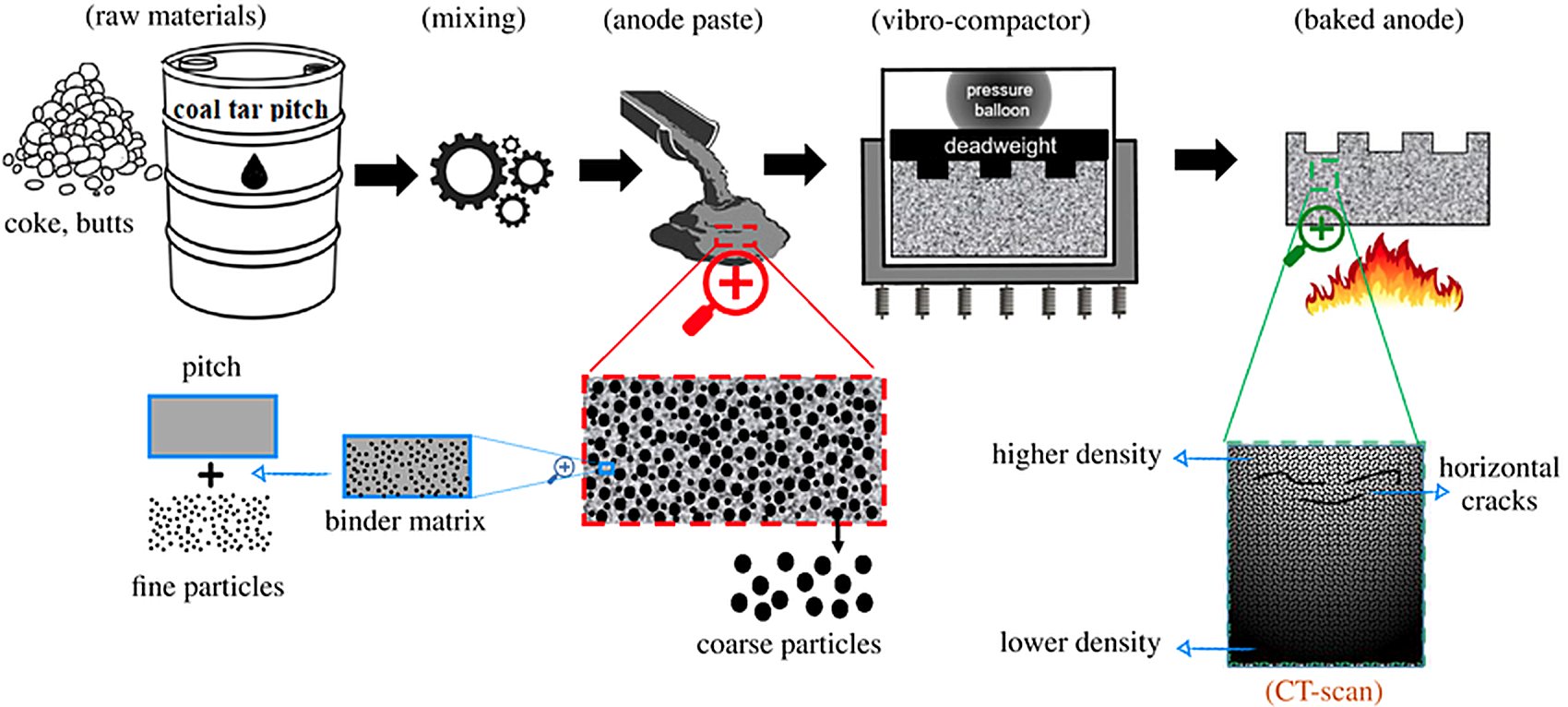
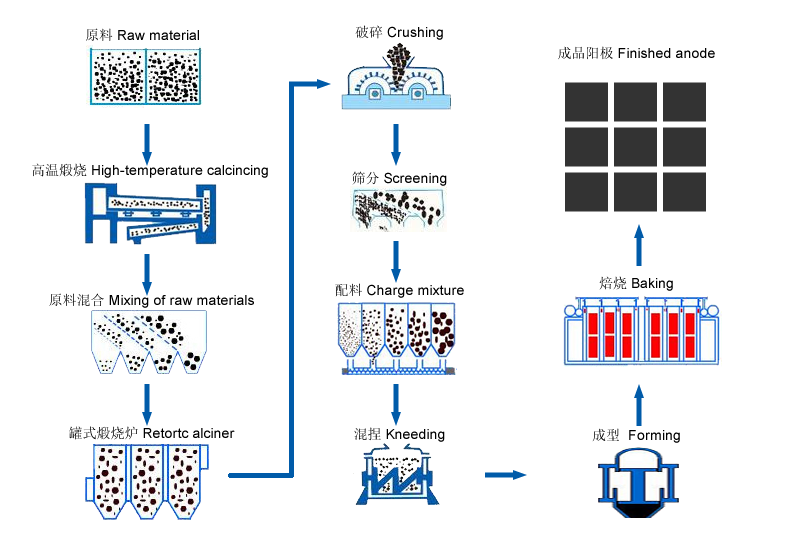
Figure 1 — Prebaked Carbon Anode production process schematics [4]
Step 1 — Raw Material Reception & Storage
- CPC received as purchased feedstock by rail, truck, or ship and stored in enclosed silos or covered stockpiles
- Coal tar pitch received as liquid (heated storage tanks at ~80°C) or as solid blocks for remelting
- Anode butt returns from the smelter potroom received, sorted, and inspected for contamination
- Conditions: CPC stored dry; liquid pitch tanks maintained at 70–90°C to prevent solidification
Step 2 — Crushing, Screening & Milling
- CPC and crushed anode butts processed through jaw crushers and roll crushers, then classified on multi-deck vibrating screens
- Fractions produced: coarse (4–14 mm), medium (1–4 mm), fine (0.2–1 mm), and flour (<0.2 mm)
- Flour produced by ball mill or impact mill to d50 ~50–80 µm
- Conditions: Ambient temperature; dust extraction on all transfer and screening points
Step 3 — Dry Aggregate Proportioning & Preheating
- CPC fractions and anode butt aggregate weighed gravimetrically per the anode recipe using automated batch weighers
- Butt content: typically 15–20 wt% of dry aggregate
- Blended dry aggregate preheated to 150–170°C in a screw preheater or fluidised bed preheater
- Conditions: Recipe controlled for optimum particle size distribution targeting maximum packing density and minimum void volume
Step 4 — Paste Mixing (Kneading)
- Preheated dry aggregate transferred to twin-shaft batch kneader or continuous Intensive Mixing Cascade (IMC, Fives ECL technology)
- Liquid coal tar pitch injected at 160–180°C; pitch content: 14–16 wt% of total paste mass
- Batch mixing time: 10–20 minutes; paste temperature maintained at 155–170°C throughout
- Rhodax® 4D inter-particle compression technology (Fives) enables homogeneous paste at lower pitch content, improving baked density
- Conditions: Closed mixer with fume extraction; paste temperature monitored continuously
Step 5 — Green Anode Forming (Vibro-Compaction)
- Hot paste discharged at 145–165°C into steel mould on vibro-compaction press
- High-frequency vibration at 40–60 Hz at controlled amplitude consolidates paste into block form
- Green anode typical dimensions: 700–900 mm (L) × 500–700 mm (W) × 550–650 mm (H)
- Target green apparent density: 1.60–1.68 g/cm³
- Dynpac® advanced compaction control (Fives) monitors and adjusts vibration parameters in real time
- Conditions: Mould temperature controlled; forming cycle 2–4 minutes per anode
Step 6 — Green Anode Cooling
- Green anodes transferred by conveyor to water spray cooling station or water pool conveyor
- Target exit temperature: <60°C before storage or baking furnace loading
- Cooling time: 30–90 minutes depending on anode size and cooling system design
- Conditions: Controlled cooling rate to avoid thermal cracking or pitch migration
Step 7 — Baking
- Green anodes loaded into pits of open-top ring furnace (dominant technology) with packing coke (filler) surrounding each anode block to prevent oxidation and support shape
- Furnace fire travels section-to-section; incoming sections preheated by hot flue gas from active baking sections (heat recovery)
- Baking temperature curve:
- Drying & pitch softening zone: 100–400°C (slow ramp, ~5°C/h through softening point)
- Carbonisation zone: 400–800°C
- Final bake plateau: 1,050–1,200°C
- Full baking cycle duration: 160–280 hours
- Pitch volatiles (BTX, PAH) combusted in flue duct system and treated in Fume Treatment Centre (FTC)
- Conditions: Inert/reducing atmosphere within anode pits; furnace section pressure and temperature monitored continuously; packing coke recovered and recycled
Step 8 — Rodding Assembly
- Baked anodes cleaned by shot-blasting; quality inspected (apparent density, electrical resistivity, crack detection by ultrasonic testing)
- Stub holes pre-cleaned; steel stub/yoke assembly positioned and cast-in using liquid cast iron at ~1,300°C
- Completed rodded anode assemblies dispatched to smelter potroom
- Conditions: Cast iron temperature and pour volume controlled for joint integrity; cooling time before dispatch ~30 minutes
Equipment & Devices
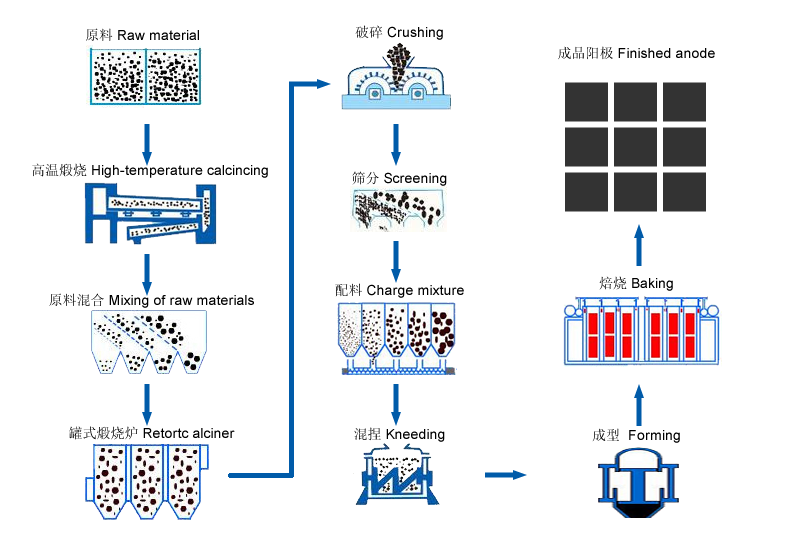
Figure 2 — Prebaked Carbon Anode production block flow diagram [3]
| Equipment |
Function |
| Jaw crusher / roll crusher |
Primary and secondary CPC & butt size reduction |
| Multi-deck vibrating screen |
Particle size classification |
| Ball mill / impact mill |
Flour fraction production |
| Gravimetric batch weigher |
Aggregate recipe proportioning |
| Screw / fluidised bed preheater |
Dry aggregate heating to mixing temperature |
| Twin-shaft batch kneader |
Paste mixing (batch configuration) |
| Intensive Mixing Cascade – IMC (Fives) |
Continuous paste mixing |
| Rhodax® 4D crusher (Fives) |
Inter-particle compression paste preparation |
| Vibro-compaction press |
Green anode forming |
| Dynpac® control system (Fives) |
Real-time compaction optimisation |
| Water spray / pool cooling conveyor |
Green anode cooling |
| Open-top ring furnace (multi-section) |
Anode baking with internal heat recovery |
| Fume Treatment Centre (FTC) |
Pitch fume capture — dry scrubbing + ESP |
| Shot-blasting unit |
Baked anode surface cleaning |
| Ultrasonic testing station |
Crack and defect detection |
| Rodding press + cast iron pouring station |
Steel stub assembly casting |
Process Efficiency
| Metric |
Value |
| Mass loss green-to-baked |
~5–8% (volatiles expelled + filler absorption) |
| Baked apparent density |
1.53–1.64 g/cm³ ? |
| Electrical resistivity |
55–62 µΩ·m ? |
| Single GAP line throughput (Fives) |
Up to 60 t/h green anodes ? |
Economic Performance
- Global PCA market: ~USD 4.8 billion (2023), projected USD 7.9 billion by 2032?
- Anode cost represents 15–20% of total primary aluminium production cost
- Key cost drivers: CPC price (dominant, ~65–70% of anode cost), coal tar pitch price, baking furnace energy, and rodding materials
- Continuous mixing (IMC) and advanced compaction control reduce OPEX vs. legacy batch-only plants
Global Deployments & Licensors
PCA plant engineering is procured from specialist technology suppliers per plant section rather than as a single unified licence package:
| Technology Provider |
Scope & Key Technologies |
Notable Deployments |
Fives ECL
(France) |
Green Anode Plants — IMC, Rhodax® 4D, Dynpac®, SMARTVibro compaction control |
Xinfa Group (China)
twin 60 tph GAP lines ; 50+ years installed
base globally |
| Riedhammer GmbH (Germany) |
Ring furnace and tunnel kiln design, engineering & construction |
Multiple global smelter
anode plants |
| Outotec / Metso Outotec (Finland) |
Furnace and calcination technologies; anode baking systems |
Global aluminium and
carbon plant installations |
| Zhonghui Kiln (China) |
Ring furnace construction, domestic market |
Numerous Chinese
merchant anode plants |
| Rain CII Carbon (USA) |
Primarily CPC supply; integrated anode-grade coke management |
Merchant CPC supply to global anode producers |
China dominates global PCA production, accounting for over 55% of global output, with the majority supplied by independent merchant producers to both domestic and export aluminium smelters. Captive smelter-integrated plants dominate in the Middle East, Russia, and Western markets
References
- International Aluminium Institute (March 2, 2022). Production process: Anode Production
- Dataintelo Consulting. Report MC-268858: Pre Baked Anode Market 2023
- Huanggang Huayao Zhonghui Kiln Company. Production line for prebaked anodes for electrolytic aluminum (Accessed Mar 5, 2026)
- Mollaabbasi R., Hansen L., Grande T., Taghavi S.M., & Alamdari H. (May 2021). Effect of fine coke particles on rheological properties of the binder matrix of carbon anodes in aluminium production process. The Canadian Journal of Chemical Engineering, 100(S1), S58–S71. DOI: 10.1002/cjce.24108?
- Fives. Green Anode Plant (Accessed Mar 5, 2026)
- Wikipedia. Prebaked consumable carbon anode (Page version: Nov 7, 2025)
- Riedhammer. Carbon Backing Furnaces (Accessed Mar 5, 2026)
- Lang Guanghui, et al. Chinese patent CN107235728B: Energy-saving production process of prebaked anode. Jun 22, 2017 — Application filed by Sotong Development Co Ltd
- Khaji K., & Al Qassemi M. (2015). Role of anode manufacturing processes in net carbon consumption. In Travaux 44, Proceedings of 33rd International ICSOBA Conference (p. 445). Dubai, United Arab Emirates
- MRA (Jan 11, 2026). Regional Analysis of Prebaked Anodes (Prebaked Carbon Anodes) Growth Trajectories