S-ANT is the trademarked designation of the complete acrylonitrile technology with independent intellectual property rights developed by Sinopec Shanghai Research Institute of Petrochemical Technology (SRIPT), a subsidiary of China Petroleum & Chemical Corporation (Sinopec), and offered for licensing by SRIPT/Sinopec as an integrated package — process package, matching SANC-series catalyst, reactor design, separation technology and environmental-protection technology — at scales up to a 400 kt/a single train, the world's largest, started up at Sinopec Zhenhai Refining & Chemical on 12 August 2025. The technology produces acrylonitrile by fluidized-bed ammoxidation of propylene over silica-supported SANC catalysts. Its patent base (230+ granted acrylonitrile patents) is anchored by CN1056601C — fluidized-bed dilute-phase internals that raise ammonia conversion from ~93% to 97–99% by promoting the secondary NH₃/acrolein/propylene reaction, underpinning the "clean-process" concept that minimises ammonium-sulfate waste — and by the internationally filed companion family (WO1998055217A1, US6716405B1).
1. Ownership and Licensing
S-ANT is the trademarked designation of the complete acrylonitrile technology with independent intellectual property rights developed by SRIPT[1][2][8]. SRIPT is the technology owner and the technology is licensed by SRIPT/Sinopec as an integrated package comprising the process package, the SANC-series catalyst, reactor design, separation technology and environmental-protection technology[1]. SRIPT has developed more than 60 technology packages for petrochemical plants, including a 280 kt/a acrylonitrile package, and markets its catalysts and complete technologies domestically and internationally[7]. Acrylonitrile catalysts were first exported overseas in 2022, and S-ANT packages of 130 kt/a, 260 kt/a and 400 kt/a class have been licensed for new units in recent years[8][11]. Sinopec's catalyst subsidiary (Catalyst Company, Shanghai branch) manufactures the SANC catalysts commercially[8].
2. Process History
- 1960 — The Shanghai Municipal Committee decided to establish a petrochemical research institute; in May 1960 the Shanghai Institute of Petrochemical Technology (predecessor of SRIPT) was founded in two bungalows on Dongtang Road on the Huangpu River. China's acrylonitrile was then fully import-dependent, and the institute was assigned the national task of developing AN technology[1][2].
- 1962 — Under academician Guan Xingya, a 56-day continuous campaign delivered the main design data for a 60 t/a acrylonitrile pilot plant by November 1962; the fixed-bed pilot campaign laid the industrialisation foundation[1][2].
- 1964 — The institute's "New Process for Propylene Ammoxidation to Acrylonitrile" was showcased on a float at the 15th anniversary of the People's Republic of China[1][2].
- 1970 — Gaoqiao Petrochemical started up China's first 1,000 t/a fixed-bed acrylonitrile production unit, the first industrialisation step of propylene ammoxidation technology in China[1][2].
- 1980s–1990s — MB catalyst series — SRIPT developed the MB-series fluidized-bed ammoxidation catalysts: MB-82 and MB-86 (1980s; MB-86 rated at international level, comparable to BP's C-49MC), and the high-pressure/high-load MB-96 and MB-98[9][10]. In this period most Chinese AN units still ran on imported Sohio-lineage technology — Standard Oil (Sohio) had licensed its ammoxidation process to China as early as 1973, and Daqing Petrochemical's No.2 AN unit was built with BP (Sohio successor) patent technology loaded with imported C-49 catalyst[17][20][24].
- 1994 — first catalyst localisation — SRIPT's MB-86 was first applied in August 1994 at the BP-licensed Daqing No.2 AN unit, replacing imported C-49 — the first use of a domestic AN catalyst on a Sohio-line plant, passing Sinopec appraisal[17].
- 1998–1999 — SRIPT completed the "50,000 t/a acrylonitrile process package" design and helped Qilu Petrochemical expand its AN unit from 25,000 to 40,000 t/a (revamp started November 1998, first product 1 May 1999; +60% capacity, refining recovery raised to >94%, 4 points above the imported technology). The associated national "十条龙" key-technology package included the MB-98 catalyst, PV-E high-efficiency low-resistance cyclones ("one-series-one" two-stage arrangement), ridged-cap side-blown air distributor and six-ring horizontal side-blown ammonia distributor[1][9].
- 2003 — SRIPT completed the revamp of Shanghai Petrochemical's AN unit from 60,000 to 130,000 t/a[1][2].
- Early 2000s — Industrial results achieved individually in catalysts, large fluidized-bed reactors, new quench processes, AN separation technology and environmental protection technology were integrated into a new-generation Sinopec complete AN process technology, pushing large-scale AN complete technology to a new level[1].
- 2006–2009 — SRIPT filed key catalyst patents, including CN101147869A/CN100566829C (Mo12BiaFebNicXdYeZfQgOx fluidized-bed catalyst addressing industrial yield decline, rising CO/CO2/HCN by-products and Mo sublimation; granted 2009)[13].
- 2008 — SANC-08 catalyst first applied at Anqing Petrochemical's 80 kt/a AN unit (October 2008); it ran for nearly 10 years without full changeout and was later adopted at Anqing II (130 kt/a), Qilu (80 kt/a), Shandong Kelu (130 kt/a) and Shanghai SECCO (260 kt/a)[3][14].
- 2020 — SANC-11+ achieved its first full commercial charge at a 130 kt/a fluidized-bed AN unit (one-shot startup); after one year the appraisal panel reported 81.5% single-pass AN yield, 1,011.6 kg propylene and 493.4 kg ammonia consumed per tonne of AN, all product prime grade, and rated the catalyst at international leading level[8].
- 2022 — First overseas export of SRIPT's acrylonitrile catalyst[8].
- 2023 — On the basis of successful SANC-11+ industrial application, SRIPT formed the 400 kt/a S-ANT complete technology process package[8].
- 2025 — Zhenhai Refining & Chemical's 400 kt/a AN unit, using SRIPT's S-ANT technology, achieved one-shot successful startup on 12 August 2025 — the world's largest single-train acrylonitrile unit and the first industrial application of a 400 kt/a complete AN technology package. The unit forms a combined AN/methionine complex (with an 180 kt/a methionine unit) inside Zhenhai's high-end synthetic new materials project (total investment ~RMB 11.3 bn, EIA acceptance May 2022); by-product HCN and sulfuric acid are fed to the methionine plant. After the first year of operation the unit completed a full-gradient performance test run (October 2025) and operates with energy consumption reported ~20 kg standard oil per tonne below comparable units[4][6][15][18][19].
Cumulatively, SRIPT has obtained more than 230 domestic and foreign invention patents for its acrylonitrile technology and has won 14 national and provincial science & technology progress and technology invention awards, including 1 National Science & Technology Progress First Prize, 2 Second Prizes and 1 China Patent Gold Award[1][11].
3. Process Summary, Chemistry and Catalysis
Reaction:
CH2=CH–CH3 + NH3 + 1.5 O2 → CH2=CH–CN + 3 H2O (ΔH < 0, highly exothermic)
The main by-products are acetonitrile (CH3CN), hydrogen cyanide (HCN), acrolein, acrylic acid, carbon monoxide and carbon dioxide, with small amounts of unreacted propylene and ammonia leaving the reactor[3]. The feed is propylene, ammonia and air; industrially a molar ratio of about propylene : ammonia : air = 1 : 1.2 : 9.8 is documented in the patent examples[3].
Catalyst: The S-ANT technology uses SRIPT's SANC-series fluidized-bed catalysts — multi-component composite metal oxides on a silica carrier, composed of iron, nickel, bismuth, molybdenum and other elements, with uniformly distributed active components; current commercial grades are SANC-08 (high total-nitrile yield, excellent stability, good cleanliness), SANC-11 (high AN yield) and SANC-11+ (pressure-resistant, high low-temperature activity, excellent stability)[8][11][13][14].
Reaction conditions (from the patent base): reaction temperature 300–500 °C, pressure atmospheric to 0.2 MPa (typically 0.05–0.2 MPa depending on catalyst activity), fluidizing linear velocity 0.5–0.8 m/s (preferably 0.6–0.75 m/s), and a required ammonia conversion >85%, preferably >93%; top temperature approximately equal to bed temperature[3].
4. Step-by-Step Process Description
The description below follows the process reconstructed from the SRIPT patent CN1056601C (granted 2000; inventors Chen Xin and Wu Lianghua), which discloses the fluidized-bed reaction section forming the core of the Sinopec "clean process" concept, combined with the conventional recovery and refining train it feeds[3].
4.1 Feed vaporisation and mixing
Liquid propylene, anhydrous ammonia and filtered compressed air are vaporised, heated and metered in a fixed molar ratio (patent basis: 1 : 1.2 : 9.8 propylene : ammonia : air; the ammonia feed is deliberately kept slightly above the stoichiometric 1 : 1 to maintain catalyst activity, while excess is consumed by secondary reactions). The mixed gas enters the fluidized-bed reactor through the gas distribution grid. In the industrial configuration developed in the late-1990s package, the air distributor is a side-blown type with ridged-cap hoods and the ammonia/propylene is introduced through a six-ring horizontal side-blown distributor, suppressing back-mixing of propylene and ammonia into the oxygen-rich zone at the bottom of the bed and improving fluidization quality[3][9].
4.2 Fluidized-bed ammoxidation reactor with dilute-phase internals
The reaction takes place in a fluidized-bed reactor operating at 300–500 °C (commercial catalyst evaluation basis: 435 °C) and 0.05–0.2 MPa at a superficial velocity of 0.5–0.8 m/s (preferably 0.6–0.75 m/s)[3]. The distinctive SRIPT feature — the subject of CN1056601C — is the installation of internals in the upper part of the reaction zone (dilute phase/freeboard): packing (fill), baffle plates, louvre-type plates or retaining screens that break up the gas bubbles leaving the dense bed, intensify gas–solid contact and promote the secondary reaction in the dilute phase, in which residual propylene and the by-product acrolein react with unreacted ammonia to form additional acrylonitrile[3].
Bench-scale demonstration (38 mm i.d. reactor, ~2 m high, 550 g catalyst, 320 mm fluidized-bed height, 435 °C, 0.08 MPa, propylene : ammonia : air = 1 : 1.2 : 9.8):
| Configuration |
Propylene conversion |
Single-pass AN yield |
AN selectivity |
Ammonia conversion |
| No internals (comparative) |
96.2% |
80.1% |
83.3% |
93.0% |
| 5 porous-plate baffles (4 mm holes, 40% open) |
98.5% |
81.7% |
82.9% |
98.5% |
| 3 porous plates |
97.8% |
81.2% |
83.0% |
97.8% |
| 8 porous plates, 30 mm spacing |
98.8% |
81.7% |
82.7% |
98.7% |
| 750 g catalyst, higher gas rate (6 L/h) |
98.7% |
81.8% |
82.9% |
99.0% |
| 10-layer 6×6 mm stainless steel mesh cylinder packing |
98.8% |
81.4% |
82.4% |
99.1% |
The internals raise ammonia conversion from ~93% to 97.8–99.1% and propylene conversion from 96.2% to ~98.5–98.8%, while slightly increasing acrylonitrile yield (81.2–81.8% vs 80.1%) — because the secondary reaction converts unreacted NH3 + acrolein + propylene into product AN rather than consuming it[3].
4.3 Reactor internals equipment
Beyond the freeboard internals, the reactor system comprises the gas distribution grid with side-blown air spargers and multi-ring ammonia/propylene distributors, multi-stage cyclone separators (primary/secondary, with diplegs returning entrained catalyst to the bed; catalyst blow-out with the gas is ~0.2–0.7 kg per tonne of AN produced[3]), internal cooling coils for removal of the highly exothermic reaction heat, and catalyst addition/withdrawal nozzles for online inventory management. The large single-reactor design (up to 400 kt/a in one train) is one of SRIPT's integration achievements — "large fluidized-bed reactor, quench tower and other key equipment"[1][11]. Nationally developed high-efficiency low-resistance PV/PV-E type cyclones arranged "one-series-one" two-stage were a key enabler of the 1998–99 expansion[9].
4.4 Quench and acid removal — the ammonium-sulfate-free concept
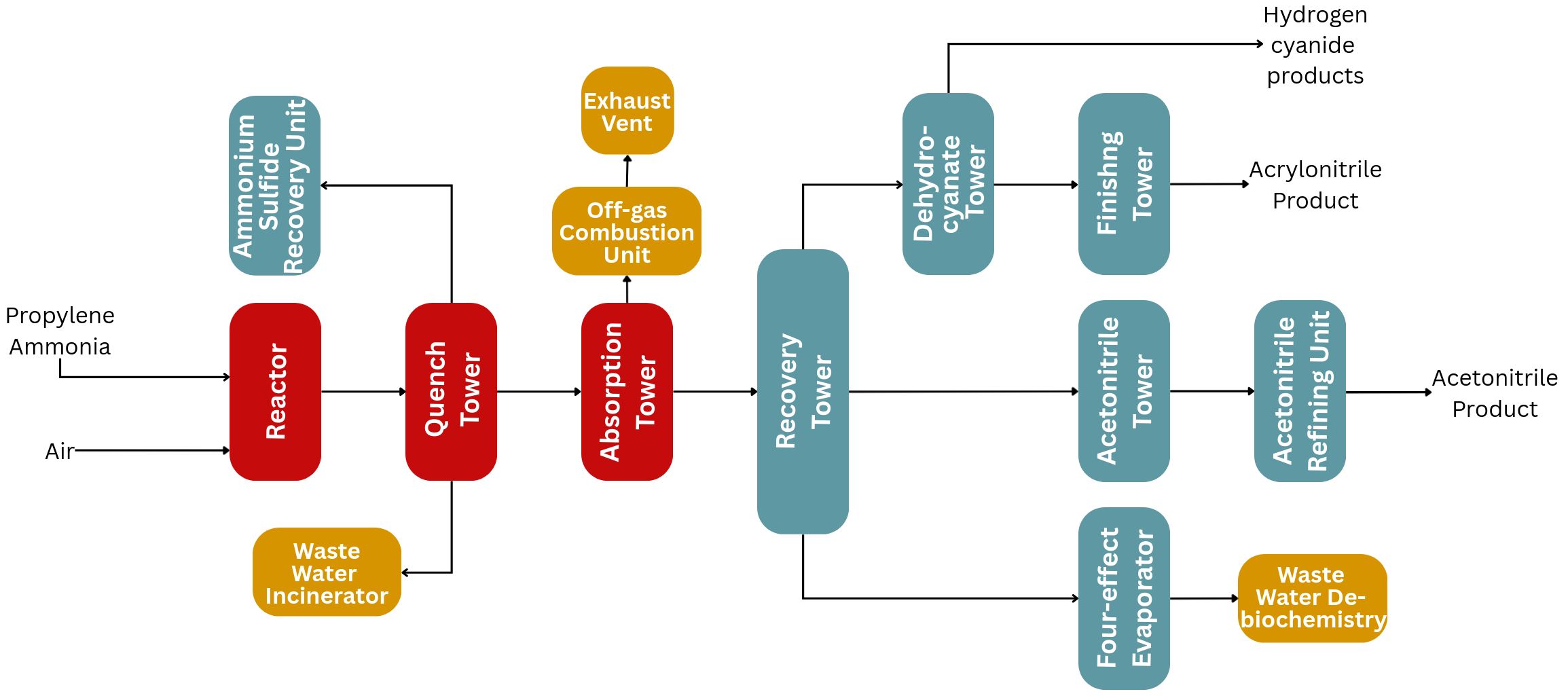
Conventional Sohio-line technology quenches the reactor gas in a sulfuric acid neutralising tower to remove unreacted ammonia, generating an intractable ammonium sulfate (thiocyanate-bearing) waste stream; the patent documents polymerisation losses of AN (2–5%), HCN (3–8%) and acrolein (40–80%) in that stream, plus dissolved organics (500–5,000 ppm) and washed-out catalyst fines, and the 850–1,100 °C incineration and SO2-corrosion problems of disposing of it[3]. S-ANT attacks this at the root: by raising catalyst/dilute-phase ammonia conversion to 97–99%, the unreacted ammonia reaching the quench is minimised, so the sulfuric acid quench can be "basically eliminated" at 97–98% NH3 conversion[3]. In the S-ANT flowsheet, the reactor effluent gas is cooled and enters a quench tower for cooling, then goes directly to the absorption section; the technology set includes the new quench process and an "ammonium-sulfate-free" (无硫铵) technology and wet-oxidation waste treatment[3][11].
4.5 Absorption
The quenched gas enters the absorption column, where all organic components are absorbed in low-temperature water; the off-gas is vented after emission treatment. The absorption liquor carries acrylonitrile, acetonitrile, HCN, acrolein and acrylic acid to the recovery section[3].
4.6 Recovery and refining
The absorption liquor first passes to an extraction column where water is used as solvent to separate acrylonitrile from acetonitrile (composite extraction-separation technology). Crude acrylonitrile distilled from the column top still contains HCN and water and passes through a decyanation tower (de-HCN column) and a dehydration column to yield high-purity acrylonitrile product[3]. The S-ANT technology set upgrades this train with refined-recovery technology, negative-pressure decyanation technology, online de-plugging technology and improved refining recovery[11]. By-product streams are crude acetonitrile (further refined or hydrotreated) and aqueous HCN, which in integrated configurations is consumed downstream — at Zhenhai, HCN and sulfuric acid are routed directly to the adjacent methionine unit[15].
4.7 Effluent treatment
Remaining aqueous waste is handled by wet-air oxidation technology (nitrogen compounds converted to nitrate/ammonia and thermally denitrified, allowing clean-water discharge), completing the environmental-protection package[9][11].
5. Performance
- Catalyst yields: SANC-11+ demonstrated 81.5% single-pass AN yield with 1,011.6 kg propylene and 493.4 kg ammonia per tonne AN in the 2020 industrial appraisal (international leading level); SANC-08 ran at >80% yield with near-decade service at Anqing[8][14]. MB-98 achieved 79.5% single-pass yield under high-pressure/high-load conditions; MB-86 was rated comparable to BP C-49MC[9][10].
- Material consumption: S-ANT propylene consumption as low as 1.020 t/t AN[11].
- Energy consumption: comprehensive energy consumption ~86 kg standard oil per tonne AN; the 400 kt/a package further reduced unit design energy consumption and raised environmental performance[11][4].
- Refining recovery: >94% from the 1998–99 SRIPT package — 4 percentage points above the then-imported technology[9].
- Stability/cleanliness: SANC-08 operated ~10 years at Anqing (record for a clean-type AN catalyst); SANC-11+ appraisal found stable operation, all-prime product, normal four-effect wastewater[3][8][14].
- Scale: packages of 130 kt/a, 260 kt/a and 400 kt/a licensed; 400 kt/a Zhenhai unit is the world's largest single-train AN unit[4][11].
The reviewed sources do not disclose S-ANT-specific CAPEX benchmarks, licensor royalty terms or turndown limits.
6. Commercial Experience / Installations
| Operator / Site |
Capacity |
Technology / catalyst |
Status |
| Gaoqiao Petrochemical (Shanghai) |
1,000 t/a |
First fixed-bed unit on the SRIPT (predecessor institute) process |
Started 1970 — first Chinese AN industrialisation step[2] |
| Qilu Petrochemical (Zibo) |
25,000 → 40,000 t/a |
SRIPT process package + MB-98 catalyst, PV-E cyclones |
Revamp 1998–99, +60% capacity[9] |
| Shanghai Petrochemical |
60,000 → 130,000 t/a |
SRIPT revamp technology |
2003[2] |
| Anqing Petrochemical I |
80,000 t/a |
SANC-08 (2008), SANC-11 changeout (April 2018) |
Both startups one-shot; SANC-08 ~10 years service[3] |
| Anqing II / Qilu 80 kt/a / Shandong Kelu 130 kt/a / Shanghai SECCO 260 kt/a |
80–260 kt/a |
SANC-08 catalyst |
Applied across seven reactors of four companies (per 2018 report)[3][14] |
| Daqing Petrochemical No.2 (PetroChina) |
50,000 t/a (design) |
Unit built with BP/Sohio-licensed technology; catalyst localisation: MB-86 (Aug 1994), MB-98 (Apr 2001, ~7-year run ≥78.5% mean AN yield) |
Commercial — first domestic-catalyst use on a Sohio-line plant[17][24] |
| Sinopec Tianjin Petrochemical |
130,000 t/a |
SRIPT 130 kt/a complete AN technology (licensed package) |
Built and started up (licensed before Nov 2022)[26] |
| Domestic unnamed unit |
130,000 t/a |
SANC-11+ first full charge |
2020, one-shot startup; 81.5% yield appraisal[8] |
| Zhenhai Refining & Chemical (Sinopec ZRCC, Ningbo) |
400,000 t/a |
S-ANT 40万吨 complete package + high-efficiency SANC catalyst |
Startup 12 August 2025, world's largest single train; combined with 180 kt/a methionine[4][6][15] |
| Overseas (undisclosed) |
n.a. |
SRIPT AN catalyst export |
First export 2022[8] |
| Shanghai SECCO Petrochemical Co. (SIPC-SH; 50:50 Sinopec–INEOS since 2022, ex-Sinopec/SPC/BP) — Shanghai Chemical Industry Park |
260,000 t/a |
Sinopec (SRIPT) complete AN process technology + SANC-08 catalyst, running with "advanced technical indicators" per SRIPT |
Startup pre-Nov 2022, in operation[26][25][27] |
Independent corroboration of the Zhenhai startup date (12 August 2025) and S-ANT attribution is provided by the trade press and the official Sinopec newspaper; an earlier ECHEMI review dated the commissioning "June 2025", which is not supported by the primary Sinopec sources and is noted here as a secondary-source discrepancy[4][6][16].
7. Intellectual Property Position
The S-ANT technology family rests on SRIPT's own patent estate (230+ granted AN patents) rather than on the expired Sohio patents that historically framed the global industry. Key documents reviewed:
- CN97106454.7 / CN1056601C — "Process for production of acrylonitrile", filed 6 June 1997 (published CN1201785A, 1998), granted 20 September 2000, expired at full term in 2017; inventors Chen Xin and Wu Lianghua. Discloses the fluidized-bed reactor with dilute-phase internals and the clean-process (ammonium-sulfate-minimising) concept; references prior art US5457223, US5466857 (Standard Oil), WO9625391 and CN96116456.5 (high ammonia-conversion catalyst), and rejects both alternative routes on stability and yield grounds. China-only family[3].
- CN97106455A / CN1055916C — companion reactor patent filed the same day by the same inventors/assignee, "Fluid bed reactor for ammoxidation of hydrocarbons" (granted 2000), which was the internationally filed branch: WO1998055217A1, EP1008382, US6716405B1 (granted 2004), JP4047938B2, TW466222B, BR9810414B1 — covering removal of unreacted ammonia from ammoxidation effluents[21].
- CN96116456.5 / CN1063101C (filed 1996, granted 2001) — high-NH₃-conversion fluidized-bed catalyst (An Wei, Chen Xin): AN yield 80.2% with ammonia conversion 96–97% at 440 °C / 0.082 MPa; the catalyst cited in CN1056601C as the route to near-acid-free operation[22].
- CN00111716A / CN1102576C (filed 2000, granted 2003) — high-pressure/high-load catalyst grade (Xie Guohuang, Chen Xin, Wu Lianghua): 425 °C, 0.14 MPa, WWH 0.085 h⁻¹ → 80.1% AN yield; documents the preferred parameter windows (420–470 °C, best 425–450 °C; NH₃:C₃H₆ = 1.0–1.3; air:C₃H₆ = 9.0–9.8; WWH 0.07–0.10 h⁻¹)[23].
- CN101147869A / CN100566829C — "Catalyst for preparation of acrylonitrile by ammoxidation", filed 20 September 2006, granted 9 December 2009; inventors Jiang Jiale, Yang Bin, Song Weilin. Mo12-based multi-component catalyst stabilising against yield decay and Mo sublimation[13].
- SANC-08 package — 12 granted invention patents protecting the SANC-08 catalyst and its application[25].
This autonomous patent position is what allowed Sinopec to respond to INEOS's 2014 litigation by asserting independent development over 50 years; the dispute was settled amicably (no public ruling), and the two groups subsequently signed multi-billion-dollar petrochemical cooperation agreements in 2022[12].
References
- Baidu Baike — S-ANT丙烯腈成套技术 (S-ANT Acrylonitrile Complete Technology) (updated Jun 26, 2026)
- 中国石油石化 (China Petroleum & Petrochemical) via Tencent News — 《从两间平房到国际舞台》 ("From two bungalows to the international stage") (Sep 5, 2025); also published at chinacpc.com.cn, (17 Nov 2025)
- Patent CN1056601C (application CN97106454.7, filed Jun 6, 1997, granted Sep 20, 2000), Process for production of acrylonitrile, inventors Chen Xin, Wu Lianghua; assignees China Petrochemical Corp & SRIPT
- 流程工业 PROCESS (Vogel China) — 镇海炼化40万吨/年丙烯腈装置开车成功 (Zhenhai 400 kt/a AN unit startup success) (Aug 12, 2025)
- INEOS — "INEOS announces legal action against Sinopec and Sinopec subsidiaries" (Mar 21, 2014)
- 中国石化新闻网 (Sinopec News) — 上海院丙烯腈成套技术在镇海炼化成功应用 (SRIPT complete AN technology successfully applied at Zhenhai), China Petrochemical News Aug 7, 2025)
- Sinopec Corp. (archived) — SINOPEC Shanghai Research Institute of Petrochemical Technology (SRIPT), institute profile incl. 280 kt/a AN technology package (accessed Nov 7, 2026)
- 中国石化报 via Sinopec News — 加快高端催化剂国产化突破 (Accelerating high-end catalyst localisation breakthroughs) (Sep 18, 2024) — acrylonitrile ammoxidation catalyst section (SANC-11+ data, 2022 export, 2023 400 kt/a S-ANT package); full text also in 石油工业的未来 (Future of the Petroleum Industry) compilation PDF, ppbnchina.com
- 6chem报告网 via Sohu — 丙烯腈主要生产工艺技术及技术进展 (Acrylonitrile main process technologies and progress) (Jul 23, 2020)
- Baidu Wenku — 丙烯腈生产工艺 (Acrylonitrile production process) — MB-98 yield ≥78% listing (accessed Nov 7, 2026)
- Shandong Synergy Tech (catalyst/process package trader) — ANT Acrylonitrile Technology and Catalyst — S-ANT characteristics: 1.020 t propylene/t AN, 86 kg SOE/t AN, equipment and refining technologies, 130/260/400 kt licensing (accessed Nov 7, 2026). Secondary/commercial source, consistent with [8].
- CHEManager — "Ineos Close to Dispute Settlement with Sinopec" (2015) and "Sinopec Denies Violating Ineos Acrylonitrile Patent" (2014)
- Patent CN100566829C / CN101147869A (filed Sep 20, 2006, granted Dec 9, 2009), "氨氧化法制丙烯腈催化剂", inventors Jiang Jiale, Yang Bin, Song Weilin; assignees China Petrochemical Corp & SRIPT
- 求真百科 Factpedia — 丙烯腈催化剂研制及工业应用 (SANC-08 development and industrial application) (last edited Sep 8, 2023. Aggregator of Sinopec award documentation; used for SANC-08 application sites and 2014–2016 economics
- 流程工业 PROCESS (Vogel China) — 总投资超113亿元,中石化镇海炼化高端合成新材料项目环评公示 (Zhenhai high-end synthetic new materials project EIA disclosure) (EIA acceptance May 30, 2022
- ECHEMI — 2025 Review of Acrylonitrile Industry Events in China (accessed Nov 11, 2026). States June 2025 commissioning — conflicts with the 12 August 2025 date of [4]/[6]; [4]/[6] preferred.
- 中国塑料加工工业协会 (China Plastics Processing Industry Association) — 国产丙烯氨氧化催化剂创运行纪录 (Domestic propylene ammoxidation catalyst sets run record) — Daqing No.2 AN unit (BP-licensed, originally C-49): MB-86 first application August 1994; MB-98 changeover April 2001 with ~7-year continuous run at ≥78.5% mean AN yield (accessed Nov 7, 2026).
- 中国石化新闻网 — 全球单套规模最大丙烯腈装置实现持续优化运行 (World's largest single-train AN unit achieves continuous optimised operation) (Jun 23, 2026 — first-year operation and October 2025 full-gradient performance test
- 中国石化新闻网 — 镇海炼化:原料互供拉动产业链协同增效 (Zhenhai: feedstock interchange drives chain synergies), (Jun 23, 2026) — dual-reactor configuration, HCN/H2SO4 supply to methionine, ~20 kg SOE/t energy advantage
- IGTPAN (Brazil) — Sohio process history — Sohio licensed its AN process to China in 1973, "the first transaction by an American company after China opened its doors" (accessed Nov 7, 2026). Secondary source.
- Patent CN97106455A / CN1055916C (filed Jun 6, 1997), "Fluid bed reactor for ammoxidation of hydrocarbons", same inventors/assignee as [3] — international family WO1998055217A1, EP1008382, US6716405B1 (granted 2004, "Process for removing unreacted ammonia from an effluent in a hydrocarbon ammoxidation reaction"), JP4047938B2, TW466222B, BR9810414B1
- Patent CN1063101C / CN96116456.5 (filed Aug 6, 1996, granted Mar 14, 2001), "Fluidized bed catalyst for preparing acrylonitrile" (high NH₃ conversion; inventors An Wei, Chen Xin); AN yield 80.2%, NH₃ conversion 96–97% at 440 °C, 0.082 MPa
- Patent CN1102576C / CN00111716A (filed Feb 24, 2000, granted Mar 5, 2003), "Fluidized bed catalyst for ammoxidating propylene to prepare acrylonitrile" (high-pressure/high-load grade; inventors Xie Guohuang, Chen Xin, Wu Lianghua); 425 °C, 0.14 MPa, WWH 0.085 h⁻¹ → AN yield 80.1%
- Daqing Petrochemical (PetroChina) — procurement notice confirming the No.2 AN unit was built with US BP Chemical patent technology (accessed Nov 7, 2026)
- 科创中国 (kczg.org.cn) — 高性能SANC-08丙烯腈催化剂研制及工业应用 (High-performance SANC-08 acrylonitrile catalyst development and industrial application) (published Sep 28, 2023) — 12 granted patents in the SANC-08 package, >80% yield, longest clean-catalyst run record
- SRIPT (sript.sinopec.com) — 研究一部党支部 "学习二十大" 基层动态 (published Nov 11, 2022) — states: "采用中国石化丙烯腈成套工艺技术的大型丙烯腈装置26万吨/年先后在科鲁尔公司、上海赛科建成开车成功"; "40万吨/年大型丙烯腈工艺包完成鉴定,成套技术在镇海炼化实现应用"; "13万吨/年丙烯腈成套技术许可给天津石化建成开车". Primary SRIPT source for the SECCO/Keluer 260 kt/a applications and the Tianjin licence
- INEOS — INEOS and SINOPEC complete two out of four significant petrochemical deals (2022) and signing release, Jul 28, 2022 — INEOS acquired 50% of Shanghai SECCO Petrochemical Co. from Sinopec (RMB 10.5 bn), the JV being ex-Sinopec/SPC/BP; ABS JV formed separately