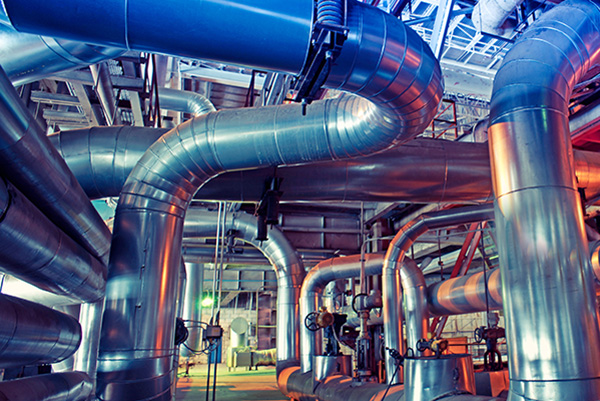
Fluid coking — often called continuous coking — is the fluidized-bed member of the Petroleum Coking technology type: a continuous thermal conversion process in which heavy feeds (deep-cut vacuum residue, atmospheric residue, oil-sands bitumen, heavy whole crudes, and deasphalter, FCC or ebullated-bed bottoms) are sprayed onto a fluidized bed of hot coke particles, cracking to full-range gas and liquid products while coke deposits layer-by-layer on the circulating particles.[1][2][3] Developed by Exxon (today ExxonMobil Research & Engineering) from fluid catalytic cracking principles, it has been licensed since the 1950s; the first commercial fluid coker started up at the Carter Oil Company refinery in Billings, Montana, in 1954, and the world's largest fluid cokers operate in the Syncrude upgrader at Fort McMurray, Canada.[2][3][4] Its variant FLEXICOKING™ adds a fluid-bed coke gasifier: the first FLEXICOKING unit began operation at Toa Oil's Keihin refinery, Japan, in 1976, and the technology is offered under a single licensing arrangement — ExxonMobil Catalysts and Licensing LLC, which granted Axens a worldwide licensing alliance in January 2020.[5][6][7][8]
The trade-off against delayed coking is structural: fluid coking and flexicoking deliver higher liquid and lower net-coke yields (roughly 5–10 wt% net coke vs ~18–31% in delayed coking) from a truly continuous, non-batch, closed system with low particulate and fugitive emissions, but require three integrated fluidized-bed vessels and a gas-cleaning train, capital cost and mechanical complexity well above a delayed coker, and a single-licensor dependency. The installed base has therefore stayed small — six FLEXICOKING units were operating by 2012 (combined ~227 kbpd / 12 Mt/a) against a global delayed-coking base of ~9.7 mb/d.[3][4][9][10]
Process history
Fluid coking grew out of Exxon's fluid catalytic cracking know-how, marrying endothermic coking with exothermic coke burning in one circulating-solids loop. The first commercial unit started in 1954 at Carter Oil's Billings, Montana refinery; five more fluid cokers were built in the late 1950s and one in 1970, and ExxonMobil has licensed fluidized-bed coking technology since the 1950s — including the largest fluid coker ever built, at Syncrude, Fort McMurray.[3][4][9] Flexicoking was designed as a fluid-coking modifier for falling coke markets and sulfur-emission constraints; it was introduced commercially in 1976 in Japan (Toa Oil, ~20 kbpd), and five further units followed through 2012 (Hellenic Petroleum Elefsina being the most recent). ExxonMobil licensed three new units after 2010 (Moscow and Tuapse in Russia, Talara in Peru) plus the Sinochem Hongrun grassroots unit in Weifang, China (licensed April 2018, ~1.2 Mt/a vacuum residue), bringing the total to ten.[5][6][9][11][12][13] As of 1998, 18 fluid/flexicoking-type units were reported worldwide — consistent with the small installed base versus delayed coking.[3]
Process summary, chemistry and catalysis
Fluid coking is purely thermal (non-catalytic) carbon rejection. Heavy oil sprayed through multiple nozzle rings coats the descending hot coke particles; the liquid film thermally cracks, depositing fresh coke layers and releasing vapour products, while part of the circulating coke is burned with air in the heater/burner to supply the endothermic heat of coking — a close integration of cracking and combustion rather than the furnace-fired arrangement of delayed coking.[1][2][14] Operating window: reactor bed ~500–550 °C (510–540 °C typical; ~964–980 °F), heater/burner ~593–677 °C, low pressure (~2 bar / ~10–15 psig); dilute-phase vapour velocities ~1–2 m/s.[2][3][14][15] In the FLEXICOKING gasifier, excess coke reacts with air and steam: rapid oxidation (C + ½O2 → CO; CO + ½O2 → CO2) and slower reduction/steam gasification (C + H2O → CO + H2; CO + H2O → CO2 + H2) at ~830–1000 °C, deliberately sub-stoichiometric in air so that coke sulfur reports as H2S (scrubbed downstream) rather than SO2.[2][14][16] No catalyst is involved.
Step-by-step process description (generic FLEXICOKING arrangement)
The generic arrangement (as drawn in ExxonMobil's process diagrams and Axens' published scheme) comprises a reactor with integral scrubber, a heater, and — in flexicoking — a gasifier, plus flexigas cleanup and conventional fractionation/gas plant.[5][7][9][17]
- Scrubber / feed mixing. Vacuum resid feed enters the scrubber atop the reactor for direct-contact heat exchange with reactor overhead product vapours; the ~525 °C+ (975 °F+) tail of the vapour condenses, scrubs out entrained coke fines, and returns to the reactor mixed with fresh feed ("feed mix to injectors"), while lighter overhead vapours pass to fractionation and light-ends recovery.[5][7][17]
- Reactor (fluidized-bed coking). The feed mix is injected with atomization steam through multiple nozzle rings into the dense fluidized coke bed; thermal cracking yields a full-range gas/liquid/coke slate. Products vapourise, pass reactor cyclones (which return entrained fines to the bed), and leave via the scrubber. Steam injected at the reactor bottom strips hydrocarbons off the coke particles and fluidizes the stripper-section bed; modern practice (e.g. ExxonMobil patent WO2016171890A1, filed 2015) runs lower steam-to-oil ratios on the upper nozzle rings to improve liquid yield.[2][3][14][18]
- Coke circulation and heater. Cold coke descends from the reactor to the heater, where gasifier products (or, in plain fluid coking, partial combustion air) heat it; hot coke returns to the reactor supplying the heat of cracking. In plain fluid coking the burner burns 15–30% of the coke with air and produces low-heating-value flue gas (~20 Btu/scf, CO/H2-rich) typically sent to a CO boiler; net fluid coke is withdrawn, quenched and shipped (isotropic, ash- and sulfur-rich — not suitable for graphite/anode markets).[1][2][3][17]
- Gasifier (flexicoking only). Excess heater coke drops into the fluid-bed gasifier reacting with air + steam at ~830–1000 °C; gasifier products return to the heater, transferring heat to the circulating coke. Approximately 95% of reactor coke is converted in-process; only ~1 wt% on fresh feed is purged as fines to extract feed metals. Units are designed to gasify 60–97% of reactor coke.[2][5][14][16]
- Flexigas recovery and treating. Flexigas exits the heater overhead through steam generation, dry/wet particulate removal (tertiary cyclones, venturi scrubbing — dry and wet coke-fines withdrawal, sour water) and integrated FLEXSORB™ amine treating with COS conversion, delivering clean flexigas at <10 vppm H2S for refinery furnaces/boilers, power generation, or H2/N2/CO2 recovery. Typical treated-gas composition: CO 18%, CO2 10%, H2 15%, N2 51%, H2O 5%, CH4 1% (low heating value ~20–40 Btu/scf).[5][7][14][16]
- Fractionation and gas plant. Reactor/scrubber overhead is fractionated to LPG, naphtha, light and heavy flexicoking gas oils (to FCC, hydrocracker and chemicals), with C1/C2 fuel gas to the gas plant — the same product-disposition framework as a delayed coker plus the flexigas stream.[5][7][17]
Process performance
Fluid/flexicoking gives higher liquid and lower net coke yields than delayed coking at comparable conversion: reactor liquid yields are essentially identical between fluid coking and flexicoking (the coking reactor is unaltered), with net coke make of only ~5–10 wt% of feed in fluid/flexicokers versus ~18–31% in delayed coking; a published flexicoking yield distribution on a typical vacuum-residue feed is ~22% flexigas, ~22% heavy gas oil, ~14% light gas oil, ~12% heavy naphtha, ~10% refinery gas, ~8% light naphtha, ~4% butane/butylene, ~3% propylene, ~2% slurry and ~3% purge coke.[3][4][19] ExxonMobil's stated design experience spans 5–105 kbpd units (60–750 t/h) on feeds with Conradson carbon residue 17–37, and all six units operating in 2012 ran above original design capacity with service factors routinely exceeding 92%; the purge-coke stream is low-sulfur because metals (not sulfur) drive the purge.[9] Fluid-coke product is fine, isotropic and rich in ash and sulfur — a fuel/landfill-grade solid only, unlike delayed-coker sponge/needle grades.[3]
Economic performance
ExxonMobil's licensor material frames the economics against the alternative of a delayed coker plus a separate oxygen-blown gasifier: the integrated "simple" steam/air gasifier, all-carbon-steel construction, absence of feed furnaces and low operating pressure yield significantly lower capital investment; for power-generation configurations ExxonMobil has quoted roughly 40% lower capital than a delayed coker combined with pet-coke gasification, and a plot-space requirement about 20% below a same-capacity delayed coker.[5][8][9] Counterweights documented in the sources are the high initial investment and mechanical complexity of three integrated fluidized-bed vessels and the flexigas cleanup train, and the small installed base that concentrates operating experience in few hands.[3][4][9] No independent same-basis CAPEX/OPEX comparison across licensors was located.
Environmental performance
Fluid coking's burner liberates coke sulfur as H2S/SO2 and the reactor operates in a fouling mode requiring full shutdowns of a month or more every 2–3 years to remove up to ~1 m of wall coke; fluid coking also emits significant H2S and SO2 from the burner.[3] Flexicoking addresses the sulfur point directly: sub-stoichiometric gasification converts coke sulfur to H2S that is scrubbed (to <10 vppm in flexigas) rather than released as SO2, and burning clean flexigas instead of high-sulfur coke cuts SOx, NOx and particulate emissions; continuous non-batch operation and closed coke handling eliminate open-pit decoking emissions altogether.[3][5][7][9][20] ExxonMobil markets the technology explicitly on these grounds — elimination of open-air coke handling, lower fired-heater emissions, flexigas replacing natural gas or high-sulfur fuel — and positions it for IMO 2020-type fuel-oil elimination and environmentally sensitive locations.[9][11][21]
Proprietary technologies and licensors
ExxonMobil is the only licensor of fluid coking and flexicoking worldwide; no competing licensor of either process was identified in any source reviewed, and the licensors occasionally confused with fluid coking in secondary literature are distinctly different businesses:
- ExxonMobil FLUID COKING™ — the original fluidized-bed coking process (reactor + heater/burner); licensed since the 1950s; largest units at Syncrude (two fluid cokers designed for 72,900 bpd bitumen, debottlenecked to >110,000 bpd each).[4][9][22]
- ExxonMobil FLEXICOKING™ — fluid coking plus steam/air coke gasifier with integrated FLEXSORB™ gas treating; sole proprietary owner, ExxonMobil Catalysts and Licensing LLC; worldwide licensing offered through the Axens alliance (signed January 2020, single license-and-engineering agreement), optionally combined with Axens' H-Oil® ebullated-bed process.[6][7][8] Continuous refinement continues under ExxonMobil patents (e.g. WO2016171890A1 fluid-coking nozzle-ring steam management, filed Apr 2015).[18]
Global capacity and growth trend
The installed base is small and slow-growing: six FLEXICOKING units by 2012 (~227 kbpd combined) — Toa Oil Kawasaki (Japan, 1976, ~20–27 kbpd), ExxonMobil Baytown (Texas, ~42 kbpd), ExxonMobil Rotterdam (Netherlands, 1986, ~42 kbpd), PDVSA Amuay (Venezuela, ~65 kbpd), Shell California (~22 kbpd), Hellenic Petroleum Elefsina (Greece, 2012, ~21–22 kbpd) — plus Syncrude's two large fluid cokers in Canada; ten units have been licensed in total, with Moscow and Tuapse (Russia) and Talara (Peru, ~22.6 kbpd, startup phase after a 2023 technical pause) following the 2010–2018 licensing round alongside Sinochem Hongrun (China).[5][6][9][11][13][19][23] OPEC's World Oil Outlook 2025 carries no separate fluid-coking line: of ~9.7 mb/d world coking capacity (Jan 2026), essentially all is delayed coking, with projected coking/visbreaking additions of only ~0.6 mb/d from existing projects 2026–2030 and ~3.0 mb/d to 2050 — a growth trend that, where a solid-coke market exists, favours delayed coking, and where it does not (no viable local coke market, poor coke quality, strict environmental limits), leaves flexicoking as the niche continuous-coking option.[4][10][24]
References
- Penn State — John A. Dutton e-Education Institute, FSC 432: Fluid and Flexi-Coking (Figures 6.8/6.9, CC BY-NC-SA 4.0).
- Farabi University — Lecture 12: Flexicoking, TTPPR course (Nov 8, 2023).
- IntechOpen — Jafar Ramezanzadeh & Hossein Moradi, Coking, Topics on Oil and Gas (DOI: 10.5772/intechopen.106190; published: Dec 20, 2023).
- Wikipedia — Delayed coker (Other processes section; latest update: Feb 11, 2026); Har K., Characterization of oil sands fluid coke, MSc thesis, University of Alberta (1981) for the 1954 Billings start-up.
- ExxonMobil — Resid conversion (FLEXICOKING™) (PDF created: Feb 5, 2016).
- Axens — FLEXICOKING™ Ultimate conversion Technology brochure (PDF created: Aug 28, 2020).
- ExxonMobil — FLEXICOKING: The Flexible Resid Upgrading Technology brochure (© 2014; PDF created: Jan 16, 2015).
- ExxonMobil / Axens — Axens and ExxonMobil Sign Alliance Agreement to Provide FLEXICOKING™ Technology and Integrated Resid Conversion Solutions (Jan 14, 2020).
- Yadav P., The Engineering Concepts — Fluid Coking and Flexi Coking (Dec 13, 2020).
- OPEC — World Oil Outlook 2025, Chapter 5: Refining outlook (Table 5.1: world coking capacity 9.7 mb/d; published: 2025).
- Process Worldwide — Exxon Mobil Awards License for Flexicoking Technology to Sinochem (Apr 10, 2018).
- Chemical Processing — ExxonMobil Licenses Coking Technology to Sinochem Hongrun (2018).
- Petroperú — Petroperú clarifies information on the Flexicoking Unit at the Talara Refinery (accessed: Nov 21, 2026).
- Mendoza S.G., Universidad de los Andes (Venezuela) — FLEXICOKING: Fundamentos y rol en la industria de los hidrocarburos (PDF created: Jun 5, 2016).
- Mendoza S.G. (ref. 14), Fig. 4 — operating conditions of an ExxonMobil Texas flexicoker: reactor 965–980 °F / 12 psig, heater ~1100 °F / 30.8 psig, gasifier ~1625 °F / 34 psig (source-labelled ExxonMobil).
- IntechOpen (ref. 3), §2.3.3.1 — gasifier reaction equations and treated-gas composition.
- ExxonMobil — Flexicoking Factsheet annotated PFD ("Flexicoking PFD annotated", copy in task folder); ExxonMobil — Flexicoking Fact Sheet — Products slate graphic.
- Google Patents — WO2016171890A1: Fluid coking process, ExxonMobil Research and Engineering Co. (priority Apr 24, 2015; published Oct 27, 2016).
- Mendoza S.G. (ref. 14), Fig. 2 — flexicoking yield distribution (Universidad de los Andes, 2012); installed-unit table (Toa Oil Japan 27 kbpd, PDVSA Venezuela 65, Shell California 22, ExxonMobil Netherlands 42, ExxonMobil Texas 42, Hellenic Greece 21, PetroPerú Peru 22, Rosneft Russia 50 — the last two listed as projects in the original).
- DigitalRefining — Maximizing refinery energy optimisation (FLEXICOKING™) (accessed: Nov 21, 2026).
- Business Wire China — ExxonMobil and Sinochem Horizon Petrochemical Co., Ltd. Reach FLEXICOKINGTM Flexible Coking Technology License Agreement (2018).
- Suncor Energy — Fluid cokers are the workhorses of our Syncrude Mildred Lake upgrader (May 2024); Engineering.com — Syncrude project profile (accessed: Nov 21, 2026).
- Oil & Gas Journal — Flexicoking unit due Elefsis refinery; Rosneft — Tuapse Refinery modernization pages (accessed: Nov 21, 2026).
- OPEC WOO 2025 (ref. 10), Tables 5.6/5.7 — secondary capacity additions and coking/visbreaking requirements 2026–2050.