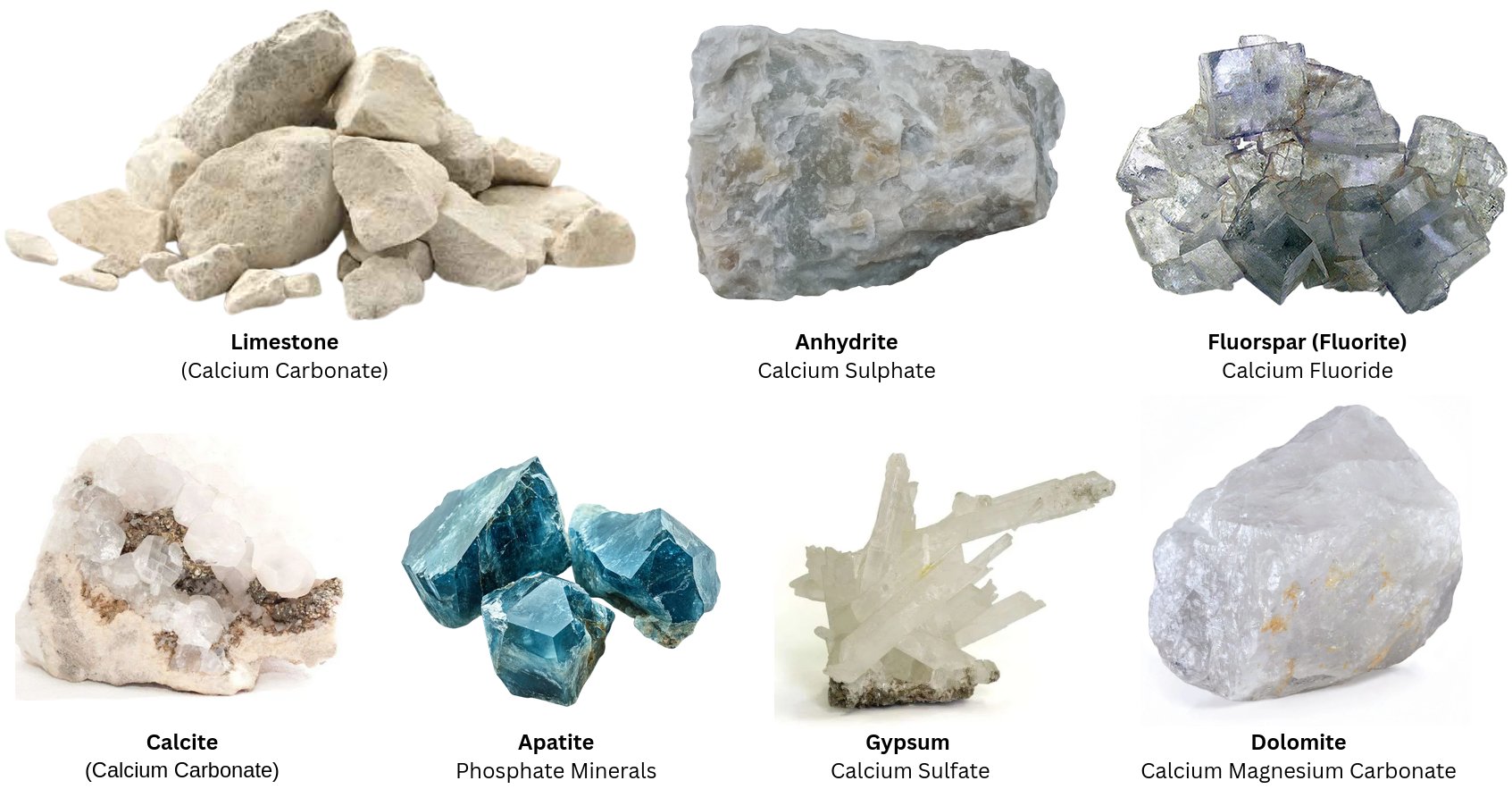
Calcium ores are naturally occurring minerals and rocks from which calcium compounds are extracted for industrial, chemical, and construction purposes. As a group, they share a common chemical foundation — the Ca²⁺ ion — but differ widely in their anion pairing, crystal structure, and application profile.
Origin and Abundance
Calcium is the fifth most abundant element in Earth's crust, named from the Latin calx meaning "lime". Because metallic calcium is highly reactive — spontaneously forming oxides and nitrides on exposure to air — it never occurs in its free elemental form in nature. Instead, it is always found locked in stable ionic compounds, primarily as carbonates, sulfates, phosphates, and halides.
Geological Formation
Calcium ores form through several geological processes:
- Sedimentary precipitation — calcite and aragonite precipitate from calcium-rich seawater to form limestone, chalk, and marine carbonate sequences
- Diagenetic transformation — aragonite slowly converts to the more stable calcite over geological time
- Evaporite deposition — gypsum and anhydrite crystallize from evaporating saline bodies of water
- Hydrothermal and metamorphic processes — marble forms from the recrystallization of limestone under heat and pressure; fluorite precipitates from hydrothermal fluids
- Biological accumulation — shells, coral reefs, and skeletal material concentrate CaCO₃, which eventually lithifies into biogenic limestone
Mineralogical Characteristics
All commercial calcium ores are ionic compounds in which calcium acts exclusively as Ca²⁺. They tend to be:
- Light-colored to white in their pure form (calcite, gypsum, fluorite), though impurities can impart greys, yellows, pinks, or purples
- Relatively soft — most fall between Mohs hardness 2 (gypsum) and 4 (fluorite), with compact limestone and marble being harder
- Low to moderate density (2.2–3.2 g/cm³ range), typical of non-metallic oxide/carbonate minerals
- Sparingly to slightly soluble in water, though all dissolve more readily in acidic conditions — a key property exploited in processing
Chemical Families
The ores divide into four chemical families based on the anion:
| Family |
Minerals |
Key Anion |
| Carbonates |
Calcite, aragonite, dolomite, chalk, marble, limestone |
CO₃²⁻ |
| Sulfates |
Gypsum, anhydrite |
SO₄²⁻ |
| Phosphates |
Apatite |
PO₄³⁻ |
| Halides |
Fluorite (fluorspar) |
F⁻ |
Commercial Significance
Calcium ores collectively represent some of the highest-volume mined commodities on Earth, underpinning industries from construction and agriculture to chemicals and advanced manufacturing. The table below ranks the principal ores by approximate annual global production:
| Rank |
Ore/Mineral |
Est. Annual Production (Mt) |
Primary Use |
| 1 |
Limestone / Calcite (CaCO₃) |
~4,000–5,000 |
Cement, construction,
lime, chemicals |
| 2 |
Gypsum & Anhydrite (CaSO₄) |
~160–340 |
Plasterboard, cement
retarder, agriculture |
| 3 |
Dolomite
(MgCa(CO₃)₂) |
~500+ |
Steelmaking flux,
construction aggregates |
| 4 |
Phosphate rock /
Apatite |
~220–230 |
Fertilizers,
phosphoric acid |
| 5 |
Fluorspar / Fluorite (CaF₂) |
~7–8 |
Fluorochemicals,
steel flux, aluminum |
| 6 |
Marble |
Included in
limestone figures |
Decorative stone, architecture |
Limestone is by far the most extracted calcium ore worldwide — China alone consumed over 1.2 billion tons of calcite-rich limestone in 2023 for cement production, and the global calcite market was valued at approximately USD 13.6 billion in 2024, with total processed volume around 112 million metric tons for specialty grades alone. Dolomite rivals limestone in bulk tonnage as a flux in steelmaking and a construction aggregate. Gypsum and anhydrite reached an estimated 160 million metric tons of mine production in 2024, recovering after a sharp decline from a 2016 peak of 261 million metric tons, with demand driven primarily by the global plasterboard and cement industries. Phosphate rock (predominantly fluorapatite) registered global production of approximately 220–230 million metric tons in 2023, with China contributing ~90 million metric tons and Morocco ~35 million metric tons; the fertilizer market underpinned by this ore was valued at USD 54.6 billion in 2023. Fluorspar, while the smallest by volume at ~7.4 million metric tons annually, commands strategic importance as the sole primary source of fluorine for refrigerants, battery electrolytes, and fluoropolymers, with China controlling over 55% of global supply.
Industrial Relevance
The carbonate group — especially limestone — is by far the most mined, underpinning the cement, steel, glass, paper, and chemical industries. A defining chemical behavior shared across all calcium carbonate ores is calcination: when heated to ~900°C, CaCO₃ decomposes into quicklime (CaO) and CO₂, which is the fundamental reaction behind lime production worldwide. Gypsum undergoes a milder analogous process — partial dehydration at ~150°C — to form plaster of Paris (CaSO₄·½H₂O), the basis of the construction materials industry.
Apatite stands apart as the world's nearly exclusive source of phosphorus for fertilizers, making it strategically critical to global food production, while fluorite is the primary feedstock for the entire fluorochemicals chain.
References
- Britannica. calcium carbonate (Page version: Feb 19, 2026). Encyclopedia Britannica
Kähler K.N. (2024). Calcium compounds. EBSCO Research Starters - The Essential Chemical Industry (Jan 16, 2017). Calcium carbonate
- Rygel M., & Quinton P. (May 15, 2023). Carbonate Sedimentary Rocks. Postdam State University of New York
- Pistilli M. (Aug 25, 2025). Top 10 phosphate countries by production. Investing News Network
- MMTA (Jun 24, 2016). Ca — Calcium. Minor Metals Trade Association (MMTA)
- MEC (Jul 12, 2016). Calcium. Minerals Education Coalition (Accessed Mar 8, 2026)
- RD (Dec 10, 2025). Calcite market. Reports and Data
- RD (Dec 11, 2025). Fluorspar Market. Reports and Data
- Sasu, D.D. (Nov 27, 2025). Major countries in gypsum mine production in 2024. Statista
- USGS (2024). Fluorspar. U.S. Geological Survey
- USGS (2024). Gypsum. U.S. Geological Survey
- USGS (2024). Phosphate Rock. U.S. Geological Survey
- Wikipedia. Calcium (Page version: Feb 15, 2026)