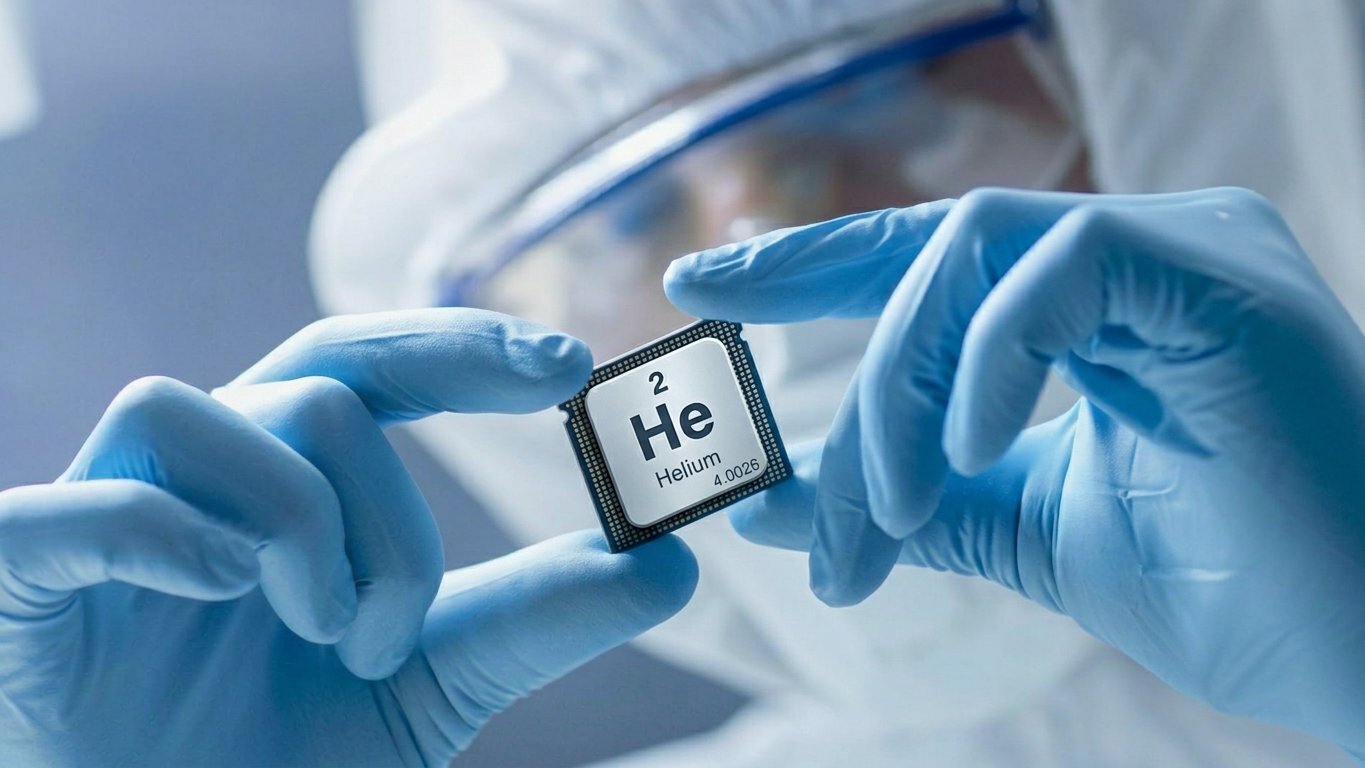
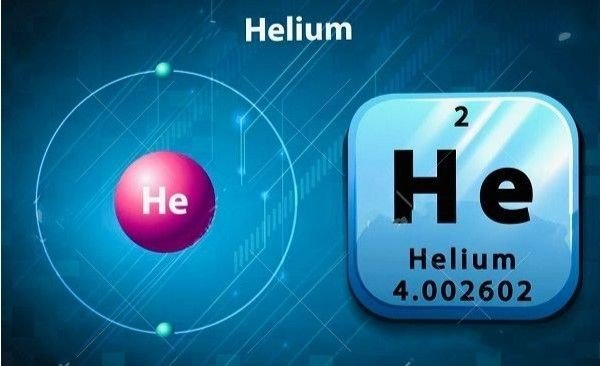
Helium is a naturally occurring, chemically inert noble gas and the second most abundant element in the observable universe, yet one of the rarest recoverable resources on Earth. It is a colorless, odorless, tasteless, and non-toxic monatomic gas under standard conditions, with atomic number 2 and an atomic mass of 4.003 g/mol. Its outer electron shell is completely filled — containing two electrons in a 1s² configuration — which renders it virtually non-reactive with any other element or compound under standard industrial conditions, forming no stable chemical compounds.
Physical Properties
Helium possesses a unique combination of physical properties that no other element can replicate. It has the lowest boiling point of any known element (−268.9°C / 4.222 K at 1 atm), approximately 4 degrees above absolute zero, a property that makes liquid helium the only practical coolant for reaching cryogenic temperatures in the range of 1–5 K. Its melting point of −272.2°C (0.95 K) is only achievable under elevated pressure of approximately 25 bar, meaning helium cannot be solidified at atmospheric pressure regardless of temperature. Its gas-phase density at STP is approximately 0.1786 g/cm³ — roughly seven times less dense than air — giving it significant buoyancy. Helium also exhibits exceptionally high thermal conductivity relative to its molecular weight, low viscosity, and very low solubility in water and organic liquids.
| Property |
Value |
| Atomic Number |
2 |
| Atomic / Molecular Weight |
4.0026 g/mol |
| Electron Configuration |
1s² |
| Oxidation State |
0 |
| State at 20°C |
Gas |
| Colour / Appearance |
Colourless, odourless, tasteless |
| Boiling Point |
−268.93°C (4.222 K) at 1 atm |
| Melting Point |
−272.20°C (0.95 K) at ~25 bar
(no solid phase at 1 atm) |
| Density (gas, 0°C, 1 atm) |
0.1786 kg/m³ |
| Density (gas, 15°C, 1 atm) |
0.1664 kg/m³ |
| Density (liquid, 4.2 K) |
125 kg/m³ |
| Specific Gravity (vs. air) |
0.138 |
| Thermal Conductivity |
0.1513 W/(m·K) at 25°C |
| Solubility in water |
0.97 mL/100 mL at 20°C |
| Flammability |
Non-flammable |
| Year Discovered |
1868 (spectroscopic); 1895 (isolated terrestrially) |
Helium exists in two stable isotopes. Helium-4 (⁴He) constitutes virtually all (~99.9998%) of terrestrial helium and is produced continuously by radioactive alpha decay of uranium and thorium in the Earth's crust. Helium-3 (³He) is a rare primordial isotope present at only ~2 ppm of terrestrial helium, of significant scientific value in neutron detection, quantum computing (dilution refrigerators), and fundamental physics research.
Origin and Production
Unlike most industrial gases, helium cannot be economically recovered from the atmosphere, where it is present at only ~5.24 ppm by volume; separation from air would be prohibitively energy-intensive. Commercial helium is produced exclusively by cryogenic fractionation of helium-bearing natural gas streams, where helium has accumulated over geological timescales through alpha decay of radioactive minerals in underlying rock formations. Helium-rich natural gas fields typically contain 0.3–3% He by volume and are found primarily in the United States (Kansas, Wyoming, Texas), Qatar, Algeria, and Russia, with emerging production in Tanzania. After extraction, crude helium is purified through pressure swing adsorption (PSA) or further cryogenic separation, then either compressed into high-pressure cylinders or liquefied for bulk transport as liquid helium (LHe).
Industrial and Scientific Applications
Helium's combination of chemical inertness, ultra-low boiling point, low density, and high thermal conductivity makes it functionally irreplaceable across a wide range of critical sectors:
- Cryogenics: Liquid helium is the sole practical coolant capable of reaching temperatures required to maintain superconductivity in MRI magnets, NMR spectrometers, and particle accelerators such as CERN's Large Hadron Collider.
- Inert shielding gas: Used in TIG/MIG arc welding and plasma cutting of reactive metals (titanium, aluminum, stainless steel), and as a blanketing atmosphere in semiconductor wafer fabrication and fiber optic manufacturing.
- Aerospace and rocket propulsion: Used to pressurize liquid hydrogen and liquid oxygen propellant tanks, purge fuel systems, and maintain structural integrity in launch vehicles.
- Leak detection: Its small atomic size, chemical inertness, and negligible atmospheric background concentration make helium the standard tracer gas for detecting micro-leaks in pressurized vessels, pipelines, vacuum systems, heat exchangers, and sealed electronic components.
- Analytical chemistry: Serves as the primary carrier gas in gas chromatography (GC) due to its inertness, low viscosity, and favorable column efficiency.
- Breathing gas mixtures: Heliox (He/O₂) and trimix (He/O₂/N₂) are used in saturation and deep-sea diving to prevent nitrogen narcosis, and in medical respiratory therapy to reduce airway resistance.
- Lifting gas: Non-flammable alternative to hydrogen for meteorological balloons, high-altitude scientific research balloons, and airships.
- Nuclear and quantum research: ³He is used in dilution refrigerators for quantum computing and in neutron detectors for nuclear security applications.
Supply and Strategic Importance
Helium is classified as a critical raw material by both the European Union and the United States Department of Energy due to its non-renewable character, its irreplaceability in key medical, scientific, and defense applications, and its highly concentrated geographic supply. Uniquely among all industrial gases, helium that escapes into the atmosphere is permanently lost to space — Earth's gravity is insufficient to retain such a light atom — making conservation, recycling, and closed-loop recovery systems strategically important priorities for helium-intensive industries.
Global proven reserves are estimated at approximately 40 billion cubic metres. Annual production currently stands at approximately 160–175 million cubic metres (~27,000–31,300 tonnes), against a demand of approximately 176–200 million cubic metres (~31,500–35,700 tonnes) per year — a structural supply deficit subject to chronic shortfalls, price volatility, and periodic geopolitical disruption, and projected to widen as demand grows toward 220–300 million cubic metres by 2030.
The United States historically supplied over 40% of world production through the US Federal Helium Reserve (Bureau of Land Management), but the progressive decommissioning of this reserve — completed in 2021 — has materially tightened the global supply balance. New production sources in Tanzania, Russia (Gazprom), and Qatar (QatarEnergy) have partially diversified supply in recent years, though the market remains structurally tight and geographically concentrated.
References
- Royal Society of Chemistry. Helium (Accessed Mar 14, 2026)
- Britannica. helium (Page version: Feb 16, 2026)
- National Library of Medicine (PubChem). Helium (Accessed Mar 14, 2026)
- Wikipedia. Isotopes of helium (Page version: Mar 1, 2026)
- Manning D.A.C. (Apr 25, 2008), Where does all the helium that we use come from?. Rapid Commun. Mass Spectrom., 22: 1640-1642. DOI: 10.1002/rcm.3452
- Cao Q., Li Y., Fang C., Liu R., Xiao H., & Wang S. (Nov 28, 2022). Status quo and utilization trend of global helium resources. Front. Environ. Sci. 10:1028471. DOI: 10.3389/fenvs.2022.1028471
- Walther-Meißner-Institut. Some facts about helium (Accessed Mar 14, 2026)
- Newradar Gas. Helium leak detection: Essential applications across aerospace, power & electronics industries (Accessed Mar 14, 2026)
- Innovation News Network. (Apr 1, 2023). The surprise industrial applications of helium: Everything you need to know
- Innovation News Network. (Jun 25, 2025). The essential role of conservation in protecting the global helium supply
- Air Products. (Aug 15, 2025). Helium industrial applications
- Vi Na Industrial Gases Company (Oct 18, 2024). Helium gas and 11 applications of helium in everyday life
- Rocky Mountain Air Solutions (Oct 24, 2017). 10 uses for helium: More than balloons and blimps
- Wikipedia. Helium (Page version: Feb 22, 2026)
- Siddhantakar A., Santillán-Saldivar J., Kippes T., Sonnemann G., Reller A., & Young S.B. (Jun 2023). Helium resource global supply and demand: Geopolitical supply risk analysis. Resources, Conservation and Recycling, 193, 106935. DOI: 10.1016/j.resconrec.2023.106935.ISSN 0921-3449
- The Oregon Group (Nov 19, 2024). Helium demand to double by 2035
- Future Markets (Jan 2025). The Global Helium Market 2025-2035