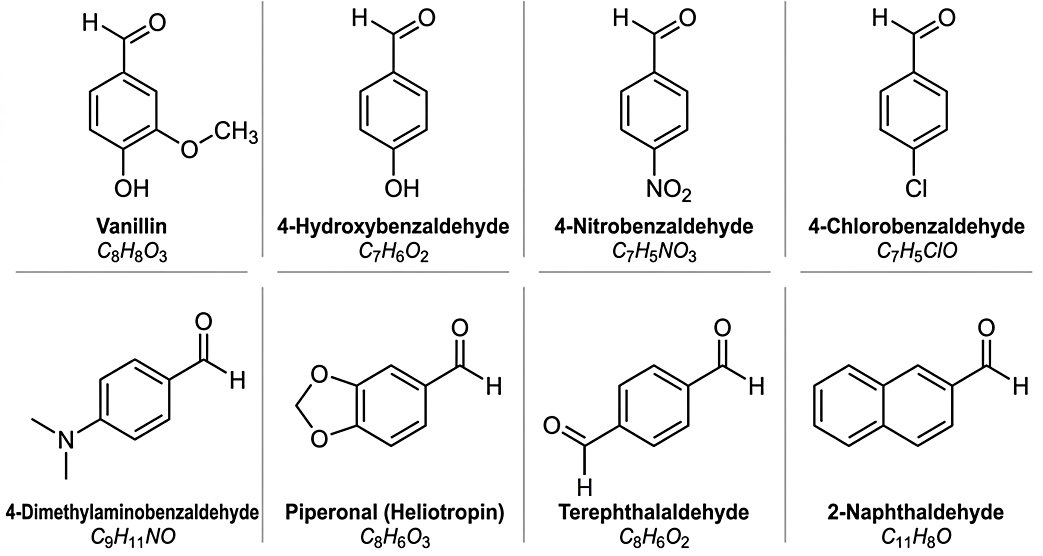
Solid aromatic aldehydes form a distinct subclass of the aromatic aldehyde family, distinguished from their liquid counterparts by molecular features that promote stronger crystal-lattice packing at room temperature. While the core reactivity of the aldehyde group remains consistent across the family, solids typically carry additional polar substituents, extended conjugation, or symmetrical/planar ring systems that raise intermolecular attraction enough to produce a crystalline solid rather than a mobile liquid.
What Makes These Aldehydes Solid
The transition from liquid to solid within the aromatic aldehyde family is driven mainly by three structural factors. First, hydrogen-bond-capable groups such as hydroxyl or amino substituents (as seen in vanillin or 4-aminobenzaldehyde) create strong directional intermolecular forces that favor an ordered crystal lattice. Second, halogen substitution, particularly with heavier halogens like bromine, increases molecular weight and polarizability, both of which raise melting points substantially. Third, extended or fused aromatic systems, such as the naphthalene backbone in naphthaldehyde isomers, increase the surface area available for van der Waals stacking between molecules, again favoring solid-state packing.
Appearance and Handling
Solid aromatic aldehydes typically present as white, pale yellow, or off-white crystalline powders or needle-like crystals, in contrast to the oily or watery liquid appearance of compounds like benzaldehyde or cuminaldehyde. Many are also more chemically stable in storage than their liquid counterparts, since the reduced molecular mobility in a crystal lattice slows down autoxidation of the aldehyde group. This stability is one reason many solid aromatic aldehydes, including vanillin and various nitro- and halo-substituted benzaldehydes, are favored as long-shelf-life intermediates in pharmaceutical, fragrance, and dye manufacturing.
Industrial and Process Relevance
Several solid aromatic aldehydes function as key impurities or process intermediates in industrial oxidation chemistry, most notably in aromatic carboxylic acid manufacturing, where partially oxidized aldehyde species can co-crystallize with the target acid product and must be removed through purification steps like hydrogenation. Others, such as vanillin and various methoxy- or hydroxy-substituted benzaldehydes, serve primarily as flavor, fragrance, or pharmaceutical synthesis building blocks rather than as process impurities.
Common Solid Aromatic Aldehydes
| Chemical Name |
Melting Point (°C) |
CAS Number |
Description |
| 1-Naphthaldehyde |
34 |
66-77-3 |
A pale yellow crystalline solid built on a naphthalene backbone; used as a fine-chemical and organic synthesis intermediate |
| Phenylacetaldehyde |
34 |
122-78-1 |
A white crystalline solid with a honey-like odor; widely used in flavor and fragrance formulation |
| Piperonal |
37 |
120-57-0 |
A white crystalline solid with a sweet, cherry-like scent; used extensively in fragrance and flavor compounding |
| 2-Methoxybenzaldehyde |
39 |
135-02-4 |
A pale crystalline solid, positional isomer used in flavor, fragrance, and pharmaceutical synthesis |
| 4-Diethylaminobenzaldehyde |
41 |
120-21-4 |
A pale yellow crystalline solid used mainly as an analytical reagent and dye intermediate |
| 3,4-Dichlorobenzaldehyde |
44 |
6287-38-3 |
A white to off-white crystalline solid used as a pharmaceutical and agrochemical intermediate |
| 2-Nitrobenzaldehyde |
44 |
552-89-6 |
A yellow crystalline solid used in organic synthesis and as a photochemistry reagent |
| 4-Chlorobenzaldehyde |
48 |
104-88-1 |
A white to pale yellow crystalline solid, common building block in pharmaceutical and agrochemical synthesis |
| 4-Bromobenzaldehyde |
57 |
1122-91-4 |
A white to pale yellow crystalline solid used as an intermediate in pharmaceutical and dye synthesis |
| 3-Nitrobenzaldehyde |
58 |
99-61-6 |
A pale yellow crystalline solid used primarily in organic synthesis and as a chemical reagent |
| 2-Naphthaldehyde |
60 |
66-99-9 |
A white to off-white crystalline solid, naphthalene-based isomer used in fine-chemical synthesis |
| 4-Dimethylaminobenzaldehyde |
74 |
100-10-7 |
A yellow crystalline solid widely used as an analytical reagent for detecting aromatic amines and indoles |
| Vanillin |
81 |
121-33-5 |
A white to pale yellow crystalline solid with the characteristic vanilla aroma; the most commercially significant flavor aldehyde |
| 3-Hydroxybenzaldehyde |
104 |
100-83-4 |
A white to pale yellow crystalline solid used as a pharmaceutical and fragrance intermediate |
| 4-Nitrobenzaldehyde |
106 |
555-16-8 |
A pale yellow crystalline solid used as an important intermediate in dye and pharmaceutical manufacturing |
| 4-Hydroxybenzaldehyde |
116 |
123-08-0 |
A white crystalline solid used as a key intermediate in flavor, fragrance, and pharmaceutical synthesis |
| Terephthalaldehyde |
116 |
623-27-8 |
A white crystalline solid with aldehyde groups on both ring positions; used as a crosslinking and polymer chemistry intermediate |
| 3,4-Dihydroxybenzaldehyde (protocatechualdehyde) |
154 |
139-85-5 |
A pale yellow to tan crystalline solid used in pharmaceutical and natural-product synthesis |